

Key takeaways
- Compare the best agility ladders for boxing footwork drills, with rung counts, lengths and carry options to sharpen speed, balance and ring movement.
- Top Pick: SKLZ Quick Ladder
- Runner-up: Yes4All Agility Ladder
- Also consider: GHB Pro Agility Ladder
Footwork wins rounds long before punches do. The boxer who controls distance, cuts angles cleanly, and stays balanced while moving is the one dictating the fight, and agility ladder drills are one of the simplest ways to build those habits outside sparring. A few minutes of in-and-out steps, lateral shuffles, and pivot work on a ladder trains the feet to stay light and precise under fatigue.
Not every ladder suits boxing training, though. Fighters need flat rungs that will not roll under a pivoting foot, webbing that stays put on gym floors, and a length that allows full combinations of steps rather than two hops and a stop. Portability matters too, because most boxers train in shared spaces and need to roll the ladder up and clear the floor quickly.
This guide compares five agility ladders that fit boxing footwork work, from a compact eight-rung option for tight spaces to a twenty-three-foot model for long drill sequences. Each pick is broken down by length, rung count, rung style, and what kind of training it suits best, so you can match a ladder to your gym, your garage, or your warm-up routine on fight week.
As an Amazon Associate, we earn from qualifying purchases.
Quick Answer
For most boxers, the SKLZ Quick Ladder is the safest all-round pick, with flat rungs, fifteen feet of length, and a carry bag for gym use. Fighters with more floor space should look at the twenty-foot GHB Pro or the twenty-three-foot Teenitor for longer drill sequences. The SKLZ Elevation Ladder adds hurdle work, while the compact Yes4All suits small training areas and travel.
How to Choose
Start with length. A fifteen-foot ladder handles the classic boxing drills well: in-and-outs, Ali shuffles, lateral two-ins, and pivot exits at the end of the line. Longer ladders, around twenty feet or more, let you chain drills together without stopping, which better matches the rhythm of a round. If your training space is a garage or a corner of a commercial gym, a shorter ladder that sets up fast may get used far more often than a long one that needs the whole floor cleared.
Rung shape is the next decision. Flat rungs lie flush against the floor, so a heel or toe landing on the edge does not roll the rung or twist an ankle. Round or raised rungs can shift under pivoting feet, and boxing footwork involves constant pivots. Look for rungs made from firm plastic that keeps its shape, stitched or clipped to webbing straps that resist tangling.
Adjustable rung spacing is worth having. Most ladders in this guide let you slide the rungs along the straps, so you can tighten the spacing for quick-feet drills or open it up for longer strides and hop patterns. Fixed spacing is fine for beginners, but adjustable ladders grow with your training.
Finally, think about setup and storage. Tangle-free webbing, a carry bag, and ground stakes for outdoor use all sound minor, yet they decide whether the ladder comes out three times a week or stays in a closet. Weight is rarely an issue, since every model here is light enough to throw in a gym bag. Durability of the strap stitching matters more than the rungs themselves, because straps take the strain every time the ladder is yanked flat.
SKLZ Quick Ladder
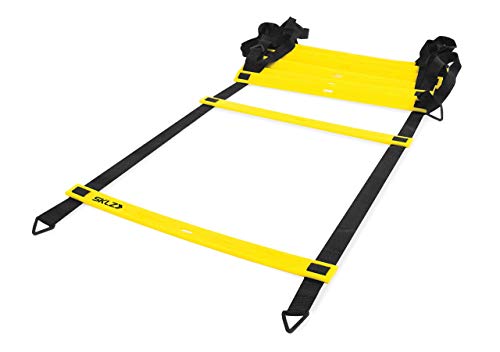
The Quick Ladder is the ladder most boxing coaches reach for first, and the design explains why. Its fifteen feet carry eleven flat plastic rungs that sit flush on the floor, so pivots and lateral steps feel stable instead of sketchy. The rungs are spaced for quick-feet work, and the webbing straps resist the tangling that makes cheaper ladders a chore to unroll.
For boxing specifically, the length is a sweet spot. It fits across most gym floors and home training spaces, and it is long enough for a full pass of in-and-outs followed by a pivot at the end. SKLZ builds the rungs to handle repeated stepping, and the included carry bag keeps the whole kit together between sessions. If you want one ladder that covers warm-ups, conditioning circuits, and dedicated footwork days, this is the default recommendation.
Specs
| Spec | Detail |
|---|---|
| Length | 15 ft |
| Rungs | 11 flat rungs |
| Rung style | Flat, low profile |
| Extras | Carry bag included |
| Model | Quick Ladder, part 0124 |
| Best for | All-round boxing footwork |
Yes4All Agility Ladder

The Yes4All ladder is the compact option in this lineup, with eight rungs on adjustable webbing. That shorter layout suits apartments, garage corners, and hotel-room warm-ups during travel, where a fifteen-foot ladder simply will not fit. The rungs slide along the straps, so you can bunch them tightly for fast-feet drills or spread them for stride work.
Because it is short, you will turn around more often, which is not always a drawback. Frequent direction changes at the end of the line are themselves a boxing skill, reinforcing the pivot-and-exit habit coaches drill constantly. The yellow rungs are easy to see on dark gym floors, and the whole ladder rolls into a small carry bag. Beginners who want to test whether ladder training sticks before committing to a longer model will find this an easy entry point.
Specs
| Spec | Detail |
|---|---|
| Rungs | 8 rungs |
| Rung spacing | Adjustable |
| Rung style | Flat plastic |
| Color | Yellow rungs |
| Model | SGQV |
| Best for | Small spaces and travel |
GHB Pro Agility Ladder

The GHB Pro stretches to twenty feet with twelve rungs, giving boxers a longer runway for chained combinations. That extra length matters when you progress from single drills to sequences, such as two-ins down the line, a lateral shuffle back, and a pivot exit, all without resetting. The rungs are thick flat plastic, and the spacing adjusts along the straps to suit the drill.
GHB includes a carry bag, and the ladder packs down small despite its length. The webbing is sewn rather than glued, which helps it survive being stepped on, dragged, and rolled up several times a week. Fighters who train outdoors on grass can pin the corners down, though stakes are not the focus of this kit. For a home gym with a clear stretch of floor, this is the best balance of length, durability, and simple design in the group.
Specs
| Spec | Detail |
|---|---|
| Length | 20 ft |
| Rungs | 12 rungs |
| Rung spacing | Adjustable |
| Rung style | Thick flat plastic |
| Model | FBA_AL |
| Best for | Long drill sequences |
Teenitor Agility Ladder

At twenty-three feet with thirteen rungs, the Teenitor is the longest ladder here, built for athletes who want extended footwork runs. Boxers running conditioning circuits will appreciate the extra distance, since fewer turns mean more continuous movement that mimics the flow of a round. The rungs are flat and the spacing adjusts, so the same ladder handles tight quick-feet patterns and wider plyometric hops.
The trade-off is space. You need a genuinely clear run of floor or turf to lay it out, and setup takes a little longer than with the compact models. Teenitor includes a carrying bag to keep the long straps from knotting in storage. If your gym has a dedicated conditioning area, or you train on a driveway or field, the extra length earns its keep quickly.
Specs
| Spec | Detail |
|---|---|
| Length | 23 ft |
| Rungs | 13 rungs |
| Rung spacing | Adjustable |
| Rung style | Flat plastic |
| Part number | TNT241 |
| Best for | Conditioning circuits |
SKLZ Elevation Ladder

The Elevation Ladder is the two-in-one entry: it works as a flat agility ladder, then converts into a series of low hurdles. For boxing training, that second mode adds something the other ladders cannot, namely low hurdle hops and lateral hurdle steps that build the spring and hip mobility fighters use when changing levels and angles.
As a ladder it is shorter than the dedicated models, with six sections, so pure footwork purists may find the run brief. But as a combined footwork and plyometric station it is hard to beat, especially in a small home gym where one tool has to do several jobs. The frame pieces click between modes without tools, and everything packs into the included bag. Coaches running youth or beginner classes also like the variety, since the hurdle mode keeps drills fresh.
Specs
| Spec | Detail |
|---|---|
| Design | 2-in-1 ladder and hurdles |
| Sections | 6 convertible sections |
| Modes | Flat ladder, low hurdles |
| Extras | Carry bag included |
| Part number | 0940 |
| Best for | Footwork plus plyometrics |
Who Should Skip It
Skip agility ladders entirely if your footwork problem is actually a balance or ankle-strength problem. Ladders teach pattern speed, not strength, and they will not fix a weak base. Fighters rehabbing an ankle or knee injury should also hold off, because the quick directional changes load the joint in exactly the ways rehab protocols usually restrict. And if your gym already has ladders in good condition, a personal one only makes sense for home training. Finally, boxers who hate structured drills will not suddenly love them because the ladder is longer; borrow one first before buying.
FAQ
How often should boxers do ladder drills?
Two or three short sessions a week is plenty for most fighters. Ten to fifteen focused minutes inside a warm-up keeps the patterns sharp without turning footwork work into a conditioning grind that dulls your boxing training later that day.
Do agility ladders really improve boxing footwork?
They improve foot speed, coordination, and the ability to repeat precise steps under fatigue, which are real components of boxing footwork. They do not replace ring movement, shadowboxing, or sparring, so treat them as one tool in the program rather than the whole program.
What surface works best for ladder training?
Flat gym flooring, smooth concrete, and short turf all work well. Avoid thick carpet, which grabs the webbing, and wet grass, which lets the straps slide. On hard floors, flat rungs protect your joints better than raised rungs when you land on an edge.
Can beginners use the longest ladders?
Yes, but expect more tangles and resets at first. Beginners usually progress faster on a fifteen-foot ladder, then move up in length once the basic patterns are automatic and the turns at each end stop breaking their rhythm.
Final Verdict
The SKLZ Quick Ladder remains the easiest recommendation for most boxers: flat rungs, a proven fifteen-foot layout, and simple storage. Choose the GHB Pro or the Teenitor when your training space allows longer, chained drill sequences, and pick the Yes4All when space is tight or you travel often. The SKLZ Elevation Ladder is the wildcard, trading pure ladder length for hurdle work that rounds out a home gym. Any of the five will build quicker, cleaner feet if the drills stay consistent.
More from Amazon
Programs that pair well with the guide above. Offers and eligibility are set by Amazon and may change.
Free shipping on eligible items, Prime Video and more. Eligible new members can start with a free trial.
Start a Prime free trialAudiobooks and podcasts to listen to on the go. Eligible new members can start with a free trial.
Try Audible freeAd-free music streaming. Eligible new subscribers can start with a free trial.
Try Music Unlimited freeA free business account with business pricing and bulk-buying tools for work, shop or home office.
Create a business accountAs an Amazon Associate we earn from qualifying purchases.




Write Your Review
No reviews yet. Be the first to share your experience!