

Key takeaways
- Best budget option: A wide, dual-wheel ab roller with a foam or rubber handle and a removable knee pad.
- Best for progressive resistance: A plate-loaded or selectorized seated ab-crunch machine with adjustable range of motion.
- Best for leg-raise training: A captain’s chair or vertical knee-raise station with adjustable elbow pads and back support.
- Best for beginners: A kneeling ab-crunch machine or short-range ab roller that lets you limit extension.
- Best for small rooms: A roller, suspension trainer, or compact resistance-band anchor rather than a freestanding tower.
- Best for varied core work: An adjustable bench paired with an ab wheel, cable attachment, or resistance bands.
The best ab machines for home workouts are an adjustable ab wheel for low-cost, high-efficiency training, a guided ab-crunch machine for controlled resistance, or a captain’s chair for stronger hip-flexor and lower-ab emphasis; the right choice depends mainly on your space, experience, height, and whether you want anti-extension or loaded spinal flexion.
Our top picks
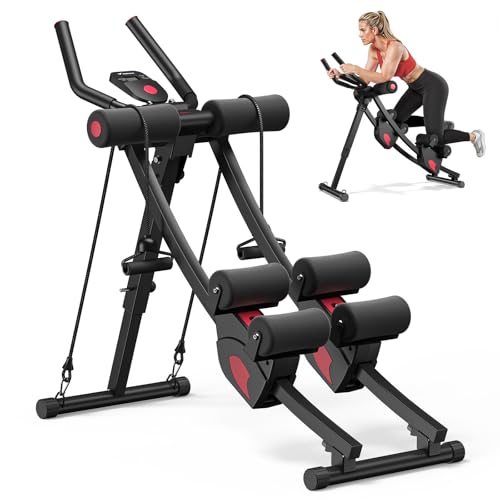
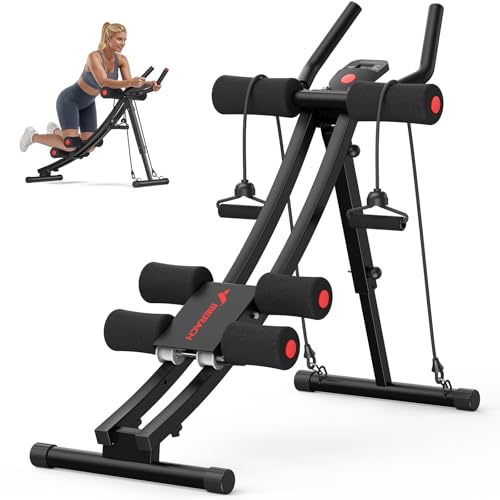
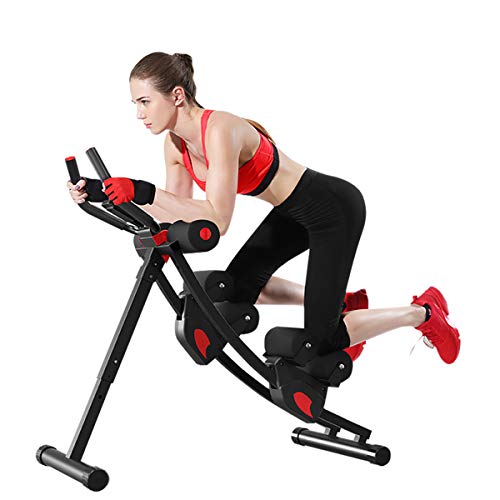

As an Amazon Associate we earn from qualifying purchases at no extra cost to you. Ratings are shown as listed on Amazon.
Quick picks by training goal
- Best budget option: A wide, dual-wheel ab roller with a foam or rubber handle and a removable knee pad.
- Best for progressive resistance: A plate-loaded or selectorized seated ab-crunch machine with adjustable range of motion.
- Best for leg-raise training: A captain’s chair or vertical knee-raise station with adjustable elbow pads and back support.
- Best for beginners: A kneeling ab-crunch machine or short-range ab roller that lets you limit extension.
- Best for small rooms: A roller, suspension trainer, or compact resistance-band anchor rather than a freestanding tower.
- Best for varied core work: An adjustable bench paired with an ab wheel, cable attachment, or resistance bands.
Ab-machine types compared
| Machine type | Resistance | Typical footprint | Typical user limit | Range-of-motion control | Best suited to |
|---|---|---|---|---|---|
| Ab roller | Bodyweight; leverage increases difficulty | 20–40 x 8–12 in.; usually under 6 lb | Usually 220–330 lb, depending on axle and wheel construction | Limited unless the user controls the rollout distance | Anti-extension strength, portability, low budgets |
| Seated ab-crunch machine | Weight stack, plates, or resistance bands | 35–55 x 35–55 in.; about 60–180 lb | Commonly 250–350 lb | Usually high; many models have adjustable stops | Progressive overload and repeatable sets |
| Captain’s chair | Bodyweight; optional ankle weights | 35–45 x 30–45 in.; about 70–150 lb | Commonly 250–350 lb | Medium; leg position determines difficulty | Knee raises, leg raises, and grip-dependent core work |
| Ab bench | Bodyweight, dumbbells, or plates | 50–65 x 20–30 in.; about 25–70 lb | Often 250–600 lb including user and load | High if incline and decline positions lock securely | Crunch variations and general strength training |
| Suspension trainer or band station | Bodyweight or elastic resistance | Wall or door area; equipment often under 5 lb | Frequently 300–400 lb, but anchor rating is decisive | Medium to high through strap length or band choice | Planks, knee tucks, rotations, and limited-space workouts |
These are useful buying ranges rather than universal specifications. Check the manufacturer’s load rating, especially for a door anchor, wall mount, or ceiling attachment. A strong strap attached to a weak anchor is not a high-capacity system.
Resistance: what actually changes the exercise?
Bodyweight and leverage
An ab wheel does not need a weight stack to become harder. Rolling farther increases the lever length between your shoulders and knees or feet, placing more demand on the abdominal muscles and shoulder stabilizers. This makes the roller highly effective but less forgiving: a small loss of pelvic control can turn the movement into an uncomfortable lower-back extension.
External load
Seated crunch machines provide the clearest progression. Adding one plate or moving a selector pin gives you a measurable increase in resistance, while the seat and back support reduce balance demands. This is useful if you want to track strength over months. The trade-off is cost, weight, and a movement pattern that may be less transferable to bracing during sport.
Elastic resistance
Bands are inexpensive and easy to store. Their resistance rises as they stretch, so the hardest part of a band crunch is often near the end of the movement. Inspect bands for cracks, discoloration, or flattened sections; replace damaged bands rather than relying on their stated resistance.
Range of motion and adjustability matter more than appearance
Look for an adjustable start position, a mechanical stop, or a seat and pad system that lets you set a comfortable arc. A machine that forces every user into the same deep bend can be a poor fit even if it feels sturdy.
- Ab rollers: Choose a wide wheel or two-wheel design for easier balance. Beginners should roll toward a wall or use a shorter range until they can keep the ribs down and hips from dropping.
- Seated crunch machines: Check whether the seat height, knee pad, chest pad, and start-stop position adjust independently. A fixed chest pad may press awkwardly into taller or shorter users.
- Captain’s chairs: Measure the distance from the floor to the elbow pads and the back pad. Tall users need enough clearance to raise bent knees without striking the frame; shorter users need elbow pads they can mount without jumping.
- Benches: Confirm that the decline angle locks firmly. A padded roller that only holds the ankles can encourage pulling with the hip flexors instead of curling the torso.
Height, fit, and room measurements
Manufacturers often publish a maximum user weight but omit a useful height range. For a tower, measure your ceiling height first. Add at least 6–8 inches above your fully extended arms or feet, depending on the exercise. For example, a 6-foot user raising straight legs may need more than 7 feet of usable clearance, and a 7-foot ceiling can become restrictive.
For a seated machine, measure the distance from the seat to the chest or shoulder pad at its shortest and longest settings. If the machine gives only one adjustment point, it is more likely to suit average-height users than very short or very tall users. Also leave approximately 24 inches of clear space around moving handles, knees, and feet.
Decision matrix: which machine fits your situation?
| Your situation | Most sensible choice | Why | What to avoid |
|---|---|---|---|
| Under about $50 and little storage | Dual-wheel roller or bands | Low cost, quick setup, and easy to store | Large towers with limited adjustability |
| Beginner training 2–3 times weekly | Bench or guided crunch machine | More stable positioning and easier range control | Full rollouts and straight-leg raises from day one |
| Experienced user training 4+ times weekly | Adjustable crunch machine plus roller | Combines measurable loading with anti-extension work | A single fixed-resistance gadget |
| Limited floor space but a sturdy door or wall anchor | Suspension trainer or bands | Most exercises per square foot | Unrated door anchors or loose furniture attachments |
| Goal is stronger bracing for sport | Roller, plank sliders, and anti-rotation bands | Challenges the core’s ability to resist movement | Only performing high-repetition crunches |
| Goal is maximum abdominal hypertrophy | Adjustable loaded crunch machine | Allows consistent progressive overload near muscular fatigue | Machines with no resistance increments or range stop |
Ownership costs and durability
Budget rollers usually fail first at the wheel bearings, axle, or handle foam. Look for a steel axle, sealed bearings, non-slip wheels, and handles that do not wobble under load. A replacement knee pad is useful, but a bent axle generally makes replacement more sensible than repair.
On larger machines, cables, pulleys, upholstery seams, and adjustment pins receive the most wear. Keep cables aligned, do not exceed the stated load, and tighten bolts after the first few sessions. Wipe sweat from vinyl and metal after use; avoid soaking foam, bearings, or cable housings. If a machine uses a weight stack, inspect the selector pin and cable end rather than assuming the stack is safe because the frame feels solid.
Consider use frequency when comparing prices. A $40 roller used three times weekly for a year costs about $0.26 per session before replacement parts. A $500 seated machine used twice weekly for the same year costs about $4.81 per session. The larger machine can still be the better purchase if its adjustability makes you use it consistently, but expensive equipment does not compensate for a poor fit or inconvenient setup.
How to choose and set up safely
- Measure the space: Include the machine’s moving range, not only its folded dimensions.
- Check your fit: Test whether your knees, elbows, chest, and feet line up with the pads at every available adjustment.
- Start with a repeatable range: Use a shorter rollout, bent-knee raise, or lighter load until you can maintain a neutral pelvis and controlled breathing.
- Progress one variable: Add a small amount of resistance, one or two repetitions, or a little range of motion—not all three at once.
- Inspect weekly: Check bolts, pins, welds, wheels, straps, bands, and cable routing before demanding movements.
Stop if an exercise causes sharp pain, numbness, or persistent back discomfort. People with an existing back, hip, or abdominal injury should ask a qualified health professional which movements and ranges are appropriate. For most home users, the best ab machine is the one that fits the body, permits controlled progression, and can be used consistently without dominating the room.



Write Your Review
No reviews yet. Be the first to share your experience!