

Key takeaways
- Support: The sink should be supported by a cabinet frame, rails, brackets, or a manufacturer-approved support system—not by silicone alone.
- Countertop edge: Choose zero reveal, positive reveal, or negative reveal before fabrication. Zero reveal aligns the counter edge with the bowl; positive reveal leaves a small sink rim visible; negative reveal exposes more countertop over the basin.
- Cutout: The fabricator needs the manufacturer’s current template. A generic drawing can produce an opening that is too large or leaves insufficient material around the sink.
- Faucet and accessories: An undermount sink has no faucet deck. The faucet, soap dispenser, air switch, and filtered-water tap need separate countertop holes.
- Plumbing: A deeper bowl may require a shorter disposal elbow or a revised drain trap. A double bowl needs correctly sloped drainage from both basins.
The best undermount kitchen sinks are the ones that fit your cabinet, countertop, and washing routine—not necessarily the largest or most expensive model: choose a 30–33-inch single bowl for flexibility, a 60/40 double bowl for separation, or a compact 24–27-inch sink when cabinet and counter space are limited.
Our top picks


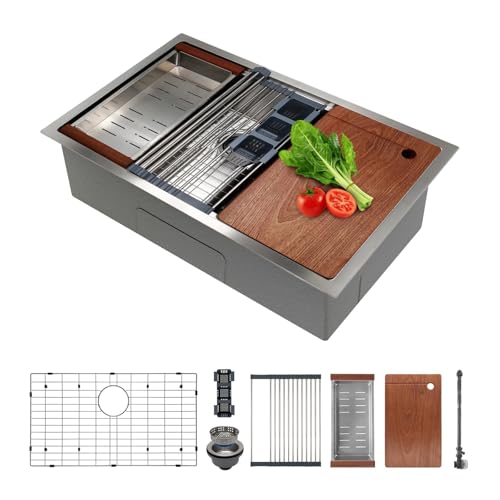

As an Amazon Associate we earn from qualifying purchases at no extra cost to you. Ratings are shown as listed on Amazon.
Quick picks by kitchen situation
| Kitchen situation | Best configuration | Useful size | Material to consider | Why it fits |
|---|---|---|---|---|
| Small kitchen or 30-inch cabinet | Single bowl | 24–27 inches wide | Stainless steel | Preserves cabinet storage and accommodates ordinary cookware |
| Frequent cooking and large pans | Deep single bowl | 30–33 inches wide, 9–10 inches deep | 16- or 18-gauge stainless steel | Lets roasting pans and sheet pans lie flat |
| Washing and rinsing at the same time | 60/40 double bowl | 30–33 inches wide | Stainless steel or fireclay | Separates dirty dishes from rinsed food or a disposal area |
| Traditional or farmhouse-style kitchen | Large single or double bowl | 30–36 inches wide | Fireclay | Provides a substantial visual focal point and resists heat |
| Quiet, low-maintenance installation | Single bowl with sound pads | 27–33 inches wide | Granite composite | Suppresses noise and hides water spots better than bright steel |
What to measure before buying
Sink width is not the same as cabinet width. A sink advertised as 33 inches wide may require a 36-inch sink base, while a 30-inch sink often needs a 33-inch cabinet. The manufacturer’s minimum cabinet-size requirement takes priority over the nominal sink width.
Measure the inside width of the cabinet at its narrowest point, including any drawer rails, supports, plumbing, or corner obstructions. Then check the sink’s exterior dimensions, bowl depth, drain position, and the required countertop cutout. For a replacement undermount sink, the existing opening is especially important: a smaller sink can usually be accommodated more easily than a larger one, but the countertop may need professional modification.
Also measure below the counter. A 10-inch-deep bowl can interfere with a garbage disposal, water filter, drain trap, or low shelf. A 9-inch bowl is often a safer compromise for older plumbing or shallow cabinets.
Single bowl versus double bowl
Single-bowl sinks
A single bowl gives the most usable uninterrupted space. This is the better choice if you wash large pots, baking sheets, Dutch ovens, or grill grates. A 30-inch bowl is a practical middle ground; a 33-inch model offers more capacity but demands a larger base cabinet and more counter space.
The drawback is workflow separation. You cannot keep soaking cookware on one side while rinsing vegetables on the other. A roll-up rack, removable colander, or sink grid can restore some flexibility without permanently dividing the basin.
Double-bowl sinks
A 60/40 configuration is generally more useful than two equal small bowls. The larger basin can handle a saucepan or dinner plate, while the smaller basin can hold a strainer, cleaning water, or food scraps. Equal 50/50 bowls suit people who routinely wash and rinse separately but can make large cookware awkward.
Look closely at the divider height. A low divider makes it easier to slide a sheet pan across the sink, while a full-height divider provides better separation but reduces flexibility. Double bowls also require two drain openings and can leave less space for a disposal or under-sink filtration system.
Material comparison: steel, composite, and fireclay
| Material | Typical thickness or construction | Typical weight for a 30–33-inch sink | Strengths | Ownership concerns |
|---|---|---|---|---|
| Stainless steel | 16–18 gauge; usually 304-series steel | 15–30 lb | Light, repairable, heat-resistant, broadest size selection | Can show scratches, water spots, and impact noise |
| Granite composite | Resin-bound mineral material, commonly about 80% mineral content | 35–55 lb | Quiet, durable-looking finish, good stain and scratch resistance | Heavy; pale finishes may show stains and harsh cleaners can dull the surface |
| Fireclay | Glazed ceramic formed and fired at high temperature | 70–120 lb | Classic appearance, heat resistance, nonporous glazed surface | Very heavy; requires strong support and careful installation |
| Cast iron with enamel | Porcelain enamel over cast iron | 100–150 lb | Stable, quiet, glossy finish, excellent heat tolerance | Demands substantial cabinet reinforcement and careful handling |
For most remodels, stainless steel is the least complicated material. Brands such as Kraus, Ruvati, Elkay, Blanco, Kohler, and Franke offer undermount stainless models in common sizes. Blanco and Elkay also have broad granite-composite ranges, while Kohler, Bocchi, and Farmhouse Sink Company are known for fireclay-style options. Confirm the exact cutout, bowl radius, drain location, and cabinet requirement for the individual model rather than relying on the brand name.
Installation requirements that affect the decision
Undermount sinks attach beneath the countertop, so the counter material must tolerate a bonded and mechanically supported installation. Granite, quartz, and solid-surface countertops are commonly suitable. Laminate countertops usually require a different sink approach because the exposed particleboard edge is vulnerable to moisture.
- Support: The sink should be supported by a cabinet frame, rails, brackets, or a manufacturer-approved support system—not by silicone alone.
- Countertop edge: Choose zero reveal, positive reveal, or negative reveal before fabrication. Zero reveal aligns the counter edge with the bowl; positive reveal leaves a small sink rim visible; negative reveal exposes more countertop over the basin.
- Cutout: The fabricator needs the manufacturer’s current template. A generic drawing can produce an opening that is too large or leaves insufficient material around the sink.
- Faucet and accessories: An undermount sink has no faucet deck. The faucet, soap dispenser, air switch, and filtered-water tap need separate countertop holes.
- Plumbing: A deeper bowl may require a shorter disposal elbow or a revised drain trap. A double bowl needs correctly sloped drainage from both basins.
For a heavy fireclay or cast-iron sink, plan the support before the countertop is installed. The cabinet may need a plywood platform or structural rails, and the fabricator must know the final sink weight.
Best undermount kitchen sinks by buying priority
Best for maximum flexibility: a 30–33-inch stainless single bowl
Choose a model with a gently rounded corner radius, a rear-positioned drain, sound-deadening pads, and a sloped base. The rear drain preserves usable floor space and leaves more room for a disposal underneath. A 10-inch bowl is convenient for oversized cookware, but a 9-inch model is more forgiving if your plumbing is crowded.
Best for separated tasks: a 60/40 stainless or composite bowl
This configuration suits households that rinse produce, soak dishes, or keep a disposal area separate from clean items. Prefer a large bowl at least 16–18 inches wide and check that your largest everyday pan fits inside it. Avoid a double bowl if your main frustration is washing baking sheets; the center divider will remain in the way.
Best for a quieter sink: granite composite
Composite sinks reduce the ringing associated with thin stainless steel and are available in black, gray, white, and neutral stone-like finishes. They are a strong match for open-plan kitchens where sink noise is noticeable. Use the cleaner specified by the manufacturer and avoid abrasive powders that can leave a dull patch on the finish.
Best for a traditional focal point: fireclay
Fireclay works well with apron-front or heritage-style cabinetry, but it is an infrastructure choice as much as a design choice. Verify cabinet width, front-apron dimensions, counter support, and delivery access before ordering. A chipped glaze can be difficult to disguise, so use a protective grid and avoid dropping cast-iron cookware.
Durability and maintenance realities
Most sink problems begin at the edges, drains, sealant, or accessories rather than in the middle of the bowl. Silicone seals can loosen if the counter or sink is not dry during installation. Sink grids can trap food underneath, and standing water around a drain flange can discolor stainless steel or stain grout and sealant.
Rinse away food debris, dry stainless steel in the direction of its grain, and clean composite or fireclay with a nonabrasive product approved for that surface. Do not use steel wool, leave bleach soaking in the basin, or place extremely hot cookware on a composite sink without checking its care instructions. Replace worn grids and rinse baskets when their rubber feet or coating deteriorate; exposed metal can scratch the bowl.
Bottom line
For the broadest range of kitchens, buy a 30–33-inch, 16- or 18-gauge stainless single bowl with sound insulation and a rear drain. Select a 60/40 double bowl when task separation matters more than full-width cookware space, granite composite when quiet operation and a colored finish matter, and fireclay only when your cabinet and countertop are designed to carry its weight. The right sink is the one whose actual cutout, cabinet requirement, depth, and support plan have been verified before the countertop is fabricated.

Write Your Review
No reviews yet. Be the first to share your experience!