

Key takeaways
- Buy the CucinaPro Krumkake Baker if you want the safest all-around balance of capacity, browning adjustment, and repeatability. Choose the Chef’sChoice Krumkake Express 838 for frequent two-cookie batches and a compact electric workflow. Choose a traditional stovetop cast-aluminum iron if thin storage, low mechanical complexity,…
The best krumkake maker for Norwegian cookies is the CucinaPro Krumkake Baker for most home bakers, while the Chef’sChoice Krumkake Express is the better pick for faster electric batches and a traditional stovetop krumkake iron is best when compact storage matters most.
The right choice depends less on maximum heat and more on four practical details: whether the plates make one or two cookies, how precisely you can control browning, whether the iron fits your storage space, and how easily you can remove baked-on butter and batter.
Our top picks
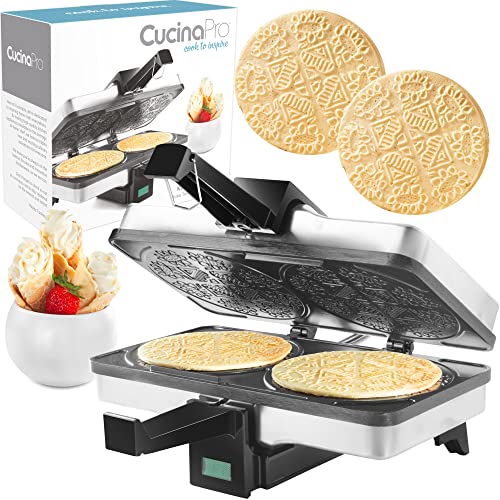

As an Amazon Associate we earn from qualifying purchases at no extra cost to you. Ratings are shown as listed on Amazon.
Best krumkake makers at a glance
| Maker or type | Cookie capacity | Approx. cookie diameter | Heat control | Storage profile | Best for |
|---|---|---|---|---|---|
| CucinaPro Krumkake Baker | 2 at a time | About 5 inches | Adjustable thermostat | Upright storage; cord wrap on many versions | Most households and consistent results |
| Chef’sChoice Krumkake Express 838 | 2 at a time | About 5 inches | Adjustable browning control | Upright, compact electric unit | Frequent baking and quick batches |
| Traditional stovetop cast-aluminum krumkake iron | 1 at a time | About 6 inches | Controlled by burner and timing | Very slim; no power cord | Small kitchens and occasional use |
| Electric single-cookie krumkake maker | 1 at a time | Usually 5–6 inches | Basic thermostat or indicator light | Smaller footprint than double models | Low-volume baking and simpler cleanup |
Dimensions and wattage can vary by production run and regional version, so check the manufacturer’s current manual before buying. The useful comparison is the operating format: double electric plates save time, whereas a stovetop iron takes less cabinet space and has fewer electrical parts to fail.
Our picks by baking situation
Best overall: CucinaPro Krumkake Baker
The CucinaPro is the most balanced choice for a baker who wants thin, evenly patterned cookies without managing a burner. Its two-cookie capacity is more useful than it first appears: if each pair takes about 90 seconds to bake, a 30-cookie batch requires roughly 15 plate cycles instead of 30. That reduces the time spent waiting for the iron and gives you a steadier rhythm for rolling.
An adjustable thermostat is important because krumkake batter can move from pale to over-browned quickly. Start near the middle setting, then adjust after the first two cookies. A slightly lower setting is usually preferable when you need enough time to roll both cookies before they harden.
The main ownership drawback is size. Double electric irons are wider and heavier than stovetop models, and the nonstick cooking surfaces should not be treated as washable griddles. They are a strong choice for annual holiday baking, family batches, and anyone who values repeatable results over minimum storage space.
Best for frequent batches: Chef’sChoice Krumkake Express 838
The Chef’sChoice Krumkake Express 838 is aimed at the same basic job but is particularly appealing if you make several batches in one session. It produces two approximately 5-inch cookies per cycle and includes browning control, allowing you to move from lightly golden shells to darker, crisper cookies.
Its advantage is workflow rather than a dramatically different cookie shape. When the iron is hot, place a measured portion in the center, close the lid, and prepare the rolling tool while the next pair bakes. That divided rhythm is easier with an electric double iron than with a single stovetop plate.
Choose it over the CucinaPro when the current price is competitive and the unit’s upright storage dimensions suit your cupboard better. Choose the CucinaPro when you prefer its controls, included cone arrangement, or warranty terms. Neither model eliminates the need to work quickly: the cookies become rigid within seconds after leaving the plates.
Best for limited storage: a traditional stovetop cast-aluminum iron
A traditional stovetop krumkake iron is the most space-efficient option. Many make one cookie of roughly 6 inches, and the two patterned plates close around the batter over a gas, electric, or compatible induction surface. There is no thermostat, indicator light, or heating element to store or replace.
The trade-off is a learning curve. Burner output, pan contact, preheating time, and the iron’s position all affect browning. A stovetop iron can produce excellent cookies, but it rewards a baker who is willing to record timing and adjust the flame. It is also slower for a large batch because it makes one cookie at a time.
Check compatibility carefully. A traditional aluminum iron may work poorly on induction unless the manufacturer specifically provides a magnetic base or an induction adapter approved for the cookware. Do not assume that a patterned iron is safe for every cooktop.
Head-to-head: what matters in daily use
Plate size and output
Two-cookie electric makers are the practical winners for volume. If one cycle takes 90 seconds, 24 cookies require about 18 minutes of baking time before allowing for scooping and rolling. A one-cookie iron would need about 36 minutes under the same assumptions. The larger approximately 6-inch stovetop cookie can be more dramatic for cones, but it also needs a larger rolling cone and more storage room for finished shells.
Plate diameter is not the same as usable cookie diameter. Patterned edges and the hinge area consume some space, so compare the maker’s stated finished-cookie size rather than the outside dimensions of the plates.
Browning control
Variable thermostats are valuable for thin cookies because a small change in batter moisture or sugar content can alter baking time. Indicator lights tell you when the iron is heating or ready, but they do not guarantee that every batch will be equally brown.
For a stovetop model, use a timer during the first batch. If the cookie is pale but dry, extend the time slightly. If it darkens before the pattern sets, reduce the heat rather than simply removing it earlier. Removing an under-set cookie can cause tearing when you roll it.
Storage
Measure the cupboard before choosing an electric iron. A double model commonly occupies roughly 12–14 inches of width, 9–11 inches of depth, and 4–6 inches of height when closed, although exact dimensions vary. A stovetop iron is usually flatter but may have long handles that require diagonal storage.
Vertical storage is useful only if the hinge and lid-lock design supports it. Never store a heavy appliance on top of its lid or wrap the cord tightly around a hot or sharp-edged section. A cone tool should be stored inside the appliance only when it cannot scratch the cooking plates.
Cleanup and surface care
Nonstick electric plates are fastest to clean, but they are not maintenance-free. Unplug the maker and let it cool until warm, then wipe the plates with a soft damp cloth. Use a wooden or silicone tool for dried batter. Avoid soaking the appliance, abrasive powder, steel wool, and cooking sprays that can leave a sticky polymerized film.
Traditional irons are usually more tolerant of residue, but they still need careful treatment. Wipe away crumbs after cooling and dry the metal completely before storage. Do not put an aluminum iron in a dishwasher unless its manufacturer explicitly says it is dishwasher-safe; detergent can discolor aluminum and damage seasoning or finishes.
A practical decision matrix
| Your situation | Best choice | Why | Compromise |
|---|---|---|---|
| First-time baker making one holiday batch | CucinaPro or similar double electric maker | Two cookies per cycle and adjustable heat reduce guesswork | More cabinet space and electrical parts |
| Frequent baking for parties or gifts | Chef’sChoice Krumkake Express 838 | Double capacity and browning adjustment support a faster workflow | Higher purchase cost than basic stovetop irons |
| Very limited kitchen storage | Traditional stovetop iron | Thin profile and no cord or base | One cookie at a time and manual heat control |
| Want the largest traditional shells | Approximately 6-inch stovetop iron | Often offers a wider rolling surface | Requires a matching cone and faster handling |
| Concerned about simple cleanup | Single electric nonstick maker | Smaller plate area means less residue to wipe | Slower for batches |
How to get thin, evenly rolled cookies
- Measure batter consistently. Start with the recipe’s recommended spoonful, then adjust until the batter reaches the patterned area without overflowing. A small cookie scoop gives more uniform thickness than an ordinary spoon.
- Preheat fully. The first cookie often behaves differently because the plates have not stabilized. Wait for the ready indicator on an electric maker, or use a timed preheat for a stovetop iron.
- Center the batter. Place it slightly behind the middle hinge area, then close the lid smoothly. Excess pressure can force batter into the hinge and edges.
- Roll immediately. Lift the cookie with a heat-safe nonmetal utensil, place it patterned-side down if that gives the cone more grip, and wrap it around the cone while flexible. You typically have only a few seconds.
- Cool the seam-side down. Hold the cone briefly, then transfer the shell with the seam underneath. It will firm as it cools.
Durability and ownership realities
The first parts likely to show wear are the nonstick coating, hinge, thermostat, and power cord—not the cookie pattern itself. Metal utensils, overheating an empty iron, and scraping hardened sugar are the common avoidable causes of surface damage. If a nonstick plate begins shedding or food sticks in patches after proper cleaning, replacement is generally more sensible than aggressive scrubbing.
For an occasional baker, a basic stovetop iron can have the lowest long-term ownership burden because it has no thermostat or heating element. For anyone making multiple batches, the time saved by a double electric maker may outweigh its higher purchase price. A simple calculation illustrates the difference: saving 18 minutes on four annual 24-cookie sessions saves about 72 minutes per year, before counting the reduced effort of controlling two cookies at once.
Final verdict
Buy the CucinaPro Krumkake Baker if you want the safest all-around balance of capacity, browning adjustment, and repeatability. Choose the Chef’sChoice Krumkake Express 838 for frequent two-cookie batches and a compact electric workflow. Choose a traditional stovetop cast-aluminum iron if thin storage, low mechanical complexity, and a classic hands-on process matter more than speed.

Write Your Review
No reviews yet. Be the first to share your experience!