

Key takeaways
- Scrape the bowl only after stopping the machine. A silicone spatula can contact moving tools if used carelessly.
- Do not exceed the recommended dough quantity to save one mixing cycle. Overloading accelerates wear on gears, belts and attachment hubs.
- Check beater-to-bowl clearance occasionally. A beater that strikes the bowl can damage both parts; adjust it according to the manufacturer’s procedure.
- Wash removable tools promptly, but check whether they are dishwasher-safe. Some coated beaters lose their finish when repeatedly exposed to harsh cycles.
- Keep flour and sugar away from ventilation openings. Fine particles can enter the motor area over time.
- Expect the dough hook, scraper and bowl coating or finish to show wear before the main motor does. Replacement accessories are part of the long-term cost.
The best planetary mixer for most home bakers is the KitchenAid Artisan 5-Quart, while frequent bread bakers should look first at the Kenwood Titanium Chef Baker XL or a non-planetary spiral-style mixer such as the Ankarsrum Assistent Original.
“Planetary” means the beater rotates on its own axis while orbiting the bowl, helping it reach more of the mixture than a simple fixed beater. That design is versatile for cakes, cookies, buttercream and moderate dough batches, but bowl size alone does not determine bread capacity. Motor control, gearing, hook design, thermal limits and the mixer’s ability to knead without walking across the counter matter just as much.
Our top picks

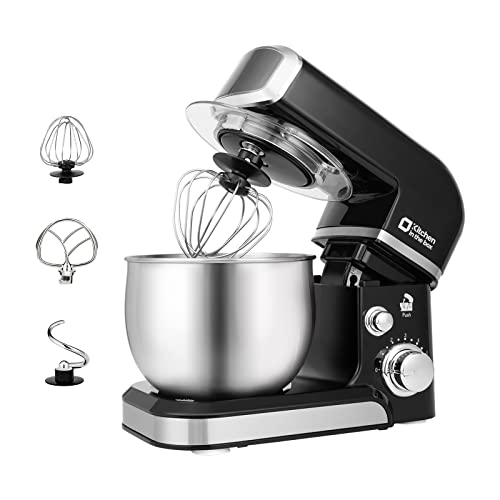
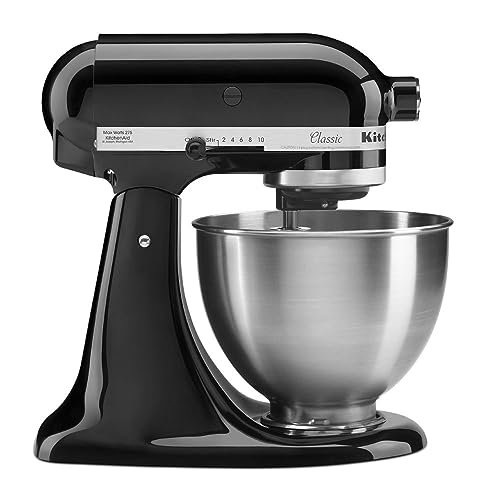

As an Amazon Associate we earn from qualifying purchases at no extra cost to you. Ratings are shown as listed on Amazon.
Best planetary mixers by home-baking situation
| Mixer | Approx. bowl capacity | Motor / controls | Best for | Approx. market range in 2026 |
|---|---|---|---|---|
| KitchenAid Artisan 5-Quart | 4.8 L / 5 qt | 10 speeds; 325 W rated motor | Versatile everyday baking and attachments | $350–$550 |
| Kenwood Titanium Chef Baker XL | 7 L main bowl; often supplied with a second bowl | Variable electronic control; 1,200 W input power | Large batches and regular bread making | $650–$900 |
| Breville Bakery Boss | 4.7 L / 5 qt | 12 speeds; 550 W motor | Frequent cakes, cookies and controlled mixing | $350–$500 |
| Cuisinart Precision Master 5.5-Quart | 5.2 L / 5.5 qt | 12 speeds; 500 W motor | Lower-cost general-purpose mixing | $250–$400 |
| Ankarsrum Assistent Original | 7 L bowl; up to about 5 kg dough capacity | Variable dial; 600 W motor | Large, heavy dough batches and longevity | $750–$1,000 |
Motor wattage is not a fair ranking by itself. Manufacturers measure input and output differently, and a well-geared 325 W mixer can outperform a less efficiently geared high-wattage model when kneading a stiff dough. Treat the figures above as context, not as a horsepower contest.
Best overall: KitchenAid Artisan 5-Quart
The Artisan is the safest all-round choice for a home baker who makes cakes, cookies, frostings and occasional bread. Its 4.8-litre stainless-steel bowl is large enough for a typical layer cake or a batch of cookies, but the mixer remains manageable on a normal kitchen counter. The tilt-head design makes it easy to add ingredients and remove the bowl.
Its strongest advantage is the attachment ecosystem. A flat beater, wire whisk and dough hook cover the basic jobs, while the front power hub accepts optional tools for tasks such as slicing, shredding, grinding and pasta rolling. That turns the mixer into a broader food-preparation platform, although attachments add cost and storage demands.
The limitations are equally important. The Artisan is not the ideal choice for repeated wholegrain loaves, very stiff bagel dough or large double batches. The tilt-head can move slightly during heavy kneading, and the splash guard is less comprehensive than on some bowl-lift machines. Use the lowest practical speed for dough rather than attempting to force it at high speed.
Best for serious bread batches: Kenwood Titanium Chef Baker XL
The Chef Baker XL makes more sense when capacity and dough handling are priorities. Its 7-litre bowl provides useful headroom for large cake mixtures and multiple loaves, and many packages include a second, smaller bowl that reduces washing when making separate components of a recipe. Integrated weighing features on applicable versions can also reduce the number of separate containers used during preparation.
The bowl-lift-style, full-size construction is more substantial than a compact tilt-head mixer. That helps it stay planted during kneading, but it also increases the countertop footprint and storage burden. Measure the available depth with the bowl, head and controls in their operating positions; a mixer that technically fits may still prevent access to a cabinet or wall outlet.
Choose it over the KitchenAid when you bake bread several times a week, regularly double recipes or want one machine with more capacity. It is excessive for occasional cupcakes and may be frustrating in a small kitchen.
Best for controlled everyday mixing: Breville Bakery Boss
The Breville Bakery Boss is attractive to bakers who care about speed control and visibility. Its electronic controls offer many incremental settings, while a timer and illuminated bowl area can make it easier to monitor a recipe without stopping the machine. The 5-quart class bowl suits normal household quantities.
Its relatively high stated wattage does not make it a dedicated bread machine. It handles enriched dough and moderate batches well when the recipe’s hydration and quantity are sensible, but heavy dough still creates more heat and strain than cake batter. The body is also less compact than some entry-level mixers, so check the height and rear clearance before buying.
Best value: Cuisinart Precision Master 5.5-Quart
The Cuisinart offers a useful middle ground: a stainless-steel bowl slightly larger than the common 5-quart format, 12 speed settings and the core beater, whisk and dough-hook set. It is a reasonable pick for a new baker who wants a stand mixer without paying for an extensive accessory system.
It is best suited to cakes, cookies, whipped mixtures and occasional moderate dough batches. Compared with heavier premium machines, its lighter construction can be more noticeable when kneading. Keep one hand near the mixer during the first few minutes of a stiff dough cycle and stop if the machine begins to shift, strain or produce an unusual smell.
Where the Ankarsrum fits
The Ankarsrum Assistent Original is not a conventional planetary mixer: its stainless-steel bowl rotates while the roller and scraper work the mixture. It deserves consideration because it is particularly capable with large or wet bread doughs and offers a generous 7-litre bowl. Its motor and drive system are built around substantial dough work rather than only light baking.
The learning curve is steeper. Ingredient placement, roller position and scraper adjustment affect the result more than they do on a typical planetary mixer. Its accessory range is broad, but the purchase makes the most sense for someone who bakes bread frequently and is willing to learn a different mixing method.
Decision matrix for choosing the right size
| Your situation | Practical target | Best fit | Reason |
|---|---|---|---|
| Small counter, baking once or twice a month | 4.5–5 qt; compact tilt-head | KitchenAid Artisan or similar | Good versatility without a commercial-size footprint |
| Mostly cakes, cookies and frosting | 5–5.5 qt; 10–12 speeds | Breville Bakery Boss or Cuisinart Precision Master | Fine speed adjustment matters more than extreme dough capacity |
| Bread once or twice weekly | 5–7 qt; robust gearing and useful dough hook | Kenwood Chef Baker XL | More headroom reduces overloading during larger batches |
| Several loaves or stiff dough every week | 7 L or more; heavy chassis | Ankarsrum or Kenwood Chef Baker XL | Better stability and capacity for sustained kneading |
| Counter space is limited but attachments matter | Standard 5-qt footprint with front hub | KitchenAid Artisan | Attachment choice is extensive, though storage is still required |
What the specifications do not tell you
Dough handling
A mixer’s usable dough capacity is usually lower than its advertised bowl capacity. A 5-quart bowl may hold a large volume of cake batter but struggle with a dense dough containing several cups of flour. For predictable results, start below the manufacturer’s maximum, especially with wholegrain, low-hydration or enriched dough. If the dough climbs the hook, smears around the bowl or makes the head vibrate, stop and adjust the quantity or hydration instead of increasing speed.
Speed control
More speed numbers are useful only when the machine can make smooth transitions. Low speed should fold flour and begin kneading without throwing ingredients out of the bowl. Medium speed helps cream butter and sugar, while high speed is mainly for whipping. Starting at full speed increases flour clouds, stresses the transmission and can overwhip mixtures before you notice.
Noise and footprint
Planetary mixers are mechanical appliances, so none is silent. Noise rises sharply with stiff dough, and the sound can be more intrusive when the mixer sits against a tiled backsplash. Heavy machines generally transmit less movement but occupy more space. Measure width, depth, height with the head raised, and the clearance needed to remove the bowl. A machine stored in a cupboard may be used less often than one that can remain safely accessible.
Ownership, cleaning and common mistakes
- Scrape the bowl only after stopping the machine. A silicone spatula can contact moving tools if used carelessly.
- Do not exceed the recommended dough quantity to save one mixing cycle. Overloading accelerates wear on gears, belts and attachment hubs.
- Check beater-to-bowl clearance occasionally. A beater that strikes the bowl can damage both parts; adjust it according to the manufacturer’s procedure.
- Wash removable tools promptly, but check whether they are dishwasher-safe. Some coated beaters lose their finish when repeatedly exposed to harsh cycles.
- Keep flour and sugar away from ventilation openings. Fine particles can enter the motor area over time.
- Expect the dough hook, scraper and bowl coating or finish to show wear before the main motor does. Replacement accessories are part of the long-term cost.
For a simple ownership comparison, suppose a $450 mixer is used twice a week for five years: 2 × 52 × 5 equals 520 uses, or about $0.87 per use before electricity and accessories. A $800 large-capacity mixer used four times a week for the same period costs about $0.77 per use. The more expensive machine is not automatically better value; its advantage appears only if its capacity and durability lead you to use it more often.
Bottom line
Buy the KitchenAid Artisan 5-Quart for the broadest mix of countertop practicality, accessory support and everyday baking performance. Choose the Kenwood Titanium Chef Baker XL when large batches and bread are central to your routine. Pick the Breville Bakery Boss for refined everyday speed control, or the Cuisinart Precision Master when keeping the initial cost lower matters. For committed bread bakers willing to learn a different system, the Ankarsrum Assistent Original is the most compelling alternative to a conventional planetary design.





Write Your Review
No reviews yet. Be the first to share your experience!