

Key takeaways
- Wide wheels: better on rough concrete, grass edges, and small surface cracks.
- Narrow wheels: lighter and compact, but more likely to catch in seams.
- Locking wheels: reduce creeping, though they do not replace ballast in strong wind.
- Fixed wheels: simple and durable, but awkward when changing direction.
- Swivel casters: easier to maneuver, but they add hardware that can loosen or collect grit.
The best pickleball nets for most home courts are the SwiftNet 2.1 for fast setup and portability, the Onix Pickleball Net for a sturdier all-purpose frame, and a heavy-duty steel tournament-style net when wind resistance matters more than easy transport.
A good home net must do more than span 22 feet. The frame should stay square when players brush against it, the center should remain at the correct height, the wheels should not creep on hard courts, and the fabric should tolerate sun, damp grass, and repeated folding. The right choice depends on how often you play and whether the net will live in one place or travel in a vehicle.
Our top picks
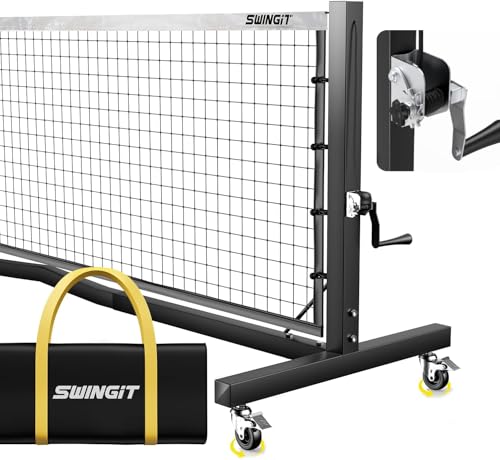


As an Amazon Associate we earn from qualifying purchases at no extra cost to you. Ratings are shown as listed on Amazon.
Best pickleball nets compared
| Net or net type | Playing width | Approx. weight | Frame and wheel design | Typical setup | Best for |
|---|---|---|---|---|---|
| SwiftNet 2.1 | 22 ft; regulation height | About 17 lb | Carbon-fiber support system; compact wheeled case | About 2 minutes | Frequent setup, travel, premium portability |
| Onix Pickleball Net | 22 ft; regulation height | About 25–30 lb, depending on version | Powder-coated steel frame; transport wheels on many versions | About 5 minutes | Home courts needing a stable general-purpose net |
| Franklin Sports portable net | 22 ft; regulation height | About 20–25 lb | Steel tubing with a carry bag; wheel configuration varies by model | About 5–10 minutes | Budget-conscious recreational players |
| JOOLA Pro Court net | 22 ft; regulation height | Roughly 25–30 lb | Steel frame with stabilizing feet and transport hardware | About 5 minutes | Players wanting a robust branded home setup |
| Heavy-duty tournament-style steel net | 22 ft; regulation height | 35–50+ lb | Larger steel sections, broad feet, locking casters on some models | About 8–15 minutes | Permanent or semi-permanent outdoor courts |
Weights and setup times are approximate because manufacturers sell multiple versions and packaging can differ. Before ordering, confirm the current model’s dimensions, wheel arrangement, and included center strap.
What “regulation” means for a home net
For pickleball, the net is 22 feet wide from post to post. Its height is 36 inches at the sidelines and 34 inches at the center. A center strap helps maintain that two-inch drop; without one, a net can sag unevenly after repeated assembly.
Look for a net with a 2-inch mesh or smaller and a dark, weather-resistant top band. The top band should be firmly stitched rather than attached only with adhesive. The sleeve or pocket that receives the frame should also be reinforced, because this area carries tension every time the net is assembled.
Some inexpensive portable nets advertise a 22-foot span but use narrow feet or flexible poles that allow the ends to tilt inward. They may be acceptable for casual games, but they do not behave like a regulation net once wind or contact is added.
Best by playing situation
| Your situation | Best choice | Why | What to give up |
|---|---|---|---|
| Set up and pack away several times a week | SwiftNet 2.1 | Low weight, fast assembly, compact storage | Higher purchase price and less mass in strong wind |
| Leave the net on a driveway or backyard court | Onix or comparable steel-frame net | More rigid frame and better resistance to accidental bumps | Heavier to move and slower to dry after rain |
| Play occasionally on a firm, sheltered surface | Franklin portable net | Usually lower market cost while retaining regulation width | Less refinement in wheels, latches, and long-term hardware |
| Windy location or frequent competitive play | Heavy-duty steel tournament-style net | Wide feet and greater frame mass reduce movement | Storage space, transport effort, and higher cost |
| Small vehicle or limited storage closet | Lightweight carbon-fiber or compact portable design | Shorter packed length and easier lifting | May need sandbags or court weights outdoors |
Head-to-head: lightweight carbon fiber versus steel
SwiftNet 2.1
The SwiftNet 2.1 is the strongest choice when the net must be transported regularly. Its carbon-fiber support structure keeps the total weight near 17 pounds, and the system is designed to fold into a compact carrying case. That makes it practical for players who use a shared tennis court, community space, or driveway that must be cleared after every session.
Its advantage is not simply weight. A quick setup reduces the temptation to leave the net partially assembled, which can distort the frame and strain the fabric. The compromise is wind: a light net has less passive resistance, so outdoor users may need approved weights placed without blocking the wheels or creating a trip hazard.
Onix Pickleball Net
An Onix net is the more conventional home-court choice. Its steel frame adds mass and generally produces a planted feel when players move around the kitchen line. It is better suited to a backyard or driveway where the net is assembled often but does not need to be carried long distances.
Steel is not automatically maintenance-free. Scratches in the powder coating can become rust points, especially when the frame is stored wet. Dry the tubing and inspect the feet after rain. Check that any wheels roll straight and that their fasteners remain tight; a loose caster can make an otherwise stable net wobble.
Franklin and similar budget nets
A Franklin portable net can make sense for new players who want regulation width without paying for premium materials. These nets are usually adequate on smooth, sheltered surfaces and are easy to share among several players.
Budget designs deserve closer inspection before purchase. Compare the packed length with your storage space, confirm whether the bag is included, and check whether the frame has a center support. A low price is less attractive if the net lacks a center strap or if replacement parts are difficult to obtain.
Wheel design matters more than it looks
Wheels are useful only when they roll predictably. Small fixed wheels are fine for moving a collapsed net in a straight line, while larger swivel casters are better when the net must be turned in a garage or around a fence. Locking casters are especially useful on painted concrete, but locks should be applied only after the frame is positioned and level.
- Wide wheels: better on rough concrete, grass edges, and small surface cracks.
- Narrow wheels: lighter and compact, but more likely to catch in seams.
- Locking wheels: reduce creeping, though they do not replace ballast in strong wind.
- Fixed wheels: simple and durable, but awkward when changing direction.
- Swivel casters: easier to maneuver, but they add hardware that can loosen or collect grit.
Setup and maintenance that extend net life
- Lay out the frame before threading the net. This prevents twisting the sleeve and shows whether every joint is fully seated.
- Position the center support first. It establishes the net’s midpoint and reduces uneven tension between the two ends.
- Stand the end posts vertically. Measure or visually confirm the 36-inch side height before tightening the top band.
- Use the center strap, if supplied. Pull it firmly enough to reach 34 inches at center, but do not over-tension it.
- Dry the net before storage. Folded damp fabric encourages mildew and can corrode steel inside sleeves.
- Clean wheels and joints monthly during heavy use. Remove grit with a dry brush and tighten hardware with the correct tool.
The components that usually wear first are the top band, hook-and-loop tension straps, wheel fasteners, plastic feet, and frame joints. Do not drag an assembled net sideways across rough pavement; lift one end or use the wheels. Dragging loads the feet and can pull the net out of square.
What should you pay?
In 2026, a reasonable market range is roughly $100–$180 for a basic portable steel net, $180–$300 for a better-equipped home net, $350–$500 for a premium lightweight system such as the SwiftNet 2.1, and $500 or more for heavy-duty tournament-style equipment. Prices vary with seasonal promotions, included bags, and wheel hardware.
For example, a $150 net used twice per month for three years provides about 72 sessions, or approximately $2.08 per use before replacement parts. A $400 premium net used four times per month for three years provides about 144 sessions, or approximately $2.78 per use. The more expensive net can therefore be the better value when portability determines whether it actually gets used.
Final recommendation
Choose the SwiftNet 2.1 if quick assembly, low lifting weight, and vehicle-friendly storage are your priorities. Choose an Onix, JOOLA, or comparable steel-frame net for a stable everyday home court. Choose a Franklin-style budget net for occasional recreational play on a sheltered surface, and move to a heavy-duty tournament-style system when wind, frequent use, and permanent placement outweigh portability.





Write Your Review
No reviews yet. Be the first to share your experience!