

Key takeaways
- Choose a compact 8- to 10-inch kiln for small work and occasional use. Choose a programmable 14- to 16-inch glass kiln for the best balance of flexibility, installation demands, and cost. Move to an 18-inch-or-larger 240-volt model only when your projects or production volume justify…
Best Glass Kilns for Fusing and Slumping
The best glass kilns for most hobbyists are top-loading electric kilns with a chamber at least 14 inches wide, a programmable digital controller, 2.5–3 inches of ceramic-fiber or brick insulation, and a reliable 120-volt or 240-volt circuit matched to the kiln’s rating.
For small jewelry, test tiles, and occasional projects, a compact 8-inch kiln such as the Skutt FireBox 8×6 is easier to install and less expensive to run. For full-size plates, bowls, and repeated production, a kiln in the 14- to 16-inch class—such as the Paragon Fusion series, Evenheat Studio Pro, or Jen-Ken AF3P range—offers substantially better working space. The right choice depends less on maximum temperature than on chamber layout, controller quality, and whether your electrical supply can support it.
Our top picks


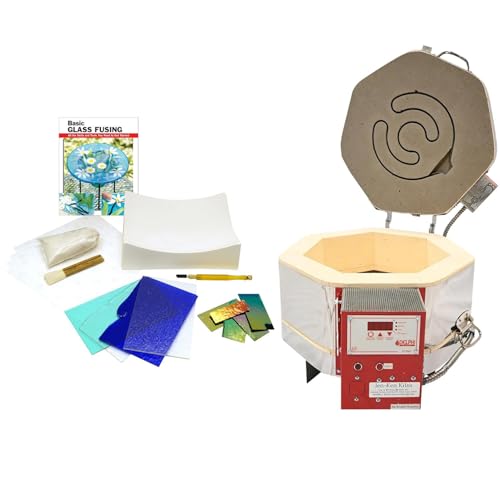
As an Amazon Associate we earn from qualifying purchases at no extra cost to you. Ratings are shown as listed on Amazon.
Quick comparison of leading glass-kiln types
| Kiln or class | Approximate chamber size | Maximum temperature | Typical power requirement | Best suited to |
|---|---|---|---|---|
| Skutt FireBox 8×6 | 8 in diameter x 6 in deep | Up to about 2,000°F | 120 V, approximately 14–15 A | Jewelry, small fusing projects, tests |
| Compact glass kiln, 8–10 in | 8–10 in wide x 6–8 in deep | About 1,800–2,000°F | 120 V, 15–20 A | Beginners and limited workspaces |
| Paragon Fusion-class kiln | Roughly 16 x 16 in shelf area, depending on model | About 2,000°F | 120 V or 240 V; commonly 15–30 A | Plates, slumping molds, regular hobby use |
| Evenheat Studio Pro 14-class kiln | About 14 x 14 x 6 in | About 2,000°F | 120 V or 240 V, model dependent | Flat glass, bowls, and small production runs |
| Large glass kiln, 18–23 in | 18–23 in wide x 6–10 in deep | About 1,800–2,000°F | Usually 240 V, commonly 30–50 A | Large platters and frequent production |
Dimensions and electrical ratings vary by exact revision and configuration, so confirm the manufacturer’s data plate before purchase. A kiln that fits a 16-inch shelf may still have less usable space once the walls, lid, and kiln furniture are taken into account.
What matters when choosing the best glass kiln
Chamber size and usable shelf area
For fusing, the shelf dimensions usually matter more than the internal volume. A shallow, wide kiln is efficient for sheets of glass, while extra depth is useful for stacked work and slumping molds. Measure the finished project—not just the glass blank—and add clearance around the perimeter.
A practical sizing rule is to leave at least 1 inch between the glass or mold and the kiln wall. For a 12-inch plate, a 14-inch internal shelf is a sensible minimum. For a 16-inch platter, choose a kiln with at least an 18-inch usable shelf if the mold has a wide rim.
Small kilns are not automatically inefficient. They heat quickly and waste less energy when firing earrings, pendants, or small samples. The problem is buying one for a large project and discovering that the work must be divided into several firings.
Temperature range and controllability
Nearly every serious glass kiln reaches approximately 1,800–2,000°F, which is more than enough for common fusing and slumping schedules. Maximum temperature is therefore a poor reason to choose one model over another.
Look instead for accurate low-temperature control, a programmable ramp-and-hold controller, and the ability to set a controlled cooling rate through the annealing range. Glass projects often fail because the kiln cools too quickly through the strain point, not because the kiln cannot reach a high peak temperature.
A good controller should allow multiple segments: heat-up rate, target temperature, hold time, controlled cooling, and a final safe shutoff. Four to eight programmable segments are sufficient for most fusing work. More segments help when using thick castings, complicated slumps, or schedules with several controlled-cooling stages.
Insulation and firing consistency
Insulation affects both energy use and temperature stability. Ceramic-fiber insulation heats rapidly and is relatively light, but it can be damaged by rough handling. Insulating firebrick is heavier and slower to heat, but it provides a rigid, durable chamber. Many kilns combine both materials.
For glass, even heating is more important than a fast peak temperature. A lid-mounted element can produce a useful top-down heat pattern, while additional side elements may improve uniformity in wider chambers. A thermocouple positioned near the work area gives the controller a more representative reading than one placed high near the lid.
Temperature variation is normal: the controller’s displayed temperature is not necessarily the temperature at every point on the shelf. If you regularly fire large or thick pieces, consider using witness cones or a kiln-reading system to compare schedules and identify hot or cool areas. Avoid placing a large mold directly against the wall, where radiant heat can be different from the center.
Power requirements and installation
Electrical planning should happen before ordering. A compact 120-volt kiln may run from a dedicated 15-amp circuit, while many medium kilns require a 20-amp circuit. Larger 240-volt kilns commonly need 30, 40, or 50 amps.
Do not use an extension cord, household power strip, or undersized outlet. The kiln should be connected according to its nameplate requirements, with the correct receptacle and breaker. Have an electrician check the circuit when the kiln’s amperage is close to the existing circuit limit.
A simple operating-cost estimate illustrates the difference. A 120-volt kiln drawing 15 amps uses approximately 1.8 kW while its elements are fully on. If a firing cycle averages 60 percent element duty for six hours, consumption is:
1.8 kW × 6 hours × 0.60 = 6.48 kWh.
At an electricity rate of $0.20 per kWh, that is about $1.30 in electricity. Actual consumption varies with insulation, room temperature, firing schedule, and how often the elements cycle. A larger kiln may cost more per firing but less per finished piece when it fires several items together.
Ventilation and placement
Firing glass can release vapors from binders, kiln wash, adhesives, coatings, and contaminants on the glass. Place the kiln in a clean, dry, noncombustible area with clearance specified by the manufacturer. Do not operate it in a bedroom, poorly ventilated closet, or area used for food preparation.
Passive room ventilation may be adequate for occasional clean firings, but frequent work may justify a kiln vent or dedicated exhaust system. Ventilation should remove fumes without creating a strong cross-draft that cools one side of the kiln. Keep combustible materials away from the lid, walls, controller, and power cable.
Best choice by situation
| Your situation | Recommended specification | Why |
|---|---|---|
| First kiln, small projects, limited budget | 8–10 in chamber, 120 V, digital controller | Lower purchase and installation cost; quick small firings |
| Beginner planning plates or bowls | 14–16 in shelf, shallow chamber, programmable controller | Leaves room to grow without requiring a large production circuit |
| Frequent weekly use | Heavy-duty elements, replaceable thermocouple, strong insulation | Better serviceability and more consistent repeated firings |
| Large platters or multiple pieces per firing | 18 in or larger shelf, usually 240 V | More usable area and less need to split production into batches |
| Apartment or shared workspace | Compact kiln with approved placement and dedicated ventilation | Lower heat output and easier space planning, subject to building rules |
Ownership realities: what wears out first
Heating elements, thermocouples, lid hinges, relays, and kiln shelves are the parts most likely to need attention. Elements gradually lose performance and may develop hot spots. A thermocouple can drift or fail after repeated high-temperature cycles. Shelves may crack if they are flexed, dropped, or loaded while cold and damp.
Kiln wash is a consumable rather than a permanent coating. Apply it thinly and evenly to a clean shelf, and remove flaking material before it contaminates the next project. Never allow glass to fuse directly to an unprotected shelf unless the kiln manufacturer specifically approves that process.
Common mistakes include firing wet kiln wash, stacking glass too close to the wall, opening the lid during a critical cooling stage, and assuming two pieces of glass are compatible because they have the same apparent thickness. Use compatible glass systems, follow a tested annealing schedule, and record each firing so you can adjust one variable at a time.
Bottom line
Choose a compact 8- to 10-inch kiln for small work and occasional use. Choose a programmable 14- to 16-inch glass kiln for the best balance of flexibility, installation demands, and cost. Move to an 18-inch-or-larger 240-volt model only when your projects or production volume justify the electrical work. Across all sizes, prioritize usable shelf area, controlled cooling, replaceable parts, adequate insulation, and safe ventilation over an impressive maximum-temperature number.




Write Your Review
No reviews yet. Be the first to share your experience!