

Key takeaways
- 18- to 20-gauge: suitable for basic locked storage, but easier to deform with hand tools.
- 14- to 16-gauge: the practical middle ground for a home cabinet, especially when the door has reinforcement.
- 10- to 12-gauge: a stronger choice for higher-risk homes, though the hinges, frame, lock, and anchor points must be equally robust.
Best Gun Cabinets for Secure Home Storage
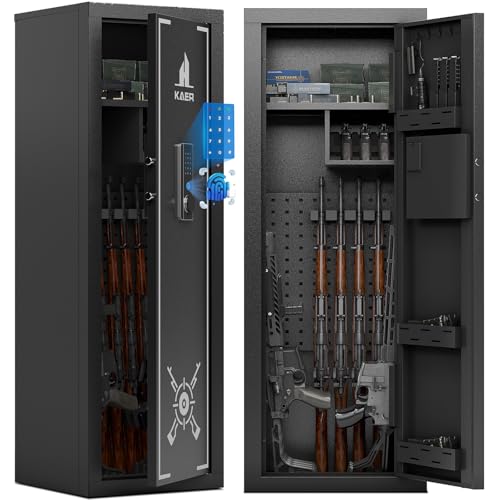
The best gun cabinets are steel, anchored to the structure, fitted with a lock appropriate to your access needs, and large enough to prevent firearms from touching or obstructing one another; for most homes, a 14- to 16-gauge steel cabinet with a reliable electronic or mechanical lock is the best balance of security, capacity, and price.
A cabinet is not automatically a safe. Many gun cabinets provide a basic barrier against unauthorized access, while a certified gun safe is designed to resist more serious forced entry and may include a tested fire rating. Choose according to your threat model, local storage rules, household access, and whether fire protection is important.
Our top picks


![[No Assembly Required] 5-8 Gun Safe for Rifles and Pistols, Rifle Safe for Home with Adjustable Shelves, Gun Cabinet for Rifle and Gun Locker, Large Capacity Gun Safes (11"D x 12"W x 52"H)](https://m.media-amazon.com/images/I/51lFN-S8hjL._SL500_.jpg)
As an Amazon Associate we earn from qualifying purchases at no extra cost to you. Ratings are shown as listed on Amazon.
Quick comparison: which cabinet suits your situation?
| Situation | Recommended specification | Why it fits | Typical market range |
|---|---|---|---|
| Lowest-cost locked storage | 18- to 20-gauge steel, key lock, 4-8 long-gun capacity | Creates a basic access barrier in a low-risk environment | $80-$180 |
| Regular household use | 14- to 16-gauge steel, electronic or mechanical combination lock, 8-16 long-gun capacity | Better resistance to prying and more convenient controlled access | $180-$500 |
| Children or frequent visitors at home | 12- to 14-gauge steel, concealed hinges, bolt-style locking bars, anchoring hardware | Reduces the chance that casual access becomes unauthorized access | $350-$900 |
| Fire protection is a priority | Certified fire-rated safe, preferably with a stated rating of at least 30 minutes | A thin steel cabinet alone offers little insulation from high heat | $700-$2,000+ |
| Small apartment or limited floor area | Compact, wall- or floor-anchorable cabinet, 4-8 long-gun capacity or dedicated handgun compartment | Uses less space but still allows the unit to be secured to the building | $100-$400 |
Steel thickness: the number matters, but construction matters too
Steel gauge is expressed in reverse order: a lower gauge number generally means thicker steel. A 12-gauge panel is approximately 2.7 mm thick, 14-gauge is about 1.9 mm, 16-gauge about 1.5 mm, and 20-gauge about 0.9 mm. Measurements can vary slightly by manufacturing convention and coatings.
- 18- to 20-gauge: suitable for basic locked storage, but easier to deform with hand tools.
- 14- to 16-gauge: the practical middle ground for a home cabinet, especially when the door has reinforcement.
- 10- to 12-gauge: a stronger choice for higher-risk homes, though the hinges, frame, lock, and anchor points must be equally robust.
Do not judge a cabinet by the body panel alone. Look for a folded or reinforced door, a rigid door frame, protected hinges, a continuous strike area, and locking bolts that engage the cabinet frame rather than a thin side panel. A heavy-looking door with a weak frame can still be pried open.
Locking systems: speed versus resistance
Key locks
Key locks are simple and do not require batteries. Their weaknesses are lost-key management and the possibility of leaving the key accessible. If you choose one, store the key separately from the cabinet and keep it under your direct control. A spare key should not be hidden in an obvious nearby location.
Electronic keypad locks
Electronic locks provide quick access and allow the combination to be changed without replacing a cylinder. Look for a low-battery warning, an external emergency power method or override procedure, and a lock that automatically relocks. Replace batteries on a schedule rather than waiting for failure; lithium or alkaline batteries should be used only as specified by the manufacturer.
Mechanical combination locks
Mechanical combination locks avoid battery failure and can be dependable for long-term storage. They are usually slower to operate and require careful dialing. They are a strong choice when the cabinet is opened infrequently and reliability over years matters more than speed.
Biometric locks
Fingerprint access can be convenient, but performance may vary with wet, dirty, damaged, or poorly enrolled fingers. Treat biometric access as a convenience feature, not the only plan. A dependable backup method and a way to manage a flat battery are essential.
For any lock type, test that the door cannot be opened when the lock is engaged, the bolts fully extend, and the cabinet relocks after closing. Avoid models with a flimsy emergency key cylinder or a keypad mounted on a flexible section of the door.
Capacity: buy for the collection you will have, not the label
Advertised capacity often assumes slim firearms with no optics, slings, suppressors, or oversized stocks. A cabinet labeled for 12 long guns may hold only 6 to 8 comfortably once accessories are fitted.
Measure the tallest firearm from the bottom of the stock to the highest point of the action or optic. Then measure the available depth, including the door and hinge clearance. For a simple fit calculation, allow approximately 75-100 mm of horizontal space per long gun, and add more for scoped rifles or bulky sporting shotguns. A 10-gun cabinet can therefore need roughly 750-1,000 mm of usable internal width for practical, non-contact storage.
Useful interior features include removable shelves, adjustable racks, a separate lockbox, padded barrel supports, and a door organizer. Confirm that shelves can be removed without blocking long-gun storage and that foam or fabric will not retain moisture against metal surfaces.
Fire resistance: understand what the rating does and does not mean
A plain steel cabinet may delay access during a fire but usually has no meaningful tested fire rating. Fire-rated safes use insulation in the walls and door, and a credible specification should state a test duration and temperature standard rather than simply saying “fireproof.” A 30-minute rating is a useful minimum for many homes; longer ratings provide more protection but add weight and cost.
Fire protection is not the same as water protection. Firefighting water, smoke, and heat can still damage firearms, optics, documents, and ammunition. Keep moisture-sensitive items in suitable sealed containers inside the cabinet only if the safe manufacturer permits it, and use a desiccant or approved dehumidifier rod where appropriate.
Anchoring is a security feature, not an installation extra
An unanchored cabinet can be carried away, laid on its back, or positioned to make prying easier. Select a unit with factory-drilled anchor holes through the base or rear panel and install it into structural material, not merely drywall or thin flooring.
- For concrete, use anchors rated for the cabinet’s loaded weight and the concrete type.
- For timber floors or walls, fasten into structural joists or studs with suitable bolts or lag screws.
- Check for plumbing, electrical wiring, radiant heating, and other concealed services before drilling.
- Use all manufacturer-provided anchor points; one bolt may stop tipping but not determined removal.
- Confirm that the floor can support the loaded cabinet, particularly for fire-rated safes that may weigh several hundred kilograms.
If you rent, ask the property owner before drilling. A smaller cabinet secured inside a suitable closet may be preferable to a large unit that cannot be anchored legally or safely.
Access requirements and household safety
Storage must prevent unauthorized access while allowing the lawful owner to retrieve the firearm without improvised shortcuts. Keep the combination private, do not write it on the cabinet, and avoid predictable codes such as birthdays. If several adults require access, use a lock that supports controlled code management rather than sharing a physical key widely.
Follow the firearm manufacturer’s unloading and storage instructions, and comply with local laws governing locked storage, loaded firearms, ammunition, transport, and access by minors or prohibited persons. Requirements vary by jurisdiction and may change, so check the current rules that apply where you live.
Ownership realities: what wears out first
The lock, batteries, door seals, foam, and rack padding generally need more attention than the steel body. Key cylinders can collect grit, electronic contacts can corrode in damp rooms, and adhesive-backed foam can loosen with heat. Inspect the cabinet every few months.
- Check that hinges are tight and the door remains aligned.
- Operate the lock with the door open before closing it fully.
- Replace batteries on a calendar schedule and keep the specified spare type available.
- Remove damaged foam, rusting hardware, or damp packaging promptly.
- Use a suitable gun-safe lubricant sparingly on moving lock components; do not spray oil into an electronic keypad.
- Keep firearms clean and dry according to their manufacturers’ instructions.
Avoid overloading the cabinet, defeating the lock with modifications, or storing wet cases and damp cloths inside. These mistakes can cause poor door alignment, rust, and premature lock failure.
Bottom line
For most buyers, the best gun cabinets are mid-range models with 14- to 16-gauge steel, a reinforced door, a reliable keypad or mechanical combination lock, adjustable interior storage, and proper floor or wall anchoring. Choose a certified fire-rated safe instead of a basic cabinet when fire protection is a major requirement. Prioritize secure installation and correct access control over a larger advertised capacity, because a smaller cabinet that is anchored and maintained properly is safer than a large cabinet that can be removed or left unsecured.



Write Your Review
No reviews yet. Be the first to share your experience!