

Key takeaways
- Cuff battery pocket: the best general choice because it keeps weight away from the palm.
- Back-of-hand battery pocket: compact, but it can create pressure under ski poles or handlebars.
- Wrist battery pocket: convenient for some designs, though it may interfere with a tight jacket cuff.
- Jacket-powered system: excellent for long motorcycle or work sessions, but less convenient when moving between vehicles and buildings.
Best Heated Gloves for Cold-Weather Comfort
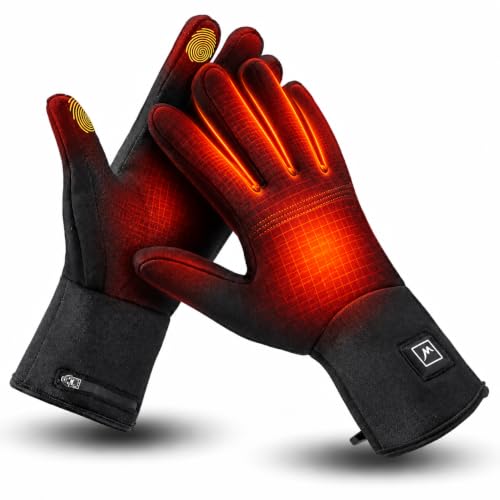
The best heated gloves for most people are waterproof, insulated gauntlet gloves with heat across the back of the hand and fingers, a removable 7.4-volt battery, and at least 2.5 hours of usable runtime on medium power.
That specification suits commuting, winter walking, spectator sports, and casual outdoor work. Riders and skiers may prefer slimmer gloves with better dexterity, while ice anglers and stationary winter photographers should prioritize maximum insulation, longer battery capacity, and heat that reaches the fingertips.
Our top picks


As an Amazon Associate we earn from qualifying purchases at no extra cost to you. Ratings are shown as listed on Amazon.
Best Heated Gloves by Cold-Weather Activity
Best for skiing and snowboarding: a low-profile heated ski glove
Choose a heated ski glove with a waterproof-breathable membrane, a long gauntlet cuff, pre-curved fingers, and heating elements on the back of the hand and along the fingers. The battery should sit in a cuff pocket rather than inside the palm. That placement reduces pressure when gripping poles and makes the glove less tiring during a full day on the mountain.
Models such as the Hestra Power Heater Gauntlet are aimed at this use. Their gauntlet construction and substantial insulation are better suited to lift rides and exposed chairlifts than short-cuff heated liners. However, bulky insulation reduces fine control, so snowboarders who frequently adjust bindings may prefer a thinner glove or heated liner under a waterproof shell.
Best for motorcycling: a heated motorcycle glove or liner
Motorcycle gloves need more than warmth. Look for hard knuckle protection, palm reinforcement, wrist retention, abrasion-resistant leather or textile, and compatibility with the motorcycle’s heated-clothing system. Battery-powered gloves are convenient for short trips, but wired gloves connected to a motorcycle harness can provide longer continuous heating.
Gerbing’s heated gloves and liners are well-known examples of the motorcycle-oriented approach. Check whether the model uses a dedicated 12-volt connection, a 7-volt battery system, or an included adapter. A glove designed for skiing should not be treated as motorcycle protective equipment unless its product documentation specifically says it meets the relevant protection standard.
Best for walking, commuting, and outdoor events: a waterproof 7.4-volt glove
For general winter use, prioritize balanced insulation and simple controls. Outdoor Research Prevail Heated Sensor Gloves are an example of this middle ground: they combine a winter glove format with touchscreen-compatible fingertips and rechargeable heating. The important buying details are not the brand name alone, but whether the heat reaches the fingers, whether the cuff seals over a jacket sleeve, and whether the battery compartment is accessible without removing the glove.
A medium-power runtime of roughly four to six hours is usually more useful than an impressive maximum-power figure. Maximum heat is valuable for warming cold hands, but it drains batteries quickly and may be unnecessary once the glove’s insulation has trapped body heat.
Best for fishing, hunting, and standing still: a heavily insulated heated gauntlet
Stationary activities create a different requirement. Walking generates warmth; sitting in a blind, boat, or ice-fishing shelter does not. Choose a roomy gauntlet with thick synthetic insulation, a waterproof shell, a wrist cinch, and enough space for a chemical hand warmer if permitted by the manufacturer.
Look for a battery of at least 3,000 mAh per glove or a high-capacity system with a documented low-setting runtime of eight hours or more. Bigger batteries add weight, but they are preferable to carrying a second pair of underpowered spare batteries in freezing conditions.
Head-to-Head: What Matters More Than Maximum Heat?
| Feature | Commuting and walking | Skiing and snowboarding | Motorcycling | Fishing, hunting, or winter photography |
|---|---|---|---|---|
| Useful insulation | Moderate synthetic insulation | Moderate to heavy | Moderate; avoid excessive bulk | Heavy insulation, ideally 100–200 g synthetic fill |
| Preferred heating coverage | Back of hand plus fingers | Back of hand and upper fingers | Back of hand and fingertips | Full back of hand, fingers, and thumb |
| Practical battery target | 2,500–3,000 mAh per glove | 2,500–3,000 mAh per glove | 7-volt battery or 12-volt vehicle connection | 3,000–5,000 mAh per glove |
| Runtime target | 4–6 hours on medium | 3–5 hours on medium | Continuous with vehicle power, or 2–5 hours on battery | 6–10 hours on low |
| Best battery location | Outer cuff pocket | Cuff pocket | Wrist or jacket pocket, away from grip | Large cuff pocket or jacket pocket |
| Waterproofing target | Water-resistant shell for light precipitation | Waterproof-breathable membrane | Waterproof membrane with sealed construction | Waterproof shell and durable palm |
These are buying targets rather than guarantees. Battery performance varies with temperature, hand size, selected heat level, battery age, and whether each glove has its own battery. A stated “up to” runtime normally refers to the lowest setting in relatively favorable conditions.
Heating Coverage: Fingers Beat a Hot Palm
Heating elements commonly run along the back of the hand and extend into the fingers. This arrangement warms blood vessels without placing rigid wiring in the main gripping area. Palm-only heating can feel powerful at first but may leave fingertips cold, especially when the glove is loose or the hand is exposed to wind.
Inspect product diagrams carefully. “Full hand heating” can mean different things: some gloves heat the back of every finger, while others heat only the back of the hand and the thumb. If your fingers are usually the first part to become uncomfortable, choose fingertip coverage over a higher advertised temperature.
Battery Life: A Useful Calculation
Suppose a pair uses two 2,600 mAh batteries and the manufacturer lists six hours on low, three hours on medium, and two hours on high. A six-hour outing should not be planned around the six-hour low-setting claim. Cold weather reduces available capacity, and raising the setting during a chairlift ride or rest stop consumes the reserve quickly.
A practical plan is to budget 25 percent less than the advertised figure. In this example, six hours becomes about 4.5 hours of dependable low-setting use. If you expect three hours outside, the pair is suitable; if you expect an eight-hour ice-fishing session, carry spare charged batteries or select a higher-capacity system.
Keep spare batteries inside an insulated pocket rather than an exterior backpack compartment. Do not charge batteries while they are wet, visibly damaged, or below the temperature range stated in the instructions.
Dexterity, Fit, and Battery Placement
Heated gloves should fit close enough to keep the heating elements near your skin, but not so tightly that insulation is compressed. Compressed insulation loses loft, and restricted fingers can feel colder. Measure the circumference of your dominant hand around the knuckles, excluding the thumb, then compare it with the manufacturer’s chart. If you are between sizes, consider the activity: a close fit favors motorcycle controls, while a little extra room favors thick liners and stationary use.
- Cuff battery pocket: the best general choice because it keeps weight away from the palm.
- Back-of-hand battery pocket: compact, but it can create pressure under ski poles or handlebars.
- Wrist battery pocket: convenient for some designs, though it may interfere with a tight jacket cuff.
- Jacket-powered system: excellent for long motorcycle or work sessions, but less convenient when moving between vehicles and buildings.
For dexterity, compare finger thickness, palm material, and closure design rather than relying on a touchscreen symbol. A thin leather or synthetic-leather palm generally gives better grip feedback than a heavily padded palm. A pre-curved pattern also reduces hand fatigue when holding poles, tools, or handlebars.
Waterproofing and Insulation Are Separate
Waterproofing prevents melting snow and rain from reaching the insulation; it does not automatically make a glove warm. Insulation slows heat loss, while the heating system replaces some of the heat that escapes. A thin waterproof heated shell may work well for active skiing but can feel cold during a long stationary period. Conversely, a very thick glove may be warm but too clumsy for controls.
Check for a waterproof-breathable membrane, a durable palm, sealed or well-protected seams, and a cuff that can be tightened. Water-resistant fabric is adequate for a short commute but is a poor choice for wet snow, falling rain, or repeated contact with ice.
Ownership Realities: What Wears Out First?
The palm and fingertips usually show wear before the heating elements fail. Repeated gripping, wet storage, and drying beside a heater can damage leather, coatings, adhesives, and wiring. Follow the care label: many heated gloves must be hand-washed, and the batteries must be removed before cleaning. Never machine-dry them unless the manufacturer explicitly permits it.
- Dry gloves at room temperature with the cuffs open; avoid radiators and high heat.
- Store batteries partly charged if the instructions recommend long-term storage at a reduced charge.
- Inspect cables where they enter the glove and battery pocket at the start of each season.
- Do not fold or sharply bend the heating zones while the gloves are wet.
- Expect replacement batteries to be a significant ownership cost; confirm that replacements are still available before buying.
For occasional use, a reliable 7-volt pair with replaceable batteries is usually the best value. Frequent users should consider a system with durable palm materials, accessible battery replacements, and a repair or warranty program. The warmest glove on its first outing is not necessarily the best heated glove if its battery is proprietary, its cuff leaks, or its palm cannot survive the activity.
Bottom Line
Choose fingertip heating and a cuff-mounted battery for skiing, balanced insulation and waterproofing for commuting, protective construction or vehicle power for motorcycling, and maximum battery capacity for stationary outdoor activities. Compare medium-setting runtime, not just maximum temperature, and select the smallest glove that fits without compressing its insulation. Those criteria will produce more dependable cold-weather comfort than choosing by heat setting or marketing claims alone.






Write Your Review
No reviews yet. Be the first to share your experience!