

Key takeaways
- Ages 4–7: 4 x 6 feet is a practical starting point. It suits close-range shooting, 3v3 games, and small yards.
- Ages 7–10: 6.5 x 12 feet or 6.5 x 18.5 feet provides a better target without requiring a full-size field.
- Ages 10–13: 7 x 16 feet is versatile for individual finishing, small-sided games, and goalkeeper work.
- Ages 13 and older: An 8 x 24-foot goal matches the standard full-size goal opening used in 11-a-side soccer. It needs substantial clearance and secure anchoring.
Best Soccer Goals for Backyard and Training
The best soccer goals depend first on the player’s age and playing space: choose a 4-by-6-foot goal for young children, a 6.5-by-12-foot or 7-by-16-foot goal for youth training, and an 8-by-24-foot goal only when older players have enough room for full-size shooting practice.
Quick picks by situation
| Situation | Best goal type | Recommended size | Why it fits | Typical price range |
|---|---|---|---|---|
| Young children, small yard | Pop-up or lightweight portable goal | 4 x 6 ft | Safe scale, quick setup, easy storage | $40–$120 per pair |
| Family backyard practice | Portable frame with reinforced net | 6.5 x 12 ft or 7 x 16 ft | Large enough for finishing and passing drills | $100–$300 |
| Frequent team training | Heavy-duty aluminum or steel portable goal | 7 x 16 ft or 8 x 24 ft | Better rebound consistency and longer service life | $300–$1,000+ |
| Limited storage or travel | Foldable pop-up goal | 4 x 6 ft or 6 x 12 ft | Folds into a carry bag and sets up in minutes | $50–$200 |
| Permanent backyard installation | Anchored steel or aluminum goal | 6.5 x 12 ft to 8 x 24 ft | Most stable for powerful shots and regular use | $500–$2,000+ |
Match the goal dimensions to the age group
A goal that is too large can make young players rely on aimless shooting, while one that is too small may frustrate older players and limit realistic finishing practice. The following sizes are useful buying benchmarks, although local leagues can use different dimensions.
Our top picks
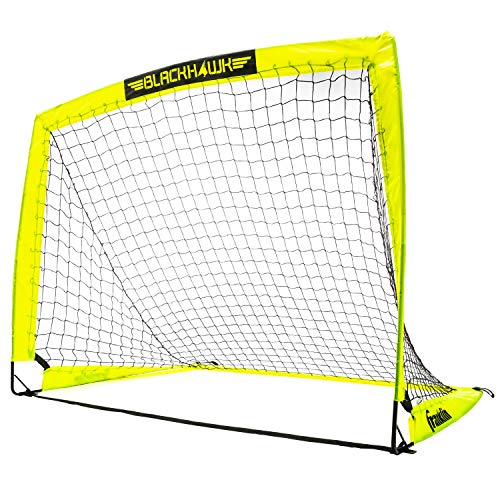


As an Amazon Associate we earn from qualifying purchases at no extra cost to you. Ratings are shown as listed on Amazon.
- Ages 4–7: 4 x 6 feet is a practical starting point. It suits close-range shooting, 3v3 games, and small yards.
- Ages 7–10: 6.5 x 12 feet or 6.5 x 18.5 feet provides a better target without requiring a full-size field.
- Ages 10–13: 7 x 16 feet is versatile for individual finishing, small-sided games, and goalkeeper work.
- Ages 13 and older: An 8 x 24-foot goal matches the standard full-size goal opening used in 11-a-side soccer. It needs substantial clearance and secure anchoring.
Measure the usable area before buying. Leave at least 6 feet behind a portable goal for net depth, movement, and safe retrieval of the ball. For powerful adult shooting, 10–15 feet behind the goal is more comfortable. Also check the height of fences, trees, windows, and neighboring property lines.
Head-to-head: pop-up, portable frame, or permanent goal?
Pop-up goals
Pop-up goals use flexible fiberglass or composite poles and a fabric or mesh body. Many can be assembled in under two minutes and folded into a compact bag. They are excellent for dribbling gates, passing exercises, travel, and young children.
The compromise is stability. A pop-up frame can move after a hard shot unless it has ground pegs, sandbag sleeves, or a weighted base. Its lighter net and fabric edges also tend to show wear first, particularly when the goal is dragged across rough ground or left folded while damp.
Portable framed goals
Portable framed goals usually use powder-coated steel, aluminum, or reinforced plastic connectors. They take approximately 5–20 minutes to assemble, depending on the joint system, but they provide a more defined crossbar, deeper net, and more predictable rebound.
Steel is usually the budget-friendly choice and resists flexing, but it is heavier and can eventually rust where paint is chipped. Aluminum is lighter and naturally corrosion-resistant, making it attractive for frequent movement or wet climates. Plastic frames are light and safe for children, but they can become brittle after prolonged ultraviolet exposure or freezing weather.
Permanent or semi-permanent goals
Anchored goals are the strongest option for repeated adult or team use. They may use ground sleeves, bolt-down plates, or large external ballast. Installation takes longer, and some systems require a level base or concrete, but the result is much less movement during shooting.
Do not confuse a heavy frame with a safe frame. Any goal can tip if it is not anchored according to the manufacturer’s instructions. A regulation-size goal with an unsecured net is a serious hazard, especially in wind.
Frame, net, and anchoring details that matter
- Frame tubing: Look for approximately 1.25–2-inch tubing on portable goals. Thicker steel adds stability but also weight. Aluminum frames offer a useful balance for households that move the goal often.
- Net material: A 2.5–3.5 mm polyethylene or polypropylene net is common for backyard use. Thicker 3.5–4 mm netting is preferable for frequent high-power shooting.
- Mesh size: Around 100 mm mesh works for normal soccer balls. Smaller mesh can reduce ball escape but adds material and wind resistance.
- Net attachment: Replaceable clips, hook-and-loop straps, or a rope channel are preferable to permanently sewn netting because the net is usually the first component to fail.
- Anchoring: Use every supplied ground stake. On hard ground, use weighted sandbags or a manufacturer-approved ballast system rather than improvised bricks that may create sharp edges.
Decision matrix: choose for your actual routine
| Your priority | Choose | Avoid |
|---|---|---|
| Lowest cost and occasional use | Small pop-up goal with included pegs | Large steel goal that takes up storage space |
| Weekly practice by children | 6.5 x 12 ft framed goal with replaceable net | Very thin fabric netting |
| Daily shooting or coaching | Reinforced 7 x 16 ft or 8 x 24 ft aluminum or steel goal | Lightweight pop-up construction |
| Small yard | 4 x 6 ft or foldable 6 x 12 ft goal | Full-size goal with a deep net |
| Frequent relocation | Aluminum frame with carry bag and quick-release joints | Heavy steel frame without wheels |
| Wet or coastal climate | Aluminum or well-coated steel with removable net | Uncoated steel left outdoors |
Setup and anchoring: a safer five-step routine
- Inspect the surface. Remove stones, holes, and branches. A goal on uneven ground is more likely to rock or twist.
- Assemble the frame flat. Confirm that every corner is fully seated before attaching the net. A partially engaged connector can fail when the ball strikes the frame.
- Attach the net without over-tensioning it. The net should hang naturally and have enough depth to absorb the ball. Excessive tension transfers more force to the frame and fasteners.
- Anchor the rear and sides. Place stakes through all designated points, angled away from the goal where appropriate. Add approved weights on hard surfaces.
- Push-test before play. Apply firm pressure to the crossbar and side posts. If the goal lifts, slides, or tips, do not use it until the anchoring is corrected.
Weather durability and ownership costs
Leaving a goal outside continuously is convenient but usually shortens its life. Sunlight weakens net fibers, rain promotes corrosion at scratches and bolt holes, and freezing temperatures can make plastic connectors brittle. After wet weather, remove or open the net so it can dry fully. Never store a damp net in its carry bag.
The net commonly wears before the frame. Inspect the top corners, bottom edge, side attachments, and areas where the ball repeatedly lands. Replacement nets are often less expensive than replacing the whole goal, but confirm the width, height, depth, attachment method, and tubing diameter before ordering.
For example, a $180 goal used twice a week for three years receives about 312 uses. That works out to roughly $0.58 per session before replacement parts. A $70 pop-up used only ten times per year for three years costs about $2.33 per session. The cheaper purchase is not automatically the lower-cost choice if the goal will become part of a regular training routine.
Clean metal frames with mild soap and water, dry them before storage, and touch up chipped steel promptly with suitable outdoor paint. Avoid dragging assembled goals, hanging from the crossbar, or using the net as a rebound trampoline. Those habits damage joints and net attachments faster than normal shooting.
Final buying recommendation
For most families, a 6.5 x 12 ft or 7 x 16 ft portable framed goal is the best middle ground: it offers realistic shooting space without the storage and anchoring demands of a full-size goal. Choose a 4 x 6 ft pop-up model when portability and a small yard matter most. Select an 8 x 24 ft heavy-duty goal only for older players, serious training, and a site that can accommodate reliable anchoring and generous clearance.





Write Your Review
No reviews yet. Be the first to share your experience!