

Key takeaways
- Draw warm water through the needle before marinade dries.
- Disassemble the needle, cap, barrel, plunger, and seal.
- Wash the bore with a narrow brush or the cleaning tool supplied with the injector.
- Flush the needle from both directions, especially after using herbs or pepper.
- Allow every part to dry separately before reassembly.
Best Meat Injectors
The best meat injector for most home cooks is a 2-ounce stainless-steel model with a 304-grade needle, a reliable threaded seal, and interchangeable needles for both thin brines and thicker marinades.
That specification matters more than a decorative handle or an oversized barrel. A good injector should draw liquid without excessive air, deliver it without leaking around the plunger, and come apart easily enough that marinade does not remain trapped behind the seal. The right choice depends on whether you inject occasional steaks, large holiday roasts, competition barbecue, or dense mixtures containing herbs and spices.
Our top picks
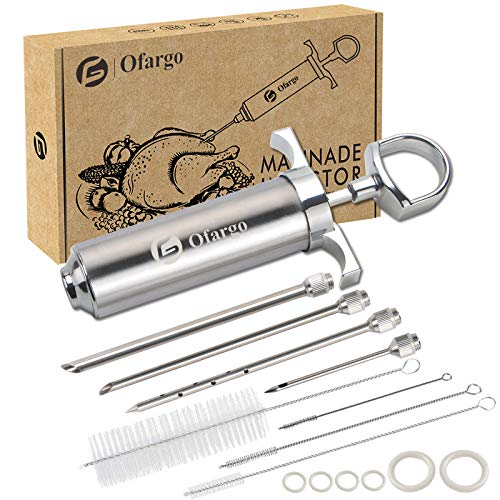


As an Amazon Associate we earn from qualifying purchases at no extra cost to you. Ratings are shown as listed on Amazon.
Best meat injectors by use case
| Best for | Recommended type | Useful capacity | Needle setup | Typical market range |
|---|---|---|---|---|
| Occasional home use | Basic stainless-steel syringe | 1–2 oz | One 1.5–2 mm needle | $10–$20 |
| Regular barbecue cooking | Heavy-duty 304 stainless injector | 2–4 oz | Fine and wide-gauge needles | $20–$45 |
| Thick marinades and chunky mixtures | Large-bore injector | 2–4 oz | 2.5–3 mm needle, removable cap | $25–$60 |
| Whole briskets and catering | Multi-needle or commercial injector | 4–6 oz | Replaceable stainless needles | $50–$150+ |
What separates a good injector from a frustrating one?
Needle size and internal opening
Needle length is less important than the size of the opening. A 1.5–2 mm needle is suitable for clear brines, melted butter, thin stock, wine-based marinades, and strained sauces. It creates relatively small punctures and is the best general-purpose option for poultry and lean pork.
A 2.5–3 mm opening handles minced garlic, finely chopped herbs, pepper flakes, and thicker barbecue marinades. It also empties faster, but produces larger injection channels and is more likely to clog if the mixture has coarse ingredients. A multi-hole needle distributes liquid over a wider area, while a single side-opening needle is easier to clear when blocked.
Needle threads are a common failure point. Look for a fully threaded stainless connection rather than a needle that merely presses into plastic. A spare needle is valuable because a bent tip or lost gasket can otherwise make the entire injector unusable.
Capacity: larger is not always better
A 1-ounce barrel is nimble for steaks and chicken breasts, but you will refill it frequently when working on a pork shoulder. A 2-ounce barrel is the practical middle ground: it is light enough to control and large enough for most roasts. Four ounces reduces refills, but the increased weight becomes tiring when the plunger is full and the food is cold or firm.
Capacity also affects accuracy. With a 2-ounce injector, one full draw can be divided into four half-ounce placements. That makes it easier to distribute a known amount evenly rather than flooding one section of meat.
Seal quality and plunger control
The seal should glide with firm, even resistance. If it moves with almost no resistance, liquid and air can bypass it. If it sticks, the injector may suddenly release a large pocket of marinade. Silicone or food-safe rubber seals are preferable to a bare plastic plunger, provided the seal can be removed for washing and replaced when swollen or cracked.
Check the connection between barrel, cap, and needle. An O-ring at the barrel-to-cap joint helps prevent leakage, while a wide flange on the plunger gives better control with wet or greasy hands. Metal construction improves durability, but the seal—not the barrel—is usually the first component to wear.
Thin brines versus thick marinades
| Marinade | Recommended needle | Preparation | Likely problem with a fine needle |
|---|---|---|---|
| Salt brine or stock | 1.5–2 mm | Use as-is; strain only if spices are large | Minimal; avoid injecting air |
| Melted butter and herbs | 2–2.5 mm | Keep warm and whisked, not hot | Butter solidifies and blocks the opening |
| Thin barbecue sauce | 2–2.5 mm | Thin slightly with stock if needed | Slow draw and difficult cleaning |
| Garlic, pepper, and herb marinade | 2.5–3 mm | Finely mince and remove hard stems | Frequent clogging |
| Very thick paste | Not recommended | Loosen with liquid or apply externally | Plunger leakage or needle blockage |
Do not assume a large needle makes every marinade injectable. A paste can overwhelm the seal, while an emulsion may separate during repeated refills. For a chunky marinade, strain the liquid into the injector and apply the solids to the surface, or mince them until they can pass freely through the opening.
Cleaning difficulty and ownership costs
The easiest injector to maintain has a removable needle, a detachable end cap, and a seal that can be taken off without tools. A one-piece plastic syringe may be inexpensive, but trapped fat and seasoning are difficult to inspect. Stainless steel is more durable and less likely to retain odors, although it still needs immediate rinsing after use.
A reliable cleaning sequence is:
- Draw warm water through the needle before marinade dries.
- Disassemble the needle, cap, barrel, plunger, and seal.
- Wash the bore with a narrow brush or the cleaning tool supplied with the injector.
- Flush the needle from both directions, especially after using herbs or pepper.
- Allow every part to dry separately before reassembly.
As a practical ownership calculation, an injector costing $30 and used twice per month for three years costs about $0.42 per use before replacement seals or needles. A $12 model used only four times per year for three years costs about $1 per use. The cheaper option is sensible for occasional cooks, but a replaceable-seal design can be better value for frequent barbecue.
Needle and capacity decision matrix
| Your situation | Choose | Avoid | Reason |
|---|---|---|---|
| Small kitchen, occasional chicken | 1–2 oz compact injector | 4 oz commercial barrel | Less storage space and easier control |
| Weekly pork shoulder or brisket | 2–4 oz stainless model | Thin disposable plastic | Fewer refills and better durability |
| Mostly clear brines | 1.5–2 mm needle | Oversized multi-hole needle | Smaller punctures and cleaner distribution |
| Herb-heavy marinades | 2.5–3 mm removable needle | Permanent fine needle | Lower clogging risk and easier flushing |
| Limited hand strength | 2 oz barrel with broad plunger flange | Large high-resistance injector | Requires less force and gives better control |
How to inject without creating wet spots
Warm the marinade enough to keep butter fluid, but never fill the injector with a dangerously hot liquid. Draw slowly with the needle submerged to reduce air bubbles. Insert the needle deep into the meat, begin pressing as you withdraw, and stop before the tip reaches the surface. Space injections in a rough grid rather than concentrating them in one location.
For a 5-pound roast, a useful starting point is 4–6 ounces of liquid, divided into 12–20 small injections. That is not a universal recipe: lean meat may need less, while a large brisket can accept more. If liquid spurts back out, the hole may be too shallow, the needle too large, or the injection rate too fast.
Common mistakes to avoid
- Using an ultra-fine needle with unstrained herbs or garlic.
- Leaving the injector assembled overnight with salty or acidic liquid inside.
- Forcing the plunger after a blockage, which can rupture the seal.
- Choosing capacity by size alone and ending up with a barrel that is awkward to control.
- Putting a metal injector in a dishwasher without checking the manufacturer’s care instructions; seals and finishes may degrade.
For most cooks, the strongest all-round choice is a 2-ounce 304 stainless-steel injector supplied with a fine needle and a 2.5–3 mm large-bore needle. Choose a compact 1-ounce model when storage and occasional use matter most, or step up to a 4-ounce commercial-style injector when you regularly prepare large roasts and value fewer refills over light handling.
Write Your Review
No reviews yet. Be the first to share your experience!