

Key takeaways
- Buying by seat width alone: Arms, side tables, and frame legs determine the actual footprint.
- Using an airtight cover on wet cushions: This traps moisture. Dry the cushions first and use a breathable cover sized for the furniture.
- Leaving cushions on the ground: Ground contact slows drying and increases exposure to dirt and insects. Store them vertically or on a ventilated rack.
- Ignoring wind: Lightweight aluminum is convenient but may move or tip. Position it against a wall, use approved anchoring, or choose a heavier frame where appropriate.
- Cleaning with aggressive chemicals: Bleach, solvents, and abrasive pads can damage finishes and weaken fabric. Start with mild soap, water, and a soft brush.
- Skipping hardware checks: Loose bolts create movement that stresses joints. Tighten fasteners periodically without overtightening or stripping them.
Best Outdoor Loveseats
The best outdoor loveseat is the one that leaves enough clearance for your space, uses a frame suited to your weather, and has removable cushions with quick-drying, solution-dyed fabric rather than simply the thickest padding.
Best Outdoor Loveseat Picks by Situation
| Outdoor situation | Best loveseat type | Useful dimensions | Preferred materials | Typical market range |
|---|---|---|---|---|
| Small apartment balcony | Compact two-seat loveseat | 42–50 in wide, 26–31 in deep | Powder-coated aluminum or resin wicker over aluminum | $180–$450 |
| Standard patio | Deep-seat conversation loveseat | 52–62 in wide, 30–36 in deep | Aluminum, teak, or coated steel | $350–$900 |
| Covered porch or screened room | Upholstered outdoor loveseat | 55–68 in wide, 32–38 in deep | Aluminum or hardwood with outdoor fabric | $500–$1,300 |
| Windy or coastal location | Low-profile, corrosion-resistant loveseat | 48–60 in wide, 28–34 in deep | Marine-grade aluminum, stainless hardware, solution-dyed fabric | $450–$1,200 |
| Frequent entertaining | Wide, high-capacity loveseat | 58–70 in wide, 32–38 in deep | Reinforced aluminum or treated hardwood | $600–$1,500 |
These are broad buying ranges rather than fixed prices. Freight, cushions, premium timber, and custom fabrics can move the final cost substantially.
Our top picks
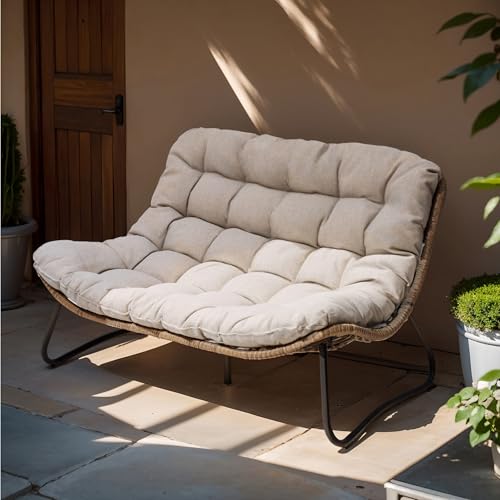


As an Amazon Associate we earn from qualifying purchases at no extra cost to you. Ratings are shown as listed on Amazon.
Best for Small Balconies: Compact Aluminum Loveseat
A balcony loveseat should be selected by its footprint first. A compact model around 44 to 50 inches wide and no more than 30 inches deep is usually easier to position without blocking a door or reducing the usable walking route.
Powder-coated aluminum is a strong choice because it resists rust and is relatively easy to move. Resin wicker can add visual warmth, but check that it is woven over an aluminum frame. Wicker itself is not the structural component, and low-quality strands may become brittle after repeated ultraviolet exposure.
Measure the balcony’s clear width, then allow at least 24 inches for a comfortable passage. For example, on a 90-inch-wide balcony, a 48-inch loveseat leaves 42 inches. If a coffee table takes 18 inches of that space, the remaining 24 inches is just enough for a practical route. A deeper 36-inch loveseat would make the arrangement feel cramped even if it technically fits.
Best for Patios: Deep-Seat Loveseat with Replaceable Cushions
For a typical patio, a 54- to 62-inch loveseat provides more comfortable seating for two adults without approaching the footprint of a small sofa. Seat depth matters: around 20 to 24 inches of usable cushion depth suits upright conversation, while 25 to 28 inches creates a more relaxed lounging position.
Look for a seat height of approximately 16 to 19 inches, measured from the ground to the top of the compressed cushion. Very low seats can be difficult to stand from, while tall seats may feel less relaxed and can make a low patio table awkward to use.
Replaceable cushions are worth prioritizing. Outdoor furniture is exposed to abrasion, pollen, spills, and ultraviolet light; the cushion cover is commonly the first visible part to deteriorate. A loveseat with replaceable covers or separately available cushions can remain useful after the original fabric fades.
Best for Covered Outdoor Spaces: Cushioned Hardwood or Upholstered Aluminum
Covered porches and screened rooms offer more flexibility because rain and direct sunlight are reduced, but they are not automatically climate-controlled. Humidity can still encourage mildew, and wind-driven rain can reach furniture near the edge of the covering.
Teak and other properly treated hardwoods provide a substantial appearance and can last for years with regular care. They are heavier than aluminum, which is helpful in windy locations but inconvenient when furniture needs to be moved. Check whether the timber is intended for outdoor use and whether the hardware is stainless steel or corrosion-resistant.
For a softer, more upholstered look, choose an aluminum frame with outdoor-rated fabric. In a covered space, you can use thicker cushions, but breathable construction still matters. A cushion that remains damp beneath a waterproof cover may develop odors more quickly than one that is allowed to dry.
Material Comparison: What Actually Wears Out?
| Material or feature | Advantages | Weak point | Maintenance expectation |
|---|---|---|---|
| Powder-coated aluminum | Light, rust-resistant, easy to clean | Can dent; hollow frames may shift in strong wind | Wash every few months; inspect chips and fasteners |
| Steel | Strong and often less expensive | Scratches can expose the metal to rust | Dry thoroughly; touch up damaged coating promptly |
| Teak or treated hardwood | Heavy, attractive, stable, repairable | Can crack, discolor, or develop mildew | Clean periodically; oil only when the care instructions call for it |
| Resin wicker | Lightweight and visually textured | Cheap strands may split or fade | Use a soft brush; avoid harsh solvents and abrasive tools |
| Solution-dyed acrylic fabric | Good color retention and outdoor suitability | Still vulnerable to grime, abrasion, and prolonged dampness | Brush off debris; wash according to the fabric instructions |
| Quick-dry foam | Drains more effectively than conventional foam | Usually costs more and is not waterproof in every situation | Stand cushions on edge after rain; allow airflow |
How to Match Loveseat Dimensions to Your Space
-
Measure the access route. Record the narrowest door, stairway, gate, and elevator opening. A loveseat that fits the patio may not fit through a 30-inch doorway once packaging and angled turns are considered.
-
Measure the usable area. Exclude door swings, drainage channels, grills, and areas needed to open storage boxes. Use the loveseat’s full outside dimensions, not just the listed seat width.
-
Add circulation space. Allow about 24 inches for a basic walkway and 30 to 36 inches where people frequently pass behind seated guests.
-
Check table clearance. A low table generally needs roughly 12 to 18 inches between its edge and the loveseat. More space is useful if the loveseat has a deep seat or thick arms.
-
Confirm weight capacity. A two-person loveseat should ideally support at least 500 pounds, with a higher rating preferable for frequent use or guests. Do not confuse total capacity with the recommended capacity per seat.
Cushion Durability: The Detail That Determines Ownership Cost
Thick cushions are not automatically more durable. Density, drainage, stitching, fabric quality, and the ability to replace covers matter more than height alone. A 5-inch cushion with a washable cover and quick-dry interior can be a better long-term choice than a 7-inch cushion that stays wet and cannot be repaired.
Inspect the seams and closures. Zippers should be protected from direct exposure where possible, and the cover should fit tightly enough that it does not bunch under normal use. Ties or anti-slip panels help prevent cushions from sliding, particularly on smooth metal or wood seats.
Consider how often the loveseat will be used. If it is used twice a month, removable cushions that can be stored may be sufficient. If it is used daily, prioritize solution-dyed fabric, replaceable covers, reinforced corners, and foam designed for outdoor drainage.
Common Outdoor Loveseat Mistakes
- Buying by seat width alone: Arms, side tables, and frame legs determine the actual footprint.
- Using an airtight cover on wet cushions: This traps moisture. Dry the cushions first and use a breathable cover sized for the furniture.
- Leaving cushions on the ground: Ground contact slows drying and increases exposure to dirt and insects. Store them vertically or on a ventilated rack.
- Ignoring wind: Lightweight aluminum is convenient but may move or tip. Position it against a wall, use approved anchoring, or choose a heavier frame where appropriate.
- Cleaning with aggressive chemicals: Bleach, solvents, and abrasive pads can damage finishes and weaken fabric. Start with mild soap, water, and a soft brush.
- Skipping hardware checks: Loose bolts create movement that stresses joints. Tighten fasteners periodically without overtightening or stripping them.
Bottom Line
Choose a compact aluminum loveseat for a tight balcony, a 54- to 62-inch deep-seat model for a general patio, and a hardwood or upholstered aluminum design for a protected porch. Across all three settings, the most valuable long-term features are weather-appropriate framing, corrosion-resistant hardware, removable solution-dyed covers, quick-draining cushions, and dimensions that preserve a usable walkway. Spend less on decorative thickness and more on components you can clean, replace, or repair.

Write Your Review
No reviews yet. Be the first to share your experience!