

Key takeaways
- Advantages: lower price, faster installation, broad availability, and easier replacement.
- Drawbacks: visible wrinkles, shifting at the corners, possible seam strain, and a less tailored appearance.
- Best for: renters, occasional use, older upholstery, and shoppers who want washable protection without commissioning a cover.
The best sectional slipcovers are the ones that match your sofa’s exact configuration, leave enough fabric for a clean tuck, and use a fastening system that can survive repeated sitting, washing, and pet traffic.
Our top picks
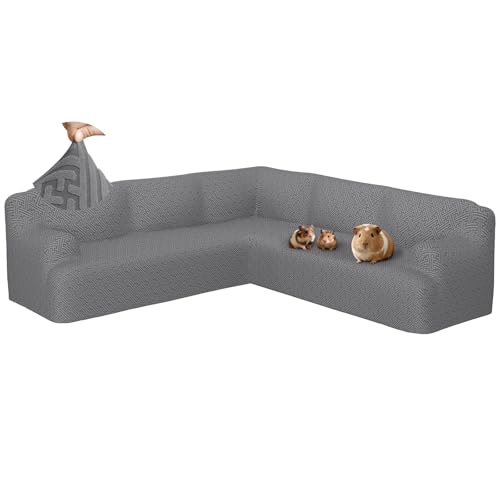

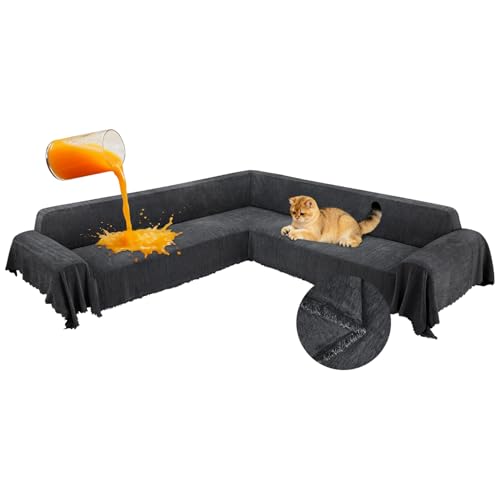
As an Amazon Associate we earn from qualifying purchases at no extra cost to you. Ratings are shown as listed on Amazon.
Best sectional slipcovers by shopping situation
| Situation | Best choice | What to prioritize | Typical market range |
|---|---|---|---|
| Lowest-cost refresh | One-piece stretch cover | Polyester-spandex blend, elastic hem, foam tuckers | $40–$120 |
| Chaise sectional with different seat depths | Separate seat and chaise covers | Piece-by-piece sizing and labeled installation | $90–$250 |
| Frequent washing or children | Machine-washable modular set | Removable cushion covers, concealed zippers, spare sets | $180–$500 |
| Dogs, cats, or heavy daily use | Dense woven or performance fabric cover | Snag resistance, tightly woven surface, reinforced seams | $150–$450 |
| Unusual modular layout | Custom-made fitted slipcover | Individual measurements, fabric samples, configuration approval | $500–$1,500+ |
Stretch covers from brands such as SureFit can be practical for a quick, budget-conscious update, especially when the sectional has conventional proportions. Custom-cover companies such as Comfort Works are more suitable when the sofa has unusually deep cushions, exposed wood, a low platform, or modules that cannot be covered neatly with a universal set. The right answer depends less on the brand name than on how accurately the cover matches your sectional’s geometry.
Stretch versus custom: the head-to-head decision
Stretch fabric covers
Most universal sectional covers use polyester, elastane, or a similar two-way or four-way stretch blend. They are forgiving of small measurement errors and can cover several sofa shapes with one product. A four-way stretch fabric generally conforms better around rounded arms and loose back cushions than a thin, nonstretch throw.
- Advantages: lower price, faster installation, broad availability, and easier replacement.
- Drawbacks: visible wrinkles, shifting at the corners, possible seam strain, and a less tailored appearance.
- Best for: renters, occasional use, older upholstery, and shoppers who want washable protection without commissioning a cover.
Custom or semi-custom covers
Custom covers are cut for the sofa’s individual pieces rather than relying on a broad size range. They usually provide a cleaner fit around the arms, back, deck, and cushion corners. Depending on the maker, you may choose separate covers for the frame, loose cushions, chaise cushion, and ottoman.
- Advantages: better alignment, fewer exposed gaps, more fabric choices, and a more permanent appearance.
- Drawbacks: higher cost, longer production time, and less tolerance for inaccurate measurements.
- Best for: expensive sectionals, unusual layouts, long-term ownership, and rooms where appearance matters as much as protection.
A fitted cover is not automatically more durable. A poorly chosen delicate fabric can wear faster than a well-installed universal cover made from dense polyester. Ask for a fabric swatch and inspect its weave, underside, stretch recovery, and washing instructions before ordering.
How to measure a chaise sectional correctly
Do not measure only the front width and assume the result applies to the entire sectional. Chaise and modular designs need a piece-by-piece inventory.
- Separate the modules. Identify the left-arm seat, armless seats, right-arm seat, corner wedge, chaise, ottoman, and any removable back cushions.
- Measure overall width. With the sectional assembled, measure from the outside edge of one arm to the outside edge of the other. Record the chaise extension separately.
- Measure each frame. For every module, record outside width, front-to-back depth, and height from the floor to the highest fixed point.
- Measure the cushions. Record width, depth, and thickness while the cushion is lying flat. Do not compress it while measuring.
- Check the arms. Measure arm width and height. A broad rolled arm can consume several inches of usable cover fabric.
- Record connections. Note whether modules use clips, brackets, hook-and-loop strips, or simply sit together. A cover can interfere with connectors if its skirt is too thick.
- Compare with the manufacturer’s range. Choose by each component’s dimensions, not merely by the combined sectional width.
For example, suppose a sectional has a 38-inch armless seat, a 38-inch corner seat, and a 42-inch chaise. The frame width totals 118 inches, but the chaise depth may be 65 inches while the other modules are only 38 inches deep. A “sofa up to 120 inches” cover may fit the width and still fail at the chaise. That is why modular sets or separate chaise covers are often the safer choice.
Fastening systems: what keeps a cover in place?
Fastening is the difference between a cover that stays tidy and one that needs daily adjustment. Look for a system suited to the sofa’s construction.
- Elastic hems: useful around the lower perimeter, but weak if the sofa has a very open underside or tapered legs.
- Foam or plastic tuck rods: inexpensive and effective in the gaps between the seat, arms, and back. They need to be pushed deeply enough that normal sitting does not pull them out.
- Hook-and-loop straps: helpful beneath cushions and around individual modules, although exposed sections can collect lint.
- Ties: adjustable and useful on loose, boxy furniture, but more visible and easier for pets or children to loosen.
- Zippers: the cleanest option for separate cushion covers. Check that the zipper is covered and positioned away from the area where people sit.
- Anti-slip backing: useful on seat pads, but it cannot compensate for an incorrectly sized frame cover.
For a frequently used sectional, separate cushion covers plus an elasticized frame cover usually offer a better balance than one giant cover. Individual pieces can be removed, washed, and reinstalled without dismantling the entire sofa.
Pet resistance and fabric durability
Pet-friendly does not mean claw-proof. Cats can snag nearly any looped or loosely woven textile, while dogs tend to create wear at the front edge of seat cushions, arm corners, and chaise entry points.
- Choose a tight, smooth weave over chenille, bouclé, or open-loop fabric if snagging is a concern.
- Favor medium shades or subtle patterns that disguise hair and small marks.
- Check whether the cover has reinforced seams at corners and zipper ends.
- Avoid relying on water resistance alone; a coated surface may resist spills but feel stiff and may lose performance after washing.
- Use a washable throw on the pet’s preferred spot rather than expecting the main cover to absorb every abrasion.
What usually wears first is not the middle of the backrest. It is the front edge of the seat, the inside corner of the chaise, the arm where a person rests an elbow, and the hem that rubs against the floor. If these areas receive constant use, buy a spare cushion cover or choose a set with replaceable components.
Washability and ownership costs
“Machine washable” still requires checking the full care label. Some covers can be washed but must be air-dried; high heat can shrink a fitted panel enough to make reinstallation difficult.
- Wash in cold or lukewarm water unless the label specifies otherwise.
- Close zippers and hook-and-loop fasteners before laundering.
- Wash dark colors separately during the first few cycles.
- Do not leave a damp cover crumpled in the machine.
- Reinstall while slightly damp only when the manufacturer permits it; otherwise dry completely to avoid odor and mildew.
Consider cost per use rather than purchase price alone. A $90 cover used once a week for two years costs about $0.87 per use before replacement. A $300 modular set used four times a week for three years costs about $0.48 per use. The more often the sectional is occupied or washed, the more value there is in durable fabric, replaceable pieces, and a fastening system that reduces daily adjustment.
Common buying mistakes
- Ordering by total width while ignoring chaise depth and cushion thickness.
- Assuming a sectional cover includes a corner wedge, ottoman, or recliner section.
- Choosing a loose throw when the goal is protection from pet hair and spills.
- Measuring over bulky blankets or decorative pillows.
- Ignoring the sofa’s underside and discovering that the hem blocks reclining mechanisms or modular connectors.
- Buying a very pale cover without confirming whether it can tolerate frequent washing.
- Removing the original upholstery before confirming that the new cover fits.
Bottom line
For a standard chaise sectional and a limited budget, start with a four-way stretch cover that includes tuck rods and a strong elastic hem. For a household that washes covers often, choose a modular set with separate cushion covers and concealed zippers. For pets, prioritize a dense, smooth weave and reinforced high-wear areas rather than marketing claims alone. When the sectional has mismatched depths, unusual modules, or valuable upholstery, a custom or semi-custom cover is usually the best sectional slipcover investment because accurate measurements matter more than a one-size-fits-most label.

Write Your Review
No reviews yet. Be the first to share your experience!