

Key takeaways
- Mirror polish: Bright and formal, but it shows fingerprints and fine scratches more readily.
- Satin or brushed finish: Hides small marks and water spots better, making it a strong daily-use choice.
- Matte finish: Modern-looking, but some textured surfaces hold food residue if the pattern is deep.
- Black, gold, or colored finish: Usually relies on a surface coating. It can wear at the edges, especially where knives contact plates.
Best Silverware Sets for Everyday Dining
The best silverware sets for everyday dining are usually 18/10 stainless-steel sets with balanced handles, a practical 16- to 20-piece place setting, and a finish that remains easy to clean after repeated dishwasher cycles.
For most households, choose a 20-piece set serving four people: four dinner forks, four salad forks, four dinner knives, four soup or dessert spoons, and four teaspoons. A two-person household that entertains occasionally may get better value from a 30- or 40-piece set serving six to eight, while a large family should buy at least 45 pieces serving eight or more so a dishwasher delay does not leave the cutlery drawer empty.
Our top picks
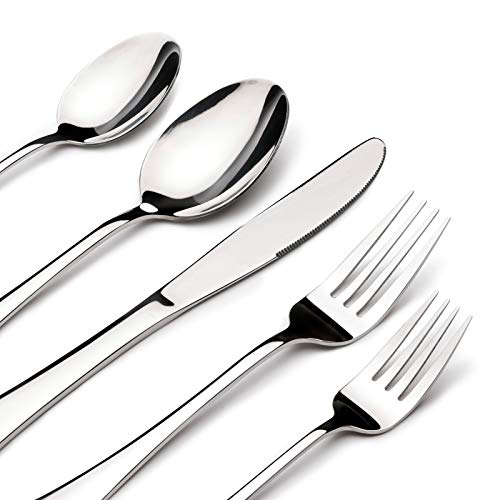


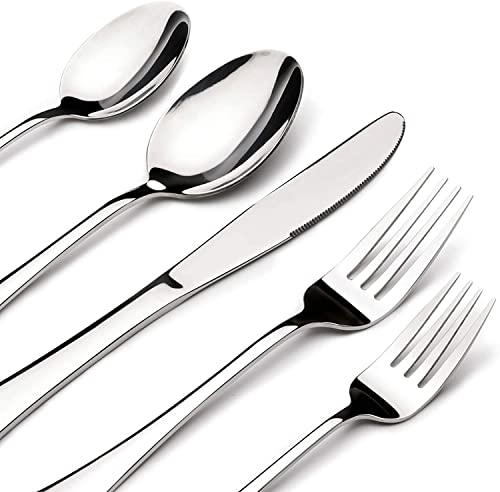
As an Amazon Associate we earn from qualifying purchases at no extra cost to you. Ratings are shown as listed on Amazon.
Quick comparison: what matters most
| Set type | Typical place settings | Steel grade | Typical piece weight | Best for | Usual market range |
|---|---|---|---|---|---|
| Basic everyday set | 4 to 6 | 18/0 or 18/10 | 35–55 g per fork | Budget-conscious homes and rentals | $20–$60 |
| Mid-range 18/10 set | 6 to 8 | 18/10 | 50–75 g per fork | Daily family use | $60–$160 |
| Heavy-gauge contemporary set | 4 to 8 | 18/10, often 2.5–3.5 mm thick | 70–100 g per fork | People who prefer substantial, restaurant-style cutlery | $120–$300 |
| Colored or mirror-finish set | 4 to 8 | Usually 18/0 or 18/10 with coating | 40–80 g per fork | Decorative tables and occasional use | $40–$220 |
These are useful buying ranges rather than guarantees for every brand. Weight varies by piece shape, and a knife is normally much heavier than a teaspoon.
Best choice for most households: balanced 18/10 stainless steel
18/10 stainless steel is the strongest all-round recommendation. The first number refers to approximately 18% chromium and the second to approximately 10% nickel. Chromium helps resist corrosion, while nickel improves resistance to staining and gives the steel a brighter, less gray appearance.
Look for a set in which the fork and spoon feel neither top-heavy nor blade-heavy. Hold a fork by the end of its handle, or balance it across one finger near the handle transition. The center of gravity should sit close to the middle of the handle rather than pulling sharply toward the tines. A gently rounded handle is usually more comfortable for long meals than a very thin, sharply edged design.
Brands such as Oneida, Zwilling, Henckels, WMF, Robert Welch, Viners, and IKEA offer widely available stainless-steel ranges, but the collection matters more than the logo. Within the same brand, an entry-level 18/0 line and a heavier 18/10 line can feel completely different.
Best budget option: 18/0 stainless steel with a plain finish
18/0 steel contains chromium but little or no nickel. It can still be perfectly serviceable for everyday dining, particularly when the set has a good shape and a plain polished or satin finish. It is generally less expensive and may suit a starter kitchen, student accommodation, holiday home, or household that expects cutlery to disappear into a busy dishwasher cycle.
The trade-off is appearance and stain resistance. 18/0 pieces may show water marks, tea discoloration, or small surface scratches sooner than good 18/10 pieces. They can also feel lighter because many budget sets use thinner stock. Avoid judging quality from steel grade alone: a well-designed medium-weight 18/0 set can be more pleasant than a poorly balanced 18/10 set.
Best for large families: larger sets with replacement availability
For four people eating three meals at home, a 20-piece set provides only one complete place setting per person. After breakfast and lunch, or after one dishwasher load is delayed, that becomes inconvenient. A better calculation is:
Required place settings = household members + settings needed between washes.
For a family of four running the dishwasher every other day, six place settings provide a useful buffer. Six settings normally mean at least 24 individual eating pieces, although a 30- or 45-piece set may include serving spoons and extra knives.
Check whether the manufacturer sells open-stock replacements or individual pieces. Losing one teaspoon should not force you to replace an entire set. This matters more than decorative packaging, especially when children use the cutlery daily.
Best for entertaining: 45- to 65-piece sets
When the household regularly serves eight or more people, prioritize quantity and matching serving pieces. A practical 45-piece set often includes service for eight plus a serving spoon, slotted serving spoon, serving fork, and butter knife. Some larger sets serve twelve and include several additional serving utensils.
Before buying, count the actual table pieces. “45 pieces” may include only four place settings plus a large collection of serving tools, which is less useful if you need dinner forks for ten guests. For occasional entertaining, matching dessert spoons and extra teaspoons are often more valuable than specialized pieces such as seafood forks.
Finish durability: mirror, satin, matte, and colored coatings
- Mirror polish: Bright and formal, but it shows fingerprints and fine scratches more readily.
- Satin or brushed finish: Hides small marks and water spots better, making it a strong daily-use choice.
- Matte finish: Modern-looking, but some textured surfaces hold food residue if the pattern is deep.
- Black, gold, or colored finish: Usually relies on a surface coating. It can wear at the edges, especially where knives contact plates.
For maximum dishwasher longevity, plain uncoated stainless steel is the safest choice. If you prefer colored cutlery, treat it as a finish requiring more care rather than assuming it has the same durability as bare steel. Do not leave coated pieces in salty water or contact with strong detergents for extended periods.
Dishwasher performance and the mistakes that cause damage
Most stainless-steel sets are labeled dishwasher-safe, but “dishwasher-safe” does not mean immune to every cleaning condition. Place knives with blades facing downward only if the basket design makes this safe, and keep pieces separated enough for water to reach all surfaces. Remove cutlery soon after the cycle finishes if your machine leaves pooled water.
Common causes of discoloration include prolonged contact with tomato sauce, mustard, salt, acidic food, and detergent residue. Do not soak stainless steel overnight in bleach or chlorine-based cleaners. Avoid mixing stainless-steel cutlery with silver-plated pieces in the same load, because chemical reactions can cause discoloration. Wooden-handled, hollow-handled, or glued decorative pieces may require hand washing even when the metal portion itself is dishwasher-safe.
For cloudy marks, wash with a mild detergent and dry thoroughly. A soft cloth with diluted white vinegar can help remove mineral film, but rinse afterward and follow the manufacturer’s care instructions. Never use steel wool: it can embed particles that later rust on the surface.
Decision matrix: match the set to your household
| Your situation | Recommended specification | Why |
|---|---|---|
| One or two people, limited drawer space | 16–20 pieces, compact handles, 18/10 or good 18/0 | Enough for daily use without storing redundant serving pieces |
| Family of four, frequent dishwasher use | 30–45 pieces, 18/10, replacement pieces available | Provides a buffer between wash cycles |
| Frequent dinner guests | 45–65 pieces, service for 8–12, matching serving utensils | Prevents mismatched pieces and shortages at the table |
| Children or heavy daily use | Plain satin finish, medium weight, no fragile coating | Conceals scratches and tolerates routine cleaning better |
| Formal table setting | Heavier 18/10 set, mirror finish, separate serving set | Creates a more substantial and polished presentation |
What to inspect before purchasing
Lay the pieces side by side in a showroom or compare the dimensions listed by the manufacturer. Dinner forks commonly measure about 19–21 cm, teaspoons about 13–15 cm, and dinner knives about 22–24 cm. Very short handles may feel cramped for adults, while oversized pieces can crowd a narrow cutlery tray.
Check the fork tines for even spacing and smooth edges. Run a finger carefully along the handle—not the knife edge—to find sharp seams or stamping marks. Examine the knife spine and handle joint, where low-cost construction can feel rough. A set that is 10% more expensive but has smoother edges and replacement availability may cost less over years of use than a cheaper set that must be discarded after several lost or damaged pieces.
Final verdict
Choose an uncoated, satin-finish 18/10 set with medium-heavy pieces if you want the best balance of corrosion resistance, comfort, dishwasher practicality, and long-term appearance. Choose 18/0 when price and basic function matter most, and choose a larger 45- to 65-piece set when your household entertains or runs out of clean cutlery between dishwasher cycles. The most important specifications are not the box design or the piece count alone: confirm the number of complete place settings, the handle balance, the finish type, and whether replacements are available.

Write Your Review
No reviews yet. Be the first to share your experience!