

Key takeaways
- Choose an 8-inch folding knee scooter for compact indoor mobility, the KneeRover PRO for a balanced everyday option, and the KneeRover All Terrain when rough outdoor surfaces and extra capacity justify additional weight. Fit and braking control should take priority over baskets, cosmetic features and…
The best knee scooters for most users are the Drive Medical DV8 for everyday indoor use, the KneeRover PRO for a lighter all-purpose option, and the KneeRover All Terrain when uneven outdoor surfaces matter more than compact storage.
A knee scooter, also called a knee walker, is a mobility aid for keeping weight off one lower leg while allowing the other leg to propel and steer. The right choice depends less on the seat or basket and more on six practical details: weight capacity, turning radius, braking control, knee-pad fit, wheel size, and how well the frame handles your usual surfaces.
Our top picks
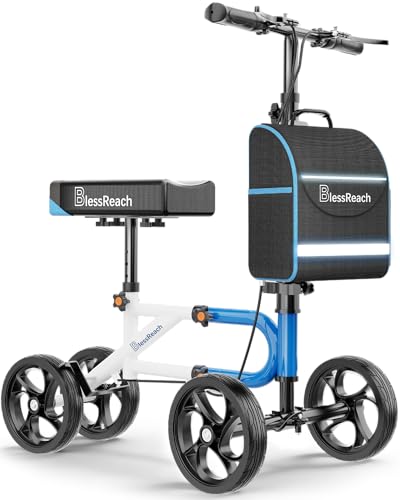


As an Amazon Associate we earn from qualifying purchases at no extra cost to you. Ratings are shown as listed on Amazon.
Best knee scooters compared
| Model or type | Approx. scooter weight | Weight limit | Wheel setup | Best use | Folding/storage |
|---|---|---|---|---|---|
| Drive Medical DV8 Aluminum Steerable Knee Walker | About 22 lb | 300 lb | 8-inch front and rear wheels | Indoor floors, sidewalks, routine errands | Folding or quick-collapse design, depending on version |
| KneeRover PRO | About 22 lb | 300 lb | 8-inch wheels | Balanced home and outdoor use | Folding frame with removable steering column |
| KneeRover All Terrain | About 27 lb | 350 lb | 12-inch front and 10-inch rear wheels | Grass, cracked sidewalks, gravel and uneven paths | Less compact than standard-wheel models |
| Standard steerable knee walker | 20–25 lb | 250–300 lb | 7.5–8-inch wheels | Budget buyers and mostly indoor routes | Usually folds, but hinge quality varies |
| Heavy-duty all-terrain knee walker | 26–32 lb | 350–400 lb | 10–12-inch front wheels | Frequent outdoor use and rougher ground | Typically bulkier and harder to lift |
Specifications can vary by production revision and regional package, so confirm the current manufacturer sheet before ordering. Do not treat the weight limit as a target: leave a useful margin for clothing, a backpack, and movement over bumps.
Our picks by situation
Best overall for mixed indoor and outdoor use: KneeRover PRO
The KneeRover PRO is a sensible middle ground. Its approximately 22-pound aluminum frame is light enough for many users to lift into a vehicle, while its 8-inch wheels are more capable than small transport wheels on ordinary sidewalks. A 300-pound capacity covers many users, but the fit still needs to be checked carefully.
Its main advantage is balance. The wheel size keeps steering relatively predictable in hallways and shops, and the folding design is more practical than a large all-terrain frame. Choose it when your route includes hard floors, pavement and occasional minor cracks rather than loose gravel or lawns.
Best for uneven outdoor surfaces: KneeRover All Terrain
The KneeRover All Terrain earns its place through wheel diameter. With an approximately 12-inch front wheel and 10-inch rear wheels, it rolls over transitions and shallow surface imperfections more easily than an 8-inch model. The higher 350-pound stated capacity is also useful for larger users, provided the knee platform, handlebars and overall geometry fit.
The trade-off is weight and maneuverability. A larger front wheel can increase the turning arc, and a roughly 27-pound frame takes more effort to carry upstairs or place in a small trunk. It is a strong choice for a house with a driveway, garden paths or rough sidewalks, but overkill for a compact apartment with smooth flooring.
Best for everyday indoor maneuvering: Drive Medical DV8
The Drive Medical DV8 Aluminum Steerable Knee Walker is well suited to kitchens, corridors, offices and shops. Its 8-inch wheels and approximately 22-pound aluminum frame provide a useful blend of stability and portability, while the 300-pound capacity is common for this class.
Small wheels turn more readily in tight rooms, although they transmit more vibration over door thresholds. If your primary concern is getting around furniture or storing the scooter in a closet, a standard-wheel design such as the DV8 is generally easier to live with than an all-terrain model.
Best budget approach: a standard 8-inch steerable model
Lower-priced knee scooters commonly sell in the approximate $100–$180 range, while more established mid-range models often fall around $180–$300. The budget option can work well for short-term, mostly indoor use, but inspect the steering column, brake cable routing, wheel bearings and folding latch rather than choosing on price alone.
A budget scooter is less attractive when you will use it daily for several weeks, carry it frequently, or travel over rough surfaces. Paying more for a rigid frame, sealed bearings, adjustable knee support and dependable brakes may reduce frustration and replacement costs.
How the key features change the decision
Weight limit and frame stability
Capacity is not the same as comfort. A scooter rated for 300 pounds may technically support a 295-pound user, but there is little reserve for a bag or the repeated impact of thresholds. Look for at least 25–50 pounds of capacity above your body weight when possible. Heavy-duty models often use a wider frame and larger hardware, but that usually adds several pounds.
Turning radius
A tight turning radius matters in bathrooms, narrow hallways and crowded stores. Standard 7.5- to 8-inch wheels usually make U-turns easier than 10- to 12-inch wheels. Large wheels improve rollover ability, not tight-space agility. Before buying, measure the narrowest doorway and the clear floor area where you will turn.
Braking
Most steerable knee scooters use a hand lever connected to a rear-wheel brake. A single lever is simpler to operate; dual-wheel braking can offer more even stopping on sloped or smooth surfaces. The lever should be reachable without stretching, and it should hold the scooter still when parked. A parking brake is particularly useful when transferring on or off the platform.
Test braking gradually. Do not rely on a knee scooter to stop quickly on a steep slope, wet pavement or loose gravel. Avoid hanging heavy bags from the handlebars, because they can affect steering and braking balance.
Knee-pad adjustability
The knee pad should support the lower leg without forcing the hip to twist or the ankle to hang awkwardly. Useful adjustments include pad height, handlebar height and sometimes pad angle. A typical height range is roughly 16–21 inches from floor to pad, but leg length and footwear make the number less important than alignment.
When standing, keep the supported knee centered on the pad and the other foot comfortably below your hips. The handlebars should allow a relaxed, slightly bent elbow. If the pad is too high, the pelvis may tilt; if it is too low, the user may lean heavily onto the handlebars. A clinician or rehabilitation professional can help with fitting when balance, joint, or post-surgical restrictions are concerns.
Wheel size and terrain
Eight-inch wheels are the practical default for smooth indoor floors, asphalt and normal sidewalks. Ten- to 12-inch wheels handle cracks, grass and uneven paving better because they approach obstacles at a shallower angle. Pneumatic tires may soften vibration but can require inflation and may puncture. Solid rubber or polyurethane tires need less maintenance but transmit more impact.
Folding design
A folding scooter is valuable only if the latch is secure and the folded shape fits your storage space. Check three measurements: folded length, folded height and the weight of the heaviest removable section. A scooter that fits a vehicle but weighs 30 pounds may still be impractical to load daily. Removable baskets and steering columns can make storage easier, but every attachment point is another part to tighten periodically.
Decision matrix: match the scooter to your routine
| Your situation | Prioritize | Recommended direction | Acceptable compromise |
|---|---|---|---|
| Mostly indoors, limited storage | Compact folding frame, tight steering | Standard 8-inch model such as the Drive Medical DV8 | More vibration at thresholds |
| Daily mixed indoor and pavement use | Adjustability, reliable brake, moderate weight | KneeRover PRO or comparable mid-range model | Not ideal for deep gravel |
| Grass, cracked sidewalks or rough paths | Large front wheel, higher capacity, rigid frame | KneeRover All Terrain or another heavy-duty all-terrain model | Wider turning arc and harder lifting |
| Short-term use on a strict budget | Secure latch, usable brake, correct fit | Basic steerable 8-inch knee walker | Less refined bearings and padding |
| Frequent vehicle transport | Under-25-pound frame and simple folding | Light aluminum standard-wheel model | Reduced performance on uneven ground |
Setup and ownership details that matter
- Measure before adjusting. Set the knee pad so the supported leg is level and centered, then set the handlebar where your shoulders remain relaxed.
- Check every fastener. Confirm the folding latch, steering-column clamp, axle nuts and handlebar bolts before the first trip.
- Practice on a flat surface. Learn steering and braking at walking speed before attempting ramps, thresholds or crowded areas.
- Maintain the wheels. Remove hair and grit from axles, check pneumatic tire pressure if applicable, and replace wheels or bearings that wobble, grind or resist rolling.
- Clean the contact points. Wipe the knee pad and grips with a product-safe cleaner, and dry the frame after exposure to rain or road salt.
The parts most likely to wear first are tires, wheel bearings, brake cables, grips and the knee-pad cover. A loose steering joint, stretched brake cable or cracked pad should not be ignored. Avoid carrying a scooter by the handlebar, exceeding its capacity, or using it on stairs and escalators.
Bottom line
Choose an 8-inch folding knee scooter for compact indoor mobility, the KneeRover PRO for a balanced everyday option, and the KneeRover All Terrain when rough outdoor surfaces and extra capacity justify additional weight. Fit and braking control should take priority over baskets, cosmetic features and the lowest price. For any injury or condition with specific weight-bearing, balance or positioning restrictions, confirm the appropriate mobility aid and setup with a qualified healthcare professional.


Write Your Review
No reviews yet. Be the first to share your experience!