

Key takeaways
- Use 3000K-3500K for a relaxed evening routine.
- Use 4000K-5000K for most indoor application.
- Use 5000K-6500K to check how the result may look in bright outdoor conditions.
- Choose a dimmer with at least three useful levels, rather than a single bright/off setting.
The best lighted makeup mirrors for clearer detail are usually 5x magnification models with adjustable neutral-white light, a dimmer, a 6- to 8-inch viewing area, and a weighted base; choose a smaller rechargeable mirror when storage and portability matter more than a wide reflection.
Our top picks


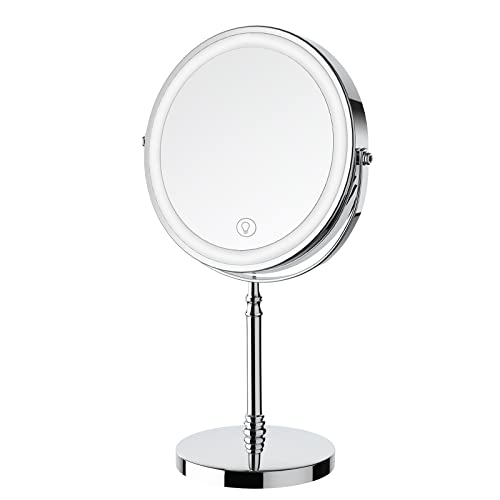
As an Amazon Associate we earn from qualifying purchases at no extra cost to you. Ratings are shown as listed on Amazon.
Quick picks by situation
| Situation | Best mirror type | Recommended specification | Why it fits |
|---|---|---|---|
| First magnifying mirror | Two-sided countertop mirror | 1x/5x, 6- to 8-inch face, dimmable LED | Normal reflection for overall work and moderate magnification for detail |
| Small bathroom or dressing table | Compact rechargeable mirror | 5- to 7-inch face, under 2.5 lb, USB-C charging | Easy to put away and less dependent on an outlet |
| Frequent, detailed application | Premium sensor or light-ring mirror | 5x to 7x, 2700K-6500K adjustment, continuous dimmer | More control over working distance, brightness, and color appearance |
| Travel or competition-day kit | Folding LED mirror | 1x/3x or 1x/5x, 4- to 6-inch face, 6+ hours per charge | Protects the glass and occupies less bag space |
| Heavy or uneven countertop | Weighted metal-base mirror | At least 2.5 lb, rubber feet, 8-inch face | Less likely to slide or tip while you work close to the glass |
What separates the best lighted makeup mirrors
A bright LED ring alone does not make a mirror useful. Clearer detail depends on five linked factors: magnification that matches your working distance, light that shows color without an unpleasant tint, enough brightness for the task, a reflection large enough to orient your face, and a base or mount that stays still.
Magnification: 3x, 5x, or 7x?
Use 1x for foundation, hair, general grooming, and checking the complete result. A 3x mirror enlarges detail without making the field of view feel too narrow, so it is a sensible choice for beginners or anyone who tends to move close to the glass.
Five-times magnification is the most versatile detail setting. It can help with eyeliner, brow shaping, precise concealer placement, and small areas where a normal mirror is not sufficiently clear. Seven-times magnification reveals more detail but shows less of the face and makes small movements look exaggerated. It works best as a secondary side rather than the only viewing surface.
Magnification also changes working distance. A 5x mirror may be comfortable at roughly 8 to 14 inches from the face, while a 7x view often encourages a much closer position. If the image looks warped, your eyelashes touch the glass, or you repeatedly lose the area you are working on, the problem may be excessive magnification rather than poor lighting.
Color temperature and brightness control
Color temperature is measured in Kelvin (K). Warm light around 2700K-3500K is comfortable but can make some colors appear more yellow. Neutral light around 4000K-5000K is a useful everyday range. Cooler light around 5500K-6500K resembles a brighter daylight appearance, although it can feel harsh in a dark room.
The most useful mirrors offer either three color settings or a continuously adjustable range. A dimmer matters just as much. Maximum output can create glare on the glass and deep shadows around the nose; a smooth control lets you use less light at close range. Touch controls are convenient, but physical buttons are often easier to operate with damp or powdered fingers.
- Use 3000K-3500K for a relaxed evening routine.
- Use 4000K-5000K for most indoor application.
- Use 5000K-6500K to check how the result may look in bright outdoor conditions.
- Choose a dimmer with at least three useful levels, rather than a single bright/off setting.
Head-to-head: countertop, rechargeable, and wall-mounted designs
| Design | Typical size and weight | Power | Advantages | Trade-offs |
|---|---|---|---|---|
| Weighted countertop | 6-10 inch face; 2-5 lb | AC adapter or batteries | Stable, bright, usually easy to rotate and clean | Uses permanent counter space and may have a short power cord |
| Rechargeable folding | 4-8 inch face; 1-3 lb | USB rechargeable battery | Portable, tidy, and convenient away from an outlet | Battery capacity and brightness can decline over time |
| Wall-mounted swing arm | 6-8 inch face; 3-8 lb installed | Hardwired or plug-in | Excellent positioning and no counter footprint | Requires suitable mounting and leaves less flexibility |
| Compact travel mirror | 3-6 inch face; under 1.5 lb | Coin cells or USB battery | Fits a kit or locker and protects easily in a case | Narrower view, lower stability, and less even illumination |
For a shared bathroom, a weighted countertop mirror is usually the least troublesome option. For a small dressing area, a folding rechargeable model avoids leaving a cable across the counter. A wall-mounted unit makes sense when the same person uses the same position every day and the wall can support the bracket securely.
Size, stability, and power are practical deal-breakers
A 4-inch mirror can show one eye clearly, but it requires more repositioning. A 6- to 8-inch face gives enough context to work on one side while still seeing nearby features. Larger 8- to 10-inch mirrors are more comfortable for full-face checks, though their bases need more depth and weight.
Look for a base at least half as deep as the mirror is tall, rubber or silicone feet, and a hinge that resists drifting. A tall, lightweight mirror can be technically bright yet frustrating: tapping the control or touching the frame may move the reflection. If you stand while applying makeup, prioritize a broad base and a tilt range of at least 30 degrees.
Plug-in mirrors generally provide the most consistent brightness. Rechargeable models are more convenient, but runtime depends heavily on brightness. As an example, a mirror with a 2,000 mAh battery rated for 8 hours at medium output would provide about 16 applications of 30 minutes each:
8 hours × 60 minutes ÷ 30 minutes = 16 uses.
Using maximum brightness may cut that figure substantially. USB-C charging is preferable to a proprietary connector because replacement cables are easier to obtain. If a mirror uses replaceable batteries, check whether the light output remains consistent as the cells discharge.
Examples of established product lines
Several established lines illustrate the main design choices. Simplehuman’s Sensor Mirror range is known for automatic activation and multiple formats, including countertop and wall-mounted styles. Riki Skinny is a compact, portable design aimed at users who want a folding lighted mirror rather than a heavy base. Conair offers a broad range of two-sided and illuminated countertop mirrors, including lower-cost choices with conventional controls. Fancii produces compact rechargeable and countertop models in several magnification configurations.
Features vary by generation, so verify the exact magnification, charging connector, color settings, and included adapter before buying. A familiar brand name does not guarantee that every version has the same battery, base, or lighting controls.
Ownership details listings often omit
- Glass cleaning: Spray cleaner onto a microfiber cloth, not directly onto the mirror. Liquid entering the LED housing, switches, or frame seam can cause failures.
- Magnification distortion: Small convex or poorly aligned magnifying panels can bend the image near the edge. Keep precise work near the center of the glass.
- LED replacement: Many illuminated mirrors use integrated LEDs. They may last for years, but the entire light assembly can be difficult or uneconomical to replace.
- Battery aging: Rechargeable cells gradually lose capacity. Avoid storing the mirror completely empty for months, and follow the manufacturer’s charging guidance.
- Steam and splashes: A bathroom mirror is not automatically waterproof. Keep non-rated models away from direct spray and heavy condensation.
- Cosmetic buildup: Powder and setting spray can coat the glass and diffuse the light. Wipe the surface regularly, especially around the lower rim.
Common mistakes include choosing 10x magnification because it sounds more precise, buying a mirror with only a bright/off switch, and ignoring the base depth. Precision comes from a stable image and appropriate working distance, not maximum enlargement.
Bottom line
For most people, the best lighted makeup mirrors combine a normal 1x view with 5x magnification, a 6- to 8-inch face, adjustable 3000K-6500K lighting, a dimmer, and a weighted rubber-footed base. Pick a rechargeable folding model if portability is central; choose a wall-mounted mirror for a permanent station; and choose a larger plug-in countertop model when consistent brightness and stability matter more than saving space.

Write Your Review
No reviews yet. Be the first to share your experience!