

Key takeaways
- Wipe the faucet with a soft microfiber cloth after cleaning.
- Use mild dish soap diluted in water for routine soil.
- For mineral deposits, use a manufacturer-approved descaling method and rinse promptly.
- Do not use scouring powder, steel wool, bleach, ammonia, or acidic bathroom cleaner unless the manufacturer specifically permits it.
- Do not spray cleaner directly into handle seams, the aerator, or the base.
The best matte black bathroom faucets are a single-handle model for easy everyday control, a widespread faucet for a spacious traditional vanity, or a wall-mount faucet when you want a clean countertop and have the plumbing access to support it.
Our top picks
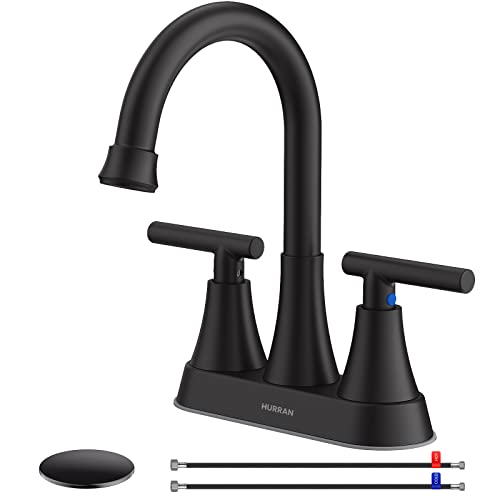


As an Amazon Associate we earn from qualifying purchases at no extra cost to you. Ratings are shown as listed on Amazon.
Quick picks by bathroom and budget
| Situation | Best configuration | Useful target specifications | Typical market range |
|---|---|---|---|
| Small vanity or shared family bathroom | Single-hole, single-handle | 4–6 in. spout reach; 4–7 in. spout height; 1.2–1.5 gpm | $80–$250 |
| Three-hole replacement with minimal countertop work | 4-inch centerset | 4 in. hole spacing; 4–5.5 in. reach; optional deck plate | $70–$220 |
| Large vanity or period-style bathroom | Widespread, three-piece | 8–16 in. adjustable spread; 5–7.5 in. reach; 1.2–1.5 gpm | $180–$650 |
| Minimalist remodel with accessible wall plumbing | Wall-mount | 6–10 in. reach; rough-in valve included or specified separately | $250–$900+ |
| Frequent hand washing or children’s bathroom | Single-handle with ceramic cartridge | Lever handle; temperature limit; 1.2 gpm flow restrictor | $100–$350 |
How the main faucet configurations compare
Single-hole faucets: the safest all-purpose choice
A single-hole faucet combines the spout and handle in one body. It is usually the easiest style to install, clean, and operate with one hand. Choose it when your sink has one faucet hole or when you are replacing a vanity top and can specify the drilling.
Its main limitation is coverage. A compact basin may work well with a 4-inch spout reach, while a vessel sink or unusually wide basin may require 5.5–7 inches. Measure from the faucet hole to the center of the drain, then compare that distance with the spout’s stated reach. The water stream should land near the drain without striking the front or rear wall of the basin.
Moen Align, Kohler Purist, and Delta Trinsic are established examples of single-handle families that are commonly offered in matte black or related dark finishes, although exact configurations vary by model and year.
Centerset faucets: convenient for existing three-hole sinks
A centerset faucet places two handles and the spout on a compact base, normally designed for holes drilled 4 inches apart. It is a practical replacement when you do not want to alter a ceramic sink or countertop. The deck plate also covers small stains and unused areas around the holes.
The trade-off is less visual flexibility and more edges around the handles for soap residue. A removable escutcheon is easier to keep clean than a design with deep seams. Confirm whether the faucet includes a matching drain assembly; a black drain is preferable when the sink has an exposed pop-up mechanism.
Widespread faucets: best for proportion and repair access
Widespread models separate the hot handle, cold handle, and spout. The connections can usually be positioned between 8 and 16 inches apart, giving them a better scale on a broad vanity. They also provide more room for cleaning around each component.
Installation takes longer because there are more connections under the counter. A widespread faucet is a poor choice for a narrow vanity where the handles would sit close to the basin edge or backsplash. It is also less forgiving if the countertop holes are already drilled at a fixed 4-inch spacing.
Wall-mount faucets: stylish, but plumbing-dependent
A wall-mount faucet clears the counter and works particularly well with vessel sinks or floating vanities. However, the visible faucet is only one part of the system. The wall must contain the correct rough-in valve at the right height and depth, and the finished spout must project far enough to reach the basin.
Retrofitting one after tile or drywall is installed can cost much more than the faucet itself. Treat a wall-mount model as a coordinated plumbing decision, not a simple cosmetic replacement.
Matte black finish durability: what matters more than color
Most good matte black bathroom faucets use a coating applied over brass, stainless steel, or zinc-based components. Look for a manufacturer’s physical vapor deposition, often abbreviated PVD, when available. PVD finishes are generally more resistant to abrasion and chemical exposure than basic painted or powder-coated surfaces, but no black finish is immune to scratching.
The finish usually does not fail first because of ordinary water. The common problems are aggressive cleaners, abrasive sponges, hard-water scale left in place, and repeated contact with metal jewelry or tools. The internal ceramic cartridge, aerator, flexible supply lines, and rubber seals are more likely to need attention before the metal body does.
- Wipe the faucet with a soft microfiber cloth after cleaning.
- Use mild dish soap diluted in water for routine soil.
- For mineral deposits, use a manufacturer-approved descaling method and rinse promptly.
- Do not use scouring powder, steel wool, bleach, ammonia, or acidic bathroom cleaner unless the manufacturer specifically permits it.
- Do not spray cleaner directly into handle seams, the aerator, or the base.
Water flow: balance rinsing speed with splash control
A bathroom faucet rated at 1.2 gallons per minute uses less water than a 1.5 gpm model, but the aerator determines much of the perceived performance. A well-designed 1.2 gpm aerator can feel adequate for hand washing, while an inexpensive aerator may produce a narrow, noisy stream.
For a rough ownership calculation, a 1.2 gpm faucet running for 30 seconds uses 0.6 gallons. At 10 uses per day, that is approximately 219 gallons per year. A 1.5 gpm model would use 274 gallons under the same assumptions, a difference of about 55 gallons annually per sink. Actual use depends on household habits, and a low-flow model will not compensate for leaving the water running during toothbrushing.
Check the faucet’s certification and local requirements before buying. In the United States, bathroom faucets are commonly sold at or below 1.5 gpm, while some areas and green-building programs favor 1.2 gpm. A flow restrictor can also affect compatibility with an undersink filter or other accessory.
Sink compatibility checklist
Measure before choosing a finish or brand. The most attractive faucet is still unsuitable if its stream misses the drain or its handle hits the backsplash.
- Hole count: Identify whether the sink has one hole, three holes at 4 inches, or three holes with a wider spread.
- Spout reach: Measure horizontally from the mounting hole or wall to the point where water should enter the basin.
- Spout height: A tall faucet may splash in a shallow undermount sink. Vessel sinks often need a taller spout or wall-mount design.
- Backsplash clearance: Leave room for the handle to move fully backward and for a plumber to tighten connections.
- Drain position: Check that the drain lift rod, if included, can move without striking the backsplash or mirror cabinet.
- Counter thickness: Thick stone, an integrated sink, or a vessel-sink adapter may require longer mounting hardware.
- Supply connections: Confirm the included hoses reach the shutoff valves and match the valve connection size.
Installation requirements and common mistakes
A single-hole or centerset replacement is often manageable for an experienced DIY homeowner, provided the shutoff valves work and the underside of the vanity is accessible. A basin wrench, adjustable wrench, bucket, flashlight, and plumber’s tape where specified by the instructions are useful. Do not apply tape to compression fittings or braided hose ends that seal with a washer.
- Shut off both supply valves and open the faucet to release pressure.
- Place a towel or bucket below the connections before removing the old supply lines.
- Clean the sink surface completely; grit under the gasket can cause a leak.
- Install the gasket and faucet body in the orientation shown by the instructions.
- Tighten the mounting nut firmly, but avoid over-tightening against porcelain or stone.
- Connect hot and cold lines correctly, then open the valves slowly.
- Remove the aerator and flush the line for 30–60 seconds to clear installation debris.
- Reinstall the aerator and inspect every connection with a dry tissue while the faucet runs.
The most frequent mistakes are reversing hot and cold, forgetting the rubber gasket, overtightening a plastic mounting nut, and failing to flush debris before it reaches the cartridge. For wall-mount, widespread, or inaccessible installations, hiring a licensed plumber can prevent concealed leaks and tile damage.
Final buying decision
Choose a single-hole matte black faucet with a ceramic cartridge and 1.2–1.5 gpm aerator for the best balance of simplicity, maintenance, and everyday usability. Choose centerset when the sink already has 4-inch holes, widespread when vanity width and visual proportion matter, and wall-mount only when the rough-in is planned for it. Prioritize verified dimensions, a durable finish process, replaceable aerators and cartridges, and clear warranty support over an unusually sculptural shape. That combination will keep the faucet compatible, quieter to own, and easier to maintain long after the matte black finish stops being the newest feature in the bathroom.



Write Your Review
No reviews yet. Be the first to share your experience!