

Key takeaways
- Radiant screens and heating elements: Grease, impact, and thermal cycling can cause cracking or failure. Avoid striking hot ceramic or placing wet food directly against electric elements.
- Racks and supports: These collect carbon and may warp if scrubbed aggressively while hot. Soak removable parts in an approved degreaser, then rinse and dry them fully.
- Burner ports and igniters: On gas units, blocked ports create uneven flames. Clean only when the appliance is off, cool, and isolated from the gas supply as required by the manual.
- Door hinges and handles: Grease buildup makes doors difficult to operate and can misalign them. Wipe these areas every shift rather than waiting for a deep-cleaning day.
- Drip and crumb trays: Empty them frequently. A full tray increases smoke, creates flare-up risk, and makes later cleaning much harder.
The best salamander broilers for commercial kitchens are gas units when you need maximum heat and fast recovery, while electric models are usually the better choice for smaller kitchens, simpler installation, and more predictable temperature control.
For most professional operations, a 36-inch gas salamander from an established commercial range manufacturer is the strongest all-round choice. Choose a 24-inch electric salamander when space, ventilation, or installation cost matters more than peak output. Before buying, compare the usable cooking width—not just the outside dimensions—along with heat output, rack movement, overhead clearance, ventilation, and the building services available at the installation point.
Our top picks
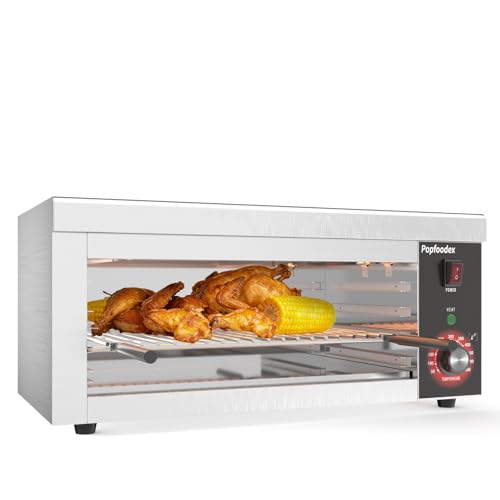


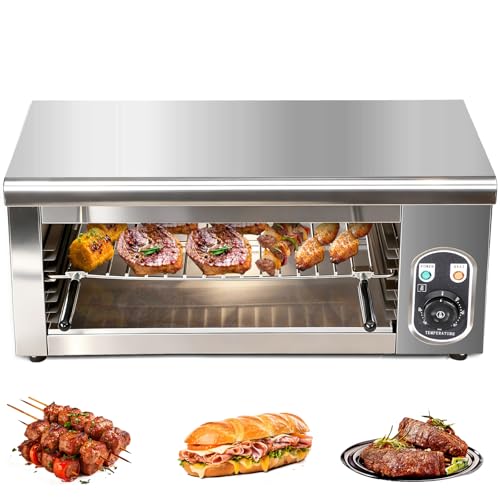
As an Amazon Associate we earn from qualifying purchases at no extra cost to you. Ratings are shown as listed on Amazon.
Best salamander broilers by kitchen situation
| Kitchen situation | Best choice | Why it fits | Main compromise |
|---|---|---|---|
| High-volume grill or steak service | 36-inch gas salamander | High radiant heat, rapid recovery, and room for several pans or plates | Requires gas, a suitable hood, and more installation work |
| Small restaurant with limited counter space | 24-inch electric salamander | Compact footprint and no gas connection | May recover more slowly during continuous loading |
| All-day finishing, melting, and gratinating | Electric unit with independent element control | Fine adjustment and steady, repeatable heat | Electrical demand can be substantial |
| Existing gas cooking line | Gas salamander matched to the range | Uses established fuel and often mounts above a compatible range | Flame and hot surfaces demand careful cleaning and supervision |
| Occasional service or low-volume catering | 24-inch, 4–6 kW electric model | Lower complexity than a large gas broiler and adequate for finishing work | Not ideal for sustained heavy broiling |
Gas versus electric salamander broilers
Gas: the better heavy-duty choice
Gas salamanders typically use burners below a radiant screen or ceramic surface. They reach working temperature quickly and can recover heat rapidly after a cold tray is inserted. That makes them well suited to steak finishing, open-faced sandwiches, seafood, and repeated service during a busy shift.
Gas models commonly offer approximately 36,000 to 60,000 BTU/h across a 24- to 36-inch cooking area, although output differs by burner arrangement and manufacturer. Independent burner controls are valuable because they let the cook run only the section being used instead of heating the entire cavity.
The disadvantages are installation-related. A gas unit needs an approved connection, shutoff valve, correct regulator settings, combustion air, and exhaust through a suitable commercial hood. A gas broiler also adds flame, burner ports, pilot or ignition components, and radiant surfaces that need inspection and cleaning.
Electric: easier to control and often easier to place
Electric salamanders use exposed or protected heating elements, usually with separate controls for left and right zones. They provide even, repeatable heat and are particularly convenient for melting cheese, browning gratins, finishing plated dishes, and cooking in kitchens where extending the gas line is impractical.
Commercial electric units commonly range from about 4 to 12 kW. A 6 kW appliance at 240 volts draws roughly 25 amps before accounting for electrical installation requirements. A 12 kW model draws about 50 amps, so “electric” does not automatically mean low-demand or plug-and-play.
Electric units produce no combustion gases at the appliance, but they still create smoke, grease vapour, and heat. In a commercial kitchen, the ventilation requirement is determined by the appliance classification and local code, not simply by whether the broiler uses gas or electricity.
Cooking width, heat output, and rack adjustment
Width should be assessed by the usable rack area. A nominal 24-inch salamander may provide around 20 to 22 inches of practical loading space after side walls and supports are accounted for. A nominal 36-inch model may provide roughly 32 to 34 inches. Measure the actual rack and the openings of the pans you use.
Rack adjustment is almost as important as width. Look for a rack or shelf with at least four positions and approximately 3 to 5 inches of vertical travel. Close positions are useful for rapid browning; lower positions provide more distance for thicker food and reduce scorching. A rack that lifts out without tools is easier to clean and safer to handle.
Heat output should be matched to the job rather than treated as a simple “more is better” specification. A high-output gas broiler is advantageous for continuous production, but an excessively powerful unit can burn bread, dry thin food, and waste energy when used only for finishing. Independent zones and responsive controls often matter more than maximum BTU or wattage.
| Common size | Typical usable width | Typical gas output | Typical electric output | Best workload |
|---|---|---|---|---|
| 24 inch | 20–22 inches | 36,000–45,000 BTU/h | 4–6 kW | Small-line finishing and moderate service |
| 30 inch | 26–28 inches | 45,000–55,000 BTU/h | 6–9 kW | Mixed à la carte production |
| 36 inch | 32–34 inches | 50,000–60,000 BTU/h | 9–12 kW | Busy service and multiple pans at once |
These are buying benchmarks, not universal specifications. Confirm the manufacturer’s data plate, rack dimensions, fuel pressure, voltage, phase, and connection requirements before ordering.
Clearance and ventilation: the measurements that prevent installation problems
A salamander is commonly mounted above a range, placed on a counter, or installed on a dedicated wall shelf. The installation manual—not a generic catalogue dimension—determines required clearances. Plan for the appliance body, rear connections, front door or rack movement, and the space needed to remove the crumb tray.
As a practical planning allowance, reserve at least 6 inches behind a countertop unit for connections unless the manual specifies less, and leave enough front clearance to pull the rack fully forward without striking a pass shelf. Overhead space must account for the hood, filters, fire-suppression nozzles, and service access. Combustible wall or shelf materials may require greater separation or a listed heat shield.
Gas salamanders generally need Type I exhaust because broiling produces grease-laden vapour. Electric models may also require Type I exhaust when used for grease-producing foods. Hood capacity, make-up air, fire suppression, and appliance placement should be reviewed by a qualified commercial-kitchen installer and the local authority having jurisdiction.
Installation cost and fit calculation
Suppose a kitchen has 34 inches of clear counter width and wants a 36-inch broiler. The unit may be listed as 36 inches wide, but its actual body can be slightly wider once side trims, mounting brackets, or rear gas fittings are included. A safer calculation is:
Available width − appliance width − service margin = remaining clearance.
For example, 34 inches − 33 inches of actual appliance body − 1 inch of side tolerance leaves zero usable margin. That is a poor fit even though the catalogue size appears close. A 24-inch unit with a 25-inch body would leave 8 inches, allowing easier cleaning and service access.
For electricity, a 6 kW, 240-volt unit requires approximately 25 amps: 6,000 ÷ 240 = 25. The final circuit, breaker, wire size, disconnect, and phase arrangement must be selected by a licensed electrician according to local code and the manufacturer’s instructions.
What wears first and how to keep ownership costs under control
- Radiant screens and heating elements: Grease, impact, and thermal cycling can cause cracking or failure. Avoid striking hot ceramic or placing wet food directly against electric elements.
- Racks and supports: These collect carbon and may warp if scrubbed aggressively while hot. Soak removable parts in an approved degreaser, then rinse and dry them fully.
- Burner ports and igniters: On gas units, blocked ports create uneven flames. Clean only when the appliance is off, cool, and isolated from the gas supply as required by the manual.
- Door hinges and handles: Grease buildup makes doors difficult to operate and can misalign them. Wipe these areas every shift rather than waiting for a deep-cleaning day.
- Drip and crumb trays: Empty them frequently. A full tray increases smoke, creates flare-up risk, and makes later cleaning much harder.
Do not line the interior with foil unless the manufacturer expressly permits it. Foil can restrict airflow, reflect excessive heat toward controls, and trap grease. Do not spray liquid onto energized electric elements or ignition components. A scheduled inspection of gas connections, electrical terminals, hood filters, and fire-suppression equipment is part of the appliance’s ownership cost.
Final buying recommendation
Choose a 36-inch gas salamander from a commercial range manufacturer such as Vulcan, Garland, Southbend, Imperial, or Star when the broiler will run repeatedly during busy service and the kitchen already has the required hood and gas infrastructure. Choose a 24-inch or 30-inch electric salamander when your work is mainly melting, browning, and finishing, or when a gas installation would require expensive changes.
Before placing the order, verify five things in writing: usable rack width, maximum heat output, number and spacing of rack positions, required clearances, and the exact gas or electrical service. The best salamander broilers are not necessarily the largest or hottest models; they are the ones that fit the line, recover quickly enough for the service volume, and can be cleaned and maintained without disrupting the kitchen.

Write Your Review
No reviews yet. Be the first to share your experience!