

Key takeaways
- Docking: Magnetic or mechanically locking docks are less likely to sag than friction-only holders.
- Hose material: Braided or reinforced hoses generally tolerate commercial movement better than thin smooth tubing.
- Controls: A large paddle or lever is easier to operate with wet or gloved hands.
- Spray pattern: A concentrated spray is useful for debris; an aerated stream reduces splashing when filling containers.
- Replacement parts: Confirm that the spray head, hose, cartridge, O-rings, and check valves are available separately.
The best commercial kitchen faucets for 2026 are determined less by brand than by reach, clearance, mounting compatibility, spray-head ergonomics, and whether the faucet can tolerate repeated heavy use; for most busy kitchens, a wall-mounted pre-rinse faucet or a deck-mounted pull-down model is the right starting point.
Our top picks


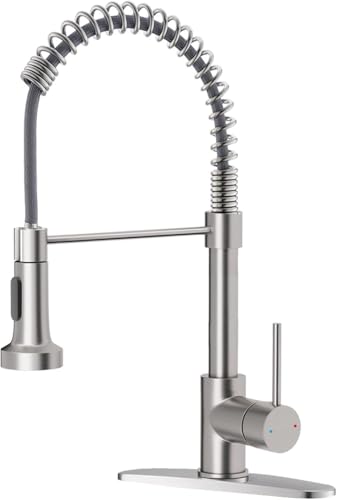
As an Amazon Associate we earn from qualifying purchases at no extra cost to you. Ratings are shown as listed on Amazon.
Best commercial kitchen faucets by situation
| Kitchen situation | Best faucet type | Useful target specifications | Why it fits |
|---|---|---|---|
| High-volume dishwashing | Wall-mounted pre-rinse faucet | 44–60 in. hose, 8–14 in. riser, 1.15–1.6 GPM | Long reach and a strong focused spray reduce scrubbing time |
| Compact café or food truck | Short deck-mounted pull-down faucet | 10–16 in. overall height, 8–10 in. spout reach, one-hole mount | Needs less wall and overhead clearance |
| Prep sink and produce washing | Commercial pull-down faucet with dual spray | 9–12 in. reach, 1.5–2.2 GPM, swivel spout | Balances controlled rinsing with everyday filling |
| Two-compartment or large pot sink | High-arc deck faucet with separate side spray | 10–14 in. reach, 8–12 in. clearance above the sink | Allows the spout and spray to cover separate basins |
| Existing wall rough-in | Wall-mounted faucet with adjustable centers | 7–9 in. adjustable inlet spacing, vacuum breaker where required | Can replace a commercial wall faucet without relocating plumbing |
Top commercial faucet choices for 2026
Best overall for a busy dish pit: wall-mounted pre-rinse faucet
A wall-mounted pre-rinse faucet is the strongest choice when the main job is removing food from plates, pans, and utensils. Its spring-style riser keeps the spray head elevated, while a flexible hose lets the operator direct water across a large sink. Established commercial lines from T&S Brass, Fisher Manufacturing, and Krowne offer this configuration with replacement valves, hoses, spray heads, and wall brackets.
Choose a model with an integral wall support, a lever handle that can be operated with a closed hand, and a spray head rated around 1.15 to 1.6 gallons per minute. A lower flow rate can reduce water use, but an excessively restricted head may make greasy or dried-on food slower to remove. A vacuum breaker is also important where local plumbing rules require backflow protection.
The trade-off is height. A typical pre-rinse assembly can rise 18 to 22 inches above the mounting surface, and the hose may extend 44 to 60 inches. Measure the distance from the wall connection to the lowest overhead shelf before buying.
Best for limited space: compact deck-mounted pull-down faucet
A compact pull-down faucet is easier to fit in a café, bar, catering van, or shallow prep area. It mounts through the sink or countertop rather than directly to the wall, and its head usually docks into a rigid or semi-rigid spout. Look for a swivel range of at least 90 degrees and a hose that pulls out 8 to 12 inches beyond the spout.
This design is more comfortable for filling containers and rinsing vegetables than a spring pre-rinse faucet, but it generally provides less hose reach. A 10-inch spout reach may cover only part of a deep sink, especially if the faucet is installed near a corner. Confirm that the mounting hole is positioned far enough from the basin wall for the handle and spray head to move freely.
Best for flexible prep work: dual-function commercial pull-down
A dual-function pull-down head switches between an aerated stream and a concentrated spray. The stream is better for filling pots without excessive splashing; the spray is more useful for rinsing cutting boards and produce. This is the most versatile option for a kitchen that performs both preparation and moderate dishwashing.
Do not judge the head only by its number of spray settings. The important details are whether the selector can be changed with one hand, whether the hose retracts smoothly, and whether the docking mechanism remains secure after repeated use. A magnetic dock or positive locking collar is preferable to a loose friction fit.
Best for two-basin coverage: high-arc faucet with side spray
A high-arc faucet paired with a separate side spray is a practical choice for a large two-compartment sink. The fixed spout can fill one basin while the side spray reaches the other. It also keeps the main faucet head lighter and simpler than a long pull-down hose.
This arrangement requires at least two countertop or sink-deck openings, and the holes must match the faucet’s connection spacing. It is less convenient when the operator needs to hold a pan with one hand and direct the spray with the other, but it can be more durable because the spray hose is not constantly dragged through the main spout.
What to check before choosing
Spray reach and sink coverage
Measure from the faucet’s mounting point to the farthest corner of the basin. A useful rule is to choose a spout reach at least 60% of the sink’s front-to-back depth, then add hose reach if the design includes a pull-down head. For example, a sink that is 24 inches deep should ideally have at least 14 to 16 inches of effective reach. A faucet with a 10-inch spout may still work, but the operator will need to move the cookware rather than the water.
Pull-down head design
- Docking: Magnetic or mechanically locking docks are less likely to sag than friction-only holders.
- Hose material: Braided or reinforced hoses generally tolerate commercial movement better than thin smooth tubing.
- Controls: A large paddle or lever is easier to operate with wet or gloved hands.
- Spray pattern: A concentrated spray is useful for debris; an aerated stream reduces splashing when filling containers.
- Replacement parts: Confirm that the spray head, hose, cartridge, O-rings, and check valves are available separately.
Clearance and mounting requirements
Commercial faucets are often taller than residential models. Allow at least 2 inches between the top of the faucet and the lowest shelf, backsplash, or window frame so the handle and head can be removed for service. For a spring pre-rinse unit, measure the complete riser height, not just the height of the spray head.
Deck-mounted faucets commonly use one, two, or three holes. Some commercial sink faucets fit adjustable centers around 7 to 9 inches, while others require a fixed 8-inch center measurement. Wall-mounted models may need eccentric fittings to correct small spacing differences, but they cannot compensate for every rough-in problem. Shut off the water and measure the center-to-center distance between the existing inlets before ordering.
Flow rate
For general prep, 1.5 to 2.2 GPM is a useful range. Pre-rinse sprays commonly fall around 1.15 to 1.6 GPM. Higher flow can rinse faster, but it also increases splash, drainage demand, and water consumption. Check the building’s hot-water capacity and local conservation requirements rather than assuming the highest flow is best.
A simple ownership calculation illustrates the difference. If a faucet runs 20 minutes per operating day, reducing flow from 2.2 to 1.5 GPM saves 14 gallons per day. Over 300 operating days, that is approximately 4,200 gallons, before accounting for the energy used to heat hot water. The saving is worthwhile only if the lower-flow spray still removes food at an acceptable speed.
Finish and material
Polished chrome is easy to inspect and usually economical, but it shows water spots and scratches. Brushed stainless steel or satin finishes hide light marks better in a busy dish area. Stainless-steel bodies can be a useful choice where cleaning chemicals and moisture are constant, although the exact alloy and internal components still matter.
Finish should not distract from the valve construction. A heavy brass or stainless body, ceramic cartridge, replaceable seals, and a robust wall bracket matter more than a decorative coating. Avoid abrasive pads and chlorine-heavy cleaners unless the manufacturer specifically permits them; these can dull finishes and damage seals.
Durability realities and maintenance
The spray head, hose O-rings, cartridge, and docking parts usually wear before the faucet body. Hard water can clog spray openings, while over-tightening the handle or hose connections can cut seals and create leaks. Keep a spare spray head and a small seal kit on site if the faucet is critical to daily service.
- Rinse food residue from the spray head at the end of each shift.
- Soak a removable aerator or spray screen in manufacturer-approved descaling solution when mineral buildup appears.
- Inspect the hose for kinks, bulges, or exposed reinforcement.
- Check connections for slow leaks with the faucet closed and the supply pressurized.
- Replace worn O-rings instead of repeatedly tightening fittings.
One common mistake is using a sink-mounted faucet on a thin countertop without a reinforcement plate. The mounting nut can loosen as the faucet is pulled sideways, eventually damaging the deck. Another is choosing a tall pre-rinse faucet under a shelf, leaving no room to remove the riser or spray head. Measure the installation area first, then compare reach, height, mounting centers, and flow rate as a group.
Final buying recommendation
Choose a T&S Brass, Fisher Manufacturing, or Krowne-style wall-mounted pre-rinse faucet for frequent commercial dishwashing and large sink coverage. Choose a compact commercial pull-down faucet for restricted clearance or a prep-focused workspace. Choose a dual-function head when one sink must handle both filling and rinsing, and choose a high-arc faucet with side spray when two basins need simultaneous coverage. The best commercial kitchen faucets are the ones whose reach and mounting geometry match the sink before their finish or feature list becomes the deciding factor.

Write Your Review
No reviews yet. Be the first to share your experience!