

Key takeaways
- 16 feet 10 inches to 17 feet of length, including end clearance.
- Approximately 8 feet of width, including side clearance.
- More width if players will stand beside the table, use bar stools, or circulate behind the throwing area.
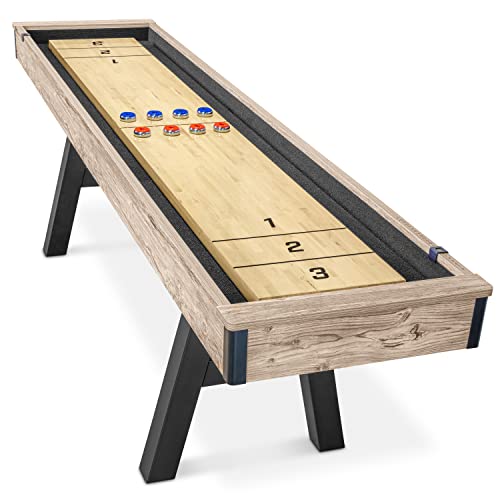
The best shuffleboard tables for home game rooms are chosen by available floor length first, then by playing-surface quality, climate adjustment, leg stability, and how much assembly you are prepared to handle.
Our top picks



As an Amazon Associate we earn from qualifying purchases at no extra cost to you. Ratings are shown as listed on Amazon.
Quick picks by home situation
| Home situation | Best table type | Recommended length | Typical market range | Why it fits |
|---|---|---|---|---|
| Occasional family games and limited space | Compact recreational table | 9–12 feet | $600–$1,500 | Easier to place and less expensive, but provides shorter shots and fewer premium construction details |
| Regular home play | Mid-size hardwood table | 14–16 feet | $1,200–$3,000 | The strongest balance of realistic play, room requirements, stability, and value |
| Experienced players or frequent entertaining | Competition-style table | 18–22 feet | $2,500–$6,000+ | Longer scoring zones, heavier construction, better climate control, and more demanding installation |
| Premium game room or permanent installation | Custom or high-end hardwood table | 18–22 feet | $5,000–$10,000+ | Superior finish, precise leveling, stronger support systems, and more customization |
How long should your shuffleboard table be?
Table length affects more than the footprint. A 9- or 12-foot table is convenient for a basement, apartment, or multipurpose room, but its playing pattern is compressed. A 14- to 16-foot table feels substantially more natural for home competition without requiring the commitment of a full-size table. Tables around 18 to 22 feet offer the most authentic experience, although they need a large, dedicated room.
Measure the table itself and the clearance around it. A practical planning allowance is approximately 2 feet of free space on each side for stance and cue movement, plus 3 to 4 feet at each end. For example, a 16-foot table needs roughly:
- 16 feet 10 inches to 17 feet of length, including end clearance.
- Approximately 8 feet of width, including side clearance.
- More width if players will stand beside the table, use bar stools, or circulate behind the throwing area.
A 16-foot table therefore fits best in a room measuring at least about 17 by 8 feet, while a 22-foot table is more comfortable in a room measuring around 23 by 9 feet or larger. These are practical minimums rather than manufacturer shipping dimensions. Draw the footprint on the floor with painter’s tape before ordering, and check doorways, stair turns, elevators, and ceiling height along the delivery route.
Playing-surface materials: what makes a table play well?
Hardwood playfields
Maple is a common choice for premium playfields because it can be machined smooth, finished evenly, and refinished when worn. Other hardwoods may be used for the cabinet or side rails. Look for a thick, rigid playfield rather than a thin decorative top. Thickness helps resist flexing and gives the surface more material for leveling and future maintenance.
Polymer and synthetic finishes
A clear polymer finish protects the wood and creates a consistent sliding surface. It is not the same thing as a plastic playing field: many quality tables use a hardwood base beneath a synthetic finish. Ask whether the finish is repairable or replaceable, and whether the maker specifies a particular cleaner or polish. A glossy appearance alone does not prove that the table will remain fast and even.
Laminate and engineered surfaces
Lower-cost tables may use engineered wood, laminate, or a thinner composite playing surface. These can be sensible for occasional use, particularly at 9 to 12 feet, but they generally offer less opportunity for professional leveling or refinishing. Inspect the warranty for restrictions involving humidity, temperature, and surface damage.
Climate adjusters are not an optional detail
Wood changes shape as the room’s humidity changes. A table that is perfectly level in a dry winter room may develop a slight crown or dip during a humid summer. Climate adjusters—usually threaded supports beneath the playfield—let the owner correct the surface gradually.
For a table longer than about 14 feet, multiple adjusters are especially valuable. They should be accessible without dismantling the cabinet and should be paired with a clear leveling procedure. Adjustment is normally a small, measured process: check the surface with a reliable level, make a minor turn, allow the wood to settle, and check again. Large corrections can stress the playfield or cabinet.
A climate adjuster cannot compensate for an unsuitable room. Keep the table away from direct sunlight, heating vents, damp exterior walls, and large temperature swings. A stable indoor environment is more important than chasing a particular humidity number.
Leg stability and cabinet construction
Shuffleboard tables are long levers: a small amount of movement at the legs can become noticeable at the far end of the playing surface. Favor wide, braced leg assemblies with substantial attachment points. Crossbars or stretchers between legs reduce side-to-side movement, while adjustable feet help correct an uneven floor.
Ask these questions before buying:
- Are the legs solid wood, metal, or a lightweight composite?
- Do the feet adjust independently?
- Are the legs joined by cross-bracing?
- Does the cabinet sit on a continuous base or only on several narrow supports?
- Is the table’s listed weight high enough for its length and construction?
Weight is not a perfect quality measure, but a long table that is unusually light may use thinner materials or less substantial support. Avoid placing any table on a soft, thick carpet unless the manufacturer specifically permits it; carpet compression can change the level after installation.
Assembly, delivery, and installation reality
Most home tables arrive in several heavy sections, with the cabinet, legs, climatic support hardware, trim, and accessories packed separately. Assembly is often described as straightforward, but “straightforward” can still mean two or three adults, several hours, and enough space to turn the cabinet safely.
Before delivery, prepare a clear path and identify the final orientation. Do not assemble a long table directly against a wall if you will later need access to the adjusters. Use the manufacturer’s fasteners, tighten the frame evenly, and do not drag the assembled table across the floor. Sliding can twist the cabinet, damage feet, or create a level problem that is difficult to diagnose.
Once assembled, level the cabinet first and the playfield second. Place a long level in several directions, including lengthwise and across the width. A short household level can miss gradual changes over a long surface. Let the table settle for a day before making final fine adjustments.
Decision matrix: which specification matters most?
| Your priority | Look for | Acceptable compromise | Avoid |
|---|---|---|---|
| Lowest initial cost | 9–12 feet, engineered cabinet, basic accessories | Fewer climate adjusters | A table too large for the room |
| Frequent weekly play | 14–16 feet, hardwood surface, polymer finish, adjustable feet | Standard rather than custom trim | Unbraced legs or a finish with unclear maintenance instructions |
| Competitive practice | 18–22 feet, thick playfield, multiple adjusters, rigid cabinet | Longer assembly and higher delivery cost | Short tables marketed as competition substitutes |
| Shared living space | Compact length, neutral cabinet, protective cover | Shorter scoring distance | Ignoring walking clearance and furniture placement |
| Long-term ownership | Repairable finish, replaceable wax and pucks, accessible hardware | Higher purchase price | Unclear parts availability or a non-serviceable surface |
Ownership costs and maintenance
The playing surface usually needs more attention than the cabinet. Shuffleboard wax, silicone spray where specified, replacement pucks, and a fitted cover are recurring expenses. Dust and grit can slow the surface and create scratches, so brush the table gently before play and cover it afterward. Never use household furniture polish unless the manufacturer specifically approves it.
Wax is a consumable, and faster grades are not automatically better. Choose a speed appropriate to the table length and player ability. Excess wax can collect at the scoring end and change rebound behavior. Inspect the pucks for burrs or damaged edges, since a damaged puck can mark the finish.
Wood movement is the most common long-term issue. Check level periodically, especially after seasonal weather changes. Do not place drinks on the rail, lean heavy objects against the cabinet, or use the table as a workbench. If the surface develops a persistent ridge, depression, or finish failure, stop making large adjuster changes and consult the manufacturer or a qualified repair specialist.
Final buying recommendation
For most home game rooms, a well-supported 14- to 16-foot table with a hardwood playfield, durable polymer finish, adjustable feet, and accessible climate adjusters is the best overall choice. Choose 9 to 12 feet when room constraints are decisive, and move to 18 feet or longer only when you have the clearance, delivery access, and commitment to maintain a full-size table. The best shuffleboard tables are not simply the longest or most expensive models; they are the ones that fit the room, remain stable, and can be leveled and maintained for years.

Write Your Review
No reviews yet. Be the first to share your experience!