

Key takeaways
- Choose the Seestar S50 for the best balance and the most sensible first purchase. Choose the Seestar S30 when portability and storage matter more than detail. Choose the Vespera II for a premium, guided experience with minimal fuss. Choose the eVscope 2 when a larger…
The best smart telescope for most beginners in 2026 is the ZWO Seestar S50, while the Vaonis Vespera II delivers a more polished premium experience, the Unistellar eVscope 2 is the strongest choice for darker skies and serious observing, and the smaller ZWO Seestar S30 suits travel and casual backyard use.
Smart telescopes use a motorized mount, onboard computer, camera and mobile app to find targets and build images automatically. They are designed for people who would rather see a galaxy or nebula on a phone or tablet than spend an evening learning manual star-hopping. The important trade-off is that a smart telescope is usually a specialized deep-sky imaging system, not a replacement for a large conventional telescope for high-power views of planets.
Our top picks

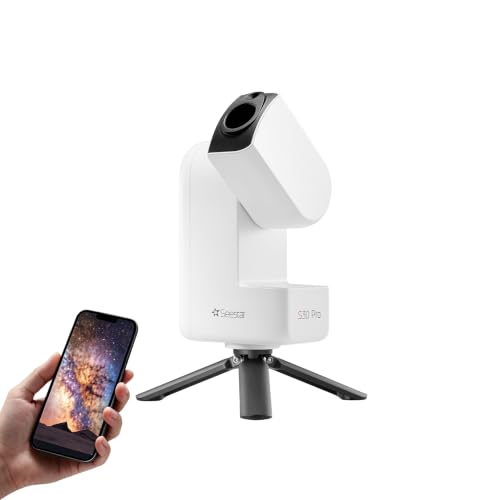

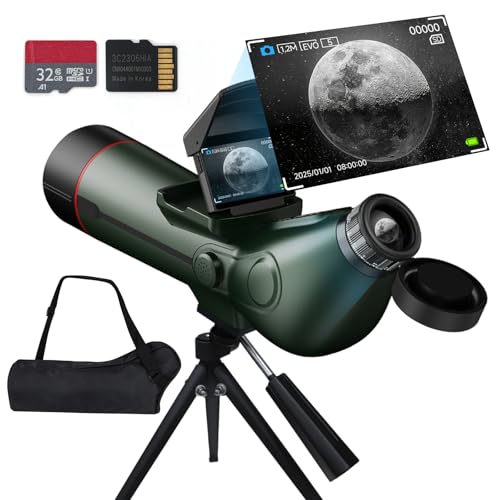
As an Amazon Associate we earn from qualifying purchases at no extra cost to you. Ratings are shown as listed on Amazon.
Quick comparison: the leading smart telescopes
| Model | Optical aperture | Focal length | Approx. weight | Typical battery life | General market price |
|---|---|---|---|---|---|
| ZWO Seestar S30 | 30 mm | 150 mm | Approximately 1.6 kg | About 4–5 hours | About $550–$700 |
| ZWO Seestar S50 | 50 mm | 250 mm | Approximately 2.5 kg | About 5–6 hours | About $700–$900 |
| Vaonis Vespera II | 50 mm | 250 mm | Approximately 5 kg with tripod | About 4–6 hours | About $1,500–$2,000 |
| Unistellar eVscope 2 | 114 mm | 450 mm | Approximately 9 kg with tripod | Up to roughly 10 hours | About $4,000–$5,500 |
Specifications and prices can vary by package, region and software bundle. The aperture figures matter most for faint objects: a 114 mm optical system collects more than five times as much light as a 50 mm system, although processing, sensor design and field of view also affect the final image.
Best overall: ZWO Seestar S50
The Seestar S50 is the easiest recommendation for most buyers because it combines a useful 50 mm aperture with automatic alignment, a compact all-in-one design and a relatively accessible price. Its app handles leveling guidance, plate solving, target selection, tracking and live stacking. You can usually go from placing the telescope on a stable surface to viewing a recognizable nebula in a few minutes.
Its 250 mm focal length provides a versatile field of view. Large targets such as the Andromeda Galaxy, Orion Nebula and North America Nebula fit comfortably, while smaller objects remain large enough to identify after several minutes of stacking. The integrated filter improves contrast on many emission nebulae, but it cannot remove the glow from a badly lit urban sky.
The S50 is particularly strong for beginners who want to save images without assembling a separate camera, mount and laptop. Its limitations are equally clear: the tripod is light, the internal battery is not designed for all-night winter sessions, and the app occasionally requires patience when GPS, Wi-Fi or the telescope’s compass information is unreliable.
Best premium compact system: Vaonis Vespera II
The Vespera II is the better choice when app refinement, industrial design and a guided observing experience matter more than the lowest price. Its automated alignment and catalog navigation are highly approachable, and the enclosure feels designed for repeated setup rather than improvised accessories. Vaonis also puts considerable emphasis on curated target recommendations and beginner-friendly image processing.
With a 50 mm aperture and 250 mm focal length, its raw light-gathering ability is broadly comparable to the Seestar S50. The price difference therefore buys more than aperture: it buys a more premium ecosystem, a carefully integrated tripod and a polished workflow. That makes the Vespera II attractive for family use, clubs and owners who value simplicity over maximum hardware-per-dollar.
It is not the obvious choice for someone who wants to experiment with every imaging setting. Buyers seeking extensive manual control, third-party accessories or the largest possible galaxies per dollar may prefer the more open and less expensive route offered by the Seestar platform.
Best for travel and small spaces: ZWO Seestar S30
The Seestar S30 is the practical pick for balconies, small patios and frequent travel. Its approximately 1.6 kg body is easier to carry than the larger alternatives, and its shorter 150 mm focal length gives it a wider view. That helps with large nebulae and makes framing less frustrating when the available sky is limited by buildings or trees.
The compromise is image scale. A 30 mm aperture collects only 36 percent as much light as a 50 mm aperture before other optical and sensor differences are considered. Faint galaxies will look smaller and take longer to build up. The S30 is best understood as a portable introduction to automated astrophotography, not a smaller version of a premium observatory system.
Best for maximum aperture: Unistellar eVscope 2
The eVscope 2 is the head-to-head winner when aperture and observing performance take priority over portability. Its 114 mm mirror gathers more light and provides a narrower, more useful view for many galaxies, globular clusters and planetary nebulae. Under genuinely dark skies, it can show considerably more structure than a 30 or 50 mm smart telescope.
Unistellar’s automatic object recognition and electronic viewing system make the telescope approachable despite its larger optical design. Its battery endurance is also better suited to extended observing sessions. The cost is substantial, and the roughly 9 kg complete setup is no longer a casual grab-and-go device. It needs a firm surface, careful transport and more storage space.
For a city apartment, the eVscope 2 may be excessive. For an owner who regularly drives to dark-sky locations and wants one integrated system rather than a conventional telescope plus astrophotography accessories, its larger aperture is meaningful.
Decision matrix: which model fits your situation?
| Your situation | Best match | Why | Main compromise |
|---|---|---|---|
| First smart telescope, moderate budget | Seestar S50 | Strong balance of aperture, price and app automation | Light tripod and limited advanced control |
| Frequent travel or very limited storage | Seestar S30 | Smallest and lightest option in this comparison | Less detail on faint or distant targets |
| Premium family or club experience | Vespera II | Polished setup, guidance and integrated design | High price for a 50 mm aperture |
| Regular dark-sky trips and demanding targets | eVscope 2 | Largest aperture and stronger faint-object performance | Heavy, expensive and less portable |
| Bright urban or suburban sky | Seestar S50 or Vespera II | Built-in processing and filters help emission nebulae | No model can fully defeat severe light pollution |
How well do smart telescopes work under light pollution?
Automated tracking and live stacking help more than many newcomers expect, but they do not create information that city lights have overwhelmed. In a bright urban sky, emission nebulae are usually the most rewarding targets because a dual-band or light-pollution filter can separate some nebula signal from the background. Open clusters and brighter globular clusters can also work well.
Galaxies are more demanding. Their low-contrast outer arms disappear first, so an urban image may show only a bright central core. Moving the telescope away from direct lamps, avoiding nights with haze and allowing longer stacking sessions usually produces a bigger improvement than changing an app setting.
A useful expectation is to budget 10–20 minutes for a pleasing beginner image and 30–60 minutes for more detail in a faint target. The telescope must remain still during that period; walking heavily on a balcony or placing it on a loose garden table can create elongated stars.
Setup and ownership realities
- Choose the surface first. Put the telescope on solid ground with a clear view of the northern or southern sky appropriate to your location. A balcony railing or flexible table can transmit vibrations.
- Level the tripod carefully. Automated plate solving can correct modest placement errors, but leveling improves tracking and reduces failed alignment attempts.
- Connect before selecting a target. Install app and firmware updates at home, then connect the phone to the telescope’s Wi-Fi or Bluetooth network outdoors.
- Start with a bright, forgiving object. The Moon, a bright cluster or a prominent nebula is a better first target than a faint galaxy near the horizon.
- Let the image stack. Avoid judging quality after the first few frames. Watch for aircraft trails, satellites and passing clouds, and use the app’s rejection tools where available.
The parts most likely to cause ownership trouble are not the sealed optical tube but the accessories and environment: tripod locks can loosen, USB-C cables can fail, battery capacity falls in cold weather, and dust on the front window reduces contrast. Keep the telescope capped, carry it in a padded case, recharge it before storage and use a hand air blower for loose dust. Do not wipe optics with a dry cloth or household glass cleaner.
Battery planning is simple: if a telescope offers roughly five hours and your session is expected to last four hours, leave a margin for startup, cold-weather loss and phone charging. A compact power bank can extend a session, but use a cable that cannot snag the mount as it rotates. Check the manufacturer’s guidance before operating or charging in damp conditions.
Final verdict
Choose the Seestar S50 for the best balance and the most sensible first purchase. Choose the Seestar S30 when portability and storage matter more than detail. Choose the Vespera II for a premium, guided experience with minimal fuss. Choose the eVscope 2 when a larger aperture, darker-sky trips and stronger faint-object performance justify the weight and cost.
The best smart telescope is ultimately the one you will set up often. A smaller telescope used twice a month will reveal more than a larger system that stays packed away, while no automated alignment system can compensate for an unstable tripod, obstructed sky or unrealistic expectations about observing from a bright city.



Write Your Review
No reviews yet. Be the first to share your experience!