

Key takeaways
- Best overall: stainless-steel perforated set. Look for three or four matching spoons, 160–170 mm long, weighing approximately 25–40 g each. Stainless steel offers the best balance of durability, low maintenance, and consistent drip control.
- Best for a traditional-looking home bar: silver-plated set. Choose a set with a nickel-silver or stainless base and a clearly stated silver plate, preferably with a protective storage pouch. It delivers a brighter period appearance but needs gentler cleaning and occasional polishing.
- Best budget choice: simple stainless set with a wide support bar. A plain stamped spoon can perform as well as a decorative one if its slots are cleanly cut and its bridge rests securely on the glass.
- Best for frequent use or entertaining: heavier stainless set. Four matching spoons weighing about 35–50 g each are easier to handle repeatedly and less likely to slide when several glasses are prepared at once.
The best absinthe spoon set for louche ritual is a three- or four-piece stainless-steel set with a 160–170 mm spoon, 20–25 mm bowl, dense slots, and a stable resting profile; choose silver-plated spoons instead when period appearance matters more than effortless cleaning.
A good set does more than hold a sugar cube. Its length must span the glass, its slots must distribute water rather than dump it in one stream, and its weight should keep the spoon from rocking as the louche develops. The most useful choice depends on how often you prepare absinthe, whether you value historical styling, and how much polishing you are willing to do.
Our top picks

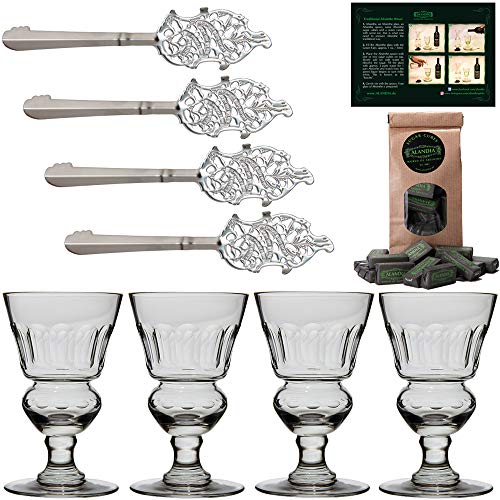
As an Amazon Associate we earn from qualifying purchases at no extra cost to you. Ratings are shown as listed on Amazon.
Top picks by situation
- Best overall: stainless-steel perforated set. Look for three or four matching spoons, 160–170 mm long, weighing approximately 25–40 g each. Stainless steel offers the best balance of durability, low maintenance, and consistent drip control.
- Best for a traditional-looking home bar: silver-plated set. Choose a set with a nickel-silver or stainless base and a clearly stated silver plate, preferably with a protective storage pouch. It delivers a brighter period appearance but needs gentler cleaning and occasional polishing.
- Best budget choice: simple stainless set with a wide support bar. A plain stamped spoon can perform as well as a decorative one if its slots are cleanly cut and its bridge rests securely on the glass.
- Best for frequent use or entertaining: heavier stainless set. Four matching spoons weighing about 35–50 g each are easier to handle repeatedly and less likely to slide when several glasses are prepared at once.
Stainless steel vs silver-plated absinthe spoons
Both materials can support a clean louche. The difference is mainly ownership: stainless steel is forgiving, while silver plate rewards careful handling.
| Characteristic | Stainless steel | Silver-plated |
|---|---|---|
| Typical spoon length | 160–170 mm | 155–170 mm |
| Typical weight per spoon | 25–50 g | 20–45 g |
| Common bowl width | 20–25 mm | 19–25 mm |
| Typical slot length | 3–8 mm | 3–8 mm |
| Typical slot width | 0.8–1.5 mm | 0.8–1.5 mm |
| Drip behavior | Consistent when slots are evenly cut | Consistent, but finish quality varies more |
| Cleaning | Warm water and mild detergent; many are dishwasher-safe | Hand-wash and dry promptly; avoid abrasive products |
| Wear concern | Scratches, bending, or rough stamped edges | Plate thinning, tarnish, and exposed base metal |
| General market range | Approximately $12–$35 for a small set | Approximately $25–$80 for a small set |
These are practical buying ranges rather than universal specifications. A spoon advertised as “silver” may be solid silver, silver-plated, or merely silver-colored alloy, so check the material description before comparing prices.
Why slot design matters more than decoration
The spoon does not normally meter the total amount of water; the user controls that by pouring slowly. Its job is to break the stream into small drops and spread them over the sugar. Slot geometry determines whether that happens smoothly.
For most glasses, a useful target is 8–16 slots distributed across a 20–25 mm bowl. Slots around 3–8 mm long and approximately 0.8–1.5 mm wide usually provide a controlled flow without making the spoon difficult to rinse. Very few, narrow openings can create a concentrated drip and encourage water to run down one side of the sugar. Extremely large openings may let water fall too quickly, especially when the sugar begins to dissolve.
Inspect the underside as well as the top. A good spoon has clean slot edges with no sharp burrs, partially blocked openings, or rough seams that can trap sugar. Decorative cutouts are not automatically useful: a beautiful pattern can provide poor distribution if most of the bowl is solid.
Decision matrix: which set fits your routine?
| Your situation | Recommended specification | Why it fits |
|---|---|---|
| Occasional use, tight budget | Three-piece stainless set, 25–35 g each | Low cost and little maintenance |
| First louche setup | 160–170 mm spoon, 8–16 evenly spaced slots | Fits common glasses and gives predictable dripping |
| Frequent home use | Heavier stainless set, 35–50 g each | More stable and resistant to repeated washing |
| Period-style barware collection | Silver-plated set with 19–25 mm bowl | Closer visual match to traditional service |
| Limited drawer or shelf space | Three spoons with a narrow bridge under 45 mm wide | Stores compactly and fits smaller glasses |
| Multiple glasses at once | Four matching spoons, 30–45 g each | Avoids preparing one glass with an unmatched spare |
Fit the spoon to the glass
Measure the glass rim before buying if possible. The spoon’s support bar should rest on opposite sides of the rim without touching the liquid. For a typical absinthe glass with an opening of 55–75 mm, a spoon bridge that spans roughly 45–65 mm is usually practical. A bridge that is too short can slip inward; one that is too wide may balance only on the outer edge.
The bowl should sit centrally above the glass rather than overhanging one side. A 160–170 mm overall length is a versatile choice, but length alone does not guarantee compatibility. Check the bridge width, bowl position, and the manufacturer’s photographs for the actual resting shape.
How to use the set for controlled louche
- Place the spoon securely. Set the bridge across the rim and confirm that it does not rock when lightly touched.
- Add the sugar. Center one standard sugar cube on the perforated bowl. Oversized cubes can block slots and cause water to run around the edges.
- Start with a slow drip. Add chilled water gradually, roughly one drop every one to two seconds at first. The sugar should soften and dissolve instead of collapsing immediately.
- Increase the flow slightly. Once the sugar is saturated, continue with a thin, controlled stream through the slots. A common starting ratio is three to five parts water to one part absinthe by volume, adjusted to preference.
- Watch the color change. Pause if the liquid becomes cloudy too abruptly or if water begins running down the glass wall. Re-center the spoon and resume more slowly.
- Rinse promptly. Remove sticky sugar residue before it dries inside the slots.
A useful calculation illustrates why spoon size matters: if a 250 ml glass contains 30 ml of absinthe and the target is a 4:1 water-to-absinthe ratio, the final water volume is about 120 ml. A spoon with evenly distributed slots will not measure that 120 ml, but it can spread the addition over several minutes rather than allowing the full amount to arrive in a few seconds.
Ownership realities and common mistakes
On stainless steel, the first problems are usually bent support bars, rough stamped edges, or residue lodged in the slots. Avoid forcing a spoon flat after it bends; repeated correction can create a weak point. Rinse immediately, use a soft brush for the underside, and dry it to prevent water spots.
Silver-plated spoons require more care. Tarnish is normal and does not mean the spoon is unusable, but aggressive polishing can gradually remove the thin silver layer. Hand-wash with mild detergent, dry with a soft cloth, and use a non-abrasive silver-care product only when necessary. Do not soak a plated spoon for long periods, and do not use steel wool or scouring powder.
- Do not place a hot spoon over a cold glass; sudden temperature changes can stress delicate glassware.
- Do not use a spoon with loose plating, exposed sharp edges, or flaking surface material.
- Do not assume dishwasher-safe labeling applies to silver plate.
- Do not judge a set by weight alone; a heavy spoon with poorly placed slots can drip worse than a lighter, well-cut one.
Final buying recommendation
For most buyers, choose a stainless-steel set of three or four spoons, each about 160–170 mm long and 25–50 g, with a 20–25 mm bowl, 8–16 cleanly cut slots, and a bridge suited to the rim of your glass. Select silver-plated spoons when the visual character of the ritual is a priority and you are prepared to hand-wash, dry, and polish them carefully. The best absinthe spoon set for louche ritual is ultimately the one that stays stable, distributes water evenly, and remains easy to maintain after the novelty of the first pour has passed.

Write Your Review
No reviews yet. Be the first to share your experience!