

Key takeaways
- 10–12 cm: individual or two-person cakes.
- 14 cm: compact celebration cake, usually 4–6 portions.
- 16 cm: the most versatile home-baking size, usually 6–8 portions.
- 18 cm: a larger family cake, generally 8–12 portions depending on height.
- 20 cm and above: useful for events but more demanding on mousse quantity and freezer space.
Best Entremet Ring Mold Set for Mousse Cakes
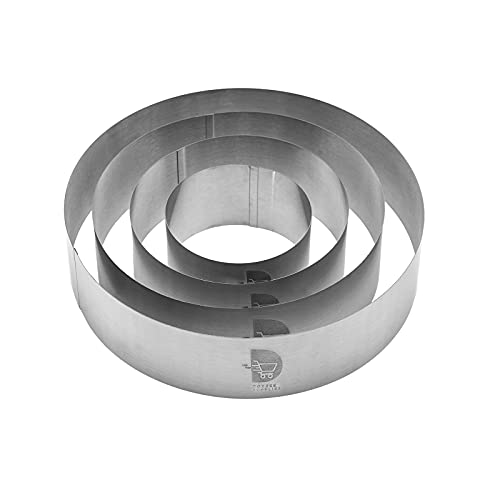
The best entremet ring mold set for mousse cakes is a consistent stainless-steel set with 14–18 cm rings, a height of at least 4.5 cm, and matching inserts that are slightly smaller than the outer mold. For most home bakers, a set built around 16 cm and 18 cm diameters offers the most useful balance between individual portions, celebration cakes, freezer space, and recipe flexibility.
Quick comparison: which set suits your recipes?
| Set type | Typical diameters | Typical height | Material | Best for | Main limitation |
|---|---|---|---|---|---|
| Compact beginner set | 6, 8, 10, 12 cm | 4.5–5 cm | 304 stainless steel or food-grade stainless steel | Small mousse cakes and practice batches | Limited capacity for large gatherings |
| All-purpose home set | 14, 16, 18 cm | 4.5–6 cm | 304 stainless steel | Layered entremets and birthday cakes | Needs separate small rings for individual portions |
| Professional-style set | 16, 18, 20 cm | 5–6 cm | Stainless steel, often seamless | Frequent production and repeated recipes | Uses more mousse and freezer space |
| Ring-and-insert system | Outer ring plus 1–3 insert sizes | 4.5–6 cm | Stainless steel rings with silicone inserts | Defined fruit, caramel, or crémeux centers | Less interchangeable between brands |
Established pastry equipment brands such as Matfer Bourgeat, de Buyer, Gobel, Pavoni Italia, and Silikomart offer useful options across these categories. The brand matters less than the dimensional accuracy, steel quality, and compatibility of the components in the particular set.
Our top picks



As an Amazon Associate we earn from qualifying purchases at no extra cost to you. Ratings are shown as listed on Amazon.
What to look for before buying
Diameter and finished portion size
Diameter determines more than the appearance of the cake. It affects mousse volume, insert size, biscuit dimensions, chilling time, and the number of portions. A 16 cm round entremet at 5 cm high has a geometric volume of approximately 1,005 ml before allowing for the insert, biscuit, and space below the rim. An 18 cm ring at the same height holds approximately 1,272 ml.
That 26% increase is significant. A recipe written for a 16 cm ring should not be poured into an 18 cm ring without increasing the ingredients. Conversely, putting a 16 cm recipe in an 18 cm ring produces a noticeably flatter cake.
- 10–12 cm: individual or two-person cakes.
- 14 cm: compact celebration cake, usually 4–6 portions.
- 16 cm: the most versatile home-baking size, usually 6–8 portions.
- 18 cm: a larger family cake, generally 8–12 portions depending on height.
- 20 cm and above: useful for events but more demanding on mousse quantity and freezer space.
Height and layering flexibility
A 4.5 cm ring is suitable for a thin biscuit, one insert, mousse, and a glaze or velvet finish. A 5–6 cm ring gives more room for a thicker insert, multiple sponge layers, and a defined top edge. Rings shorter than 4 cm can make a mousse cake look compressed, while very tall rings require more mousse and can be awkward to unmold evenly.
For a versatile set, choose rings that are all the same height. Mixing a 4 cm ring with a 6 cm ring is not automatically wrong, but it makes recipe scaling and insert positioning less predictable.
Stainless-steel quality
Food-grade stainless steel is preferable to thin plated metal because mousse cakes are assembled cold, frozen, and unmolded under pressure. Look for a smooth, rigid wall that does not visibly flex when squeezed. A seamless or neatly welded ring is easier to clean and less likely to catch syrup, chocolate, or fruit purée in a joint.
Many pastry rings are made from stainless steel commonly identified as 304. Some listings simply state “stainless steel” without giving the grade; this is not necessarily a problem, but it gives less information about corrosion resistance. Avoid rings with rough burrs, sharp unfinished edges, flaking coatings, or visibly uneven welds.
Sizing consistency
For layered entremets, a small dimensional error becomes obvious. If an outer ring advertised as 16 cm actually varies between 15.7 and 16.3 cm, a pre-cut biscuit or insert may fit one ring but leave a gap in another. Measure the internal diameter rather than relying only on the advertised external measurement.
A practical tolerance for a home set is approximately 1 mm between rings labelled with the same size. The ring should sit flat on a tray or acetate-lined board without rocking. When buying a set with inserts, confirm whether the stated insert size is the external diameter or the usable internal diameter.
Choosing between separate rings and included inserts
Separate rings are the better value if you already own silicone molds or mainly make simple mousse cakes. They are easier to combine with flexible insert molds, acetate strips, and adjustable pastry frames.
A set with included inserts is more convenient for recipes containing a fruit compote, caramel, crémeux, or ganache center. The insert should normally be 2–4 cm smaller in diameter than the outer ring. For a 16 cm cake, a 12–14 cm insert leaves enough room for a visible mousse border without creating an excessively thick outer layer.
| Outer ring | Practical insert diameter | Approximate radial mousse border | Typical use |
|---|---|---|---|
| 12 cm | 8–10 cm | 1–2 cm per side | Individual cake |
| 14 cm | 10–12 cm | 1–2 cm per side | Small celebration cake |
| 16 cm | 12–14 cm | 1–2 cm per side | General-purpose entremet |
| 18 cm | 14–16 cm | 1–2 cm per side | Large layered mousse cake |
Silicone inserts are easier to release from frozen fillings, while stainless-steel inserts give sharper geometric edges and tolerate cutting more firmly set layers. If a set contains only one insert size, check whether additional inserts are available in the same product range before committing to it.
Decision matrix by baking situation
| Your situation | Recommended configuration | Why |
|---|---|---|
| First entremet set | 14, 16, and 18 cm rings, 5 cm high | Covers most recipes without overcomplicating scaling |
| Limited freezer space | 10, 12, and 14 cm rings, 4.5–5 cm high | Smaller cakes freeze faster and occupy less shelf area |
| Frequent layered cakes | 16 and 18 cm seamless rings plus 12 and 14 cm inserts | Supports repeatable mousse-to-insert proportions |
| Occasional use and tight budget | One 16 cm stainless ring and separate acetate | Lowest cost while retaining a highly useful size |
| Individual plated desserts | 6–8 cm rings or matching silicone molds | More appropriate portion size than standard cake rings |
Worked sizing example for a 16 cm cake
Suppose a recipe is written for a 16 cm ring that is 5 cm high and produces approximately 1,000 ml of mousse mixture. If you use the same height but switch to an 18 cm ring, scale the recipe by the area ratio:
18² ÷ 16² = 324 ÷ 256 = 1.27
You therefore need about 1,270 ml of mousse, before accounting for the volume displaced by the insert and biscuit. The same calculation works for sponge layers and fruit inserts, although practical rounding is sensible. Scaling every component by the same ratio helps preserve the intended thickness of the layers.
Ownership, cleaning, and common mistakes
The first parts likely to show wear are thin edges, welded seams, and silicone inserts rather than the main stainless-steel wall. Do not use a knife to pry a frozen cake from a ring; warm the outside briefly with your hands or a gentle stream of warm air, then lift the ring vertically. Scraping the edge with metal tools can create burrs that later damage acetate.
- Wash stainless rings promptly after use with warm water and a non-abrasive detergent.
- Dry them fully before stacking to reduce water spots and trapped moisture.
- Do not leave acidic fruit residue on the metal for long periods.
- Inspect welded joints for rough spots before using acetate or delicate sponge layers.
- Wash silicone inserts without sharp brushes and avoid folding them tightly while damp.
- Store rings nested by size, with silicone parts kept flat or loosely supported.
Use a flat tray, acetate strip, or reusable cake collar beneath the ring. A ring alone is not leakproof, especially with fluid mousse or a thin glaze. Chilling the insert completely before assembly also prevents it from floating, melting the surrounding mousse, or shifting off center.
Final verdict
For most home bakers, the best entremet ring mold set for mousse cakes is a 14–18 cm stainless-steel set with uniform 5 cm height and compatible 12–16 cm inserts. Choose a compact 10–14 cm range if freezer capacity and small portions matter most; choose 16–20 cm professional-style rings if you make celebration cakes regularly. Prioritize accurate internal dimensions, rigid walls, smooth seams, and replaceable inserts over a large number of inexpensive sizes.




Write Your Review
No reviews yet. Be the first to share your experience!