

Key takeaways
- Side curbs: Raised edges help keep wheels on the platform, particularly on narrow ramps.
- Surface traction: Perforated or textured surfaces can shed water, but inspect them for mud, ice, and packed snow.
- Top lip: The upper transition should sit securely on the threshold or landing rather than merely touching a door frame.
- Bottom stability: Feet should sit flat without rocking. Never rely on a loose board or improvised block to correct an unstable angle.
- Width: Measure the usable inside width, not the manufacturer’s outside width. Door frames, side curbs, and hinges reduce clearance.
- Handrails: They are valuable on longer or higher ramps, especially where the user or attendant needs additional guidance.
- Folded dimensions: Compare the packed length, thickness, and carry handles with the actual vehicle cargo area.
The best wheelchair ramps are chosen by measuring the rise first, then matching the required length, weight capacity, surface, and portability to how the ramp will be used.
Quick picks by situation
| Situation | Best ramp type | Typical useful length | What to prioritize |
|---|---|---|---|
| Door threshold or one low step | Rubber, aluminum, or modular threshold ramp | 2–12 inches | Exact height fit, non-slip surface, edge transition |
| One or two porch steps | Folding or telescoping aluminum ramp | 4–8 feet | Low carry weight, side curbs, secure top and bottom contact |
| Minivan or SUV loading | Single-fold, bi-fold, or telescoping vehicle ramp | 6–10 feet | Folded size, vehicle clearance, traction, capacity |
| Frequent daily entrance use | Modular aluminum ramp system | 12–24 feet or more | Stable installation, handrails, weather resistance, code compliance |
| Occasional travel | Portable roll-up or lightweight folding ramp | 2–6 feet | Storage volume, setup speed, surface grip |
How long should a wheelchair ramp be?
Ramp length depends on the vertical rise, not the horizontal distance available. A commonly used planning ratio is 1:12: for every 1 inch of rise, allow at least 12 inches of ramp length. A 6-inch step therefore calls for approximately a 6-foot ramp, while a 24-inch porch requires about 24 feet before adding level landing space.
Our top picks


As an Amazon Associate we earn from qualifying purchases at no extra cost to you. Ratings are shown as listed on Amazon.
Some portable ramps are marketed for steeper slopes, such as 2:12 for a 2-inch rise per foot, but the permitted slope depends on the chair, user, attendant, surface, and local requirements. A steeper ramp may be unsuitable for an unassisted manual wheelchair user and can make descent difficult even when the listed weight limit is adequate. For a permanent or frequently used entrance, ask a qualified accessibility professional or building official to confirm the layout.
Worked sizing example
Suppose a threshold and step together create a 10-inch rise. At a 1:12 planning ratio, the minimum ramp length is:
10 inches of rise × 12 = 120 inches, or 10 feet.
The usable run is not the whole installation. You may also need a level top landing, a level bottom area, and clearance for the ramp’s support feet. If there is only 7 feet of straight space, do not simply substitute a shorter ramp without checking whether the resulting slope is safe for the specific wheelchair and user.
Ramp types compared
Threshold ramps
Threshold ramps solve small height changes at doors, sliding tracks, and raised thresholds. Rubber models are quiet and usually stay in place well on a flat surface. Aluminum threshold ramps are lighter and better suited to repeated removal. They are not a solution for a porch step unless the height is within the model’s rated range. Measure the highest point of the threshold, including trim and weather seals.
Folding aluminum ramps
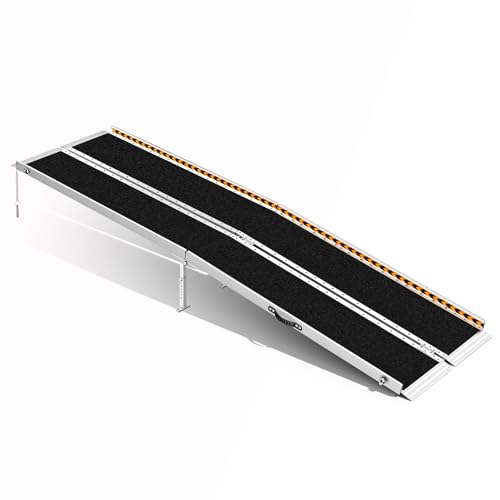
Single-fold and bi-fold ramps are practical for vehicles and occasional household use. Aluminum keeps the weight manageable and does not rust like untreated steel, while raised side curbs help prevent a wheel from drifting off the edge. The trade-off is bulk: a 6-foot bi-fold ramp may be easier to carry than a rigid ramp but still needs a long storage space when folded.
Telescoping ramps
Telescoping ramps collapse lengthwise into two narrow channels or a compact pair of tracks. They are useful when trunk space is limited, but setup requires aligning both tracks and checking that their spacing matches the wheelchair’s wheelbase. Debris in the sliding sections can cause binding. They are often less convenient for scooters with wide front wheels than a full-width platform ramp.
Roll-up ramps
Roll-up ramps are among the easiest to store and carry. They work best for short rises and occasional use where compactness matters more than a rigid, uninterrupted platform. Check whether the ramp is approved for the wheelchair’s wheel arrangement; some narrow designs are intended for small mobility devices or manual chairs rather than wide scooters.
Modular aluminum systems
Modular ramps, including systems sold by brands such as EZ-ACCESS, are assembled into a longer route with platforms, turns, and handrails. They are more stable and convenient for frequent access than a portable ramp, but they cost more, occupy more space, and may require installation. Consider them when the entrance is used every day or when the ramp must remain available in changing weather.
Material, capacity, and portability
| Construction | Typical portable weight | Common capacity range | Advantages | Limitations |
|---|---|---|---|---|
| Rubber or molded composite | 5–25 lb | 600–1,000 lb | Quiet, stable for small thresholds, no assembly | Usually short; can be bulky and difficult to reposition |
| Aluminum | 15–60 lb | 600–1,000 lb | Light, corrosion-resistant, widely available in folding designs | Can flex if undersized; hinges and latches need inspection |
| Steel | 40–100 lb | 800–1,500 lb | Very rigid and durable | Heavy to transport; exposed steel can corrode |
| Composite or fiberglass | 20–60 lb | 600–800 lb | Good weather resistance and low electrical conductivity | Less common and sometimes more expensive |
Capacity must include the combined weight of the wheelchair, scooter, user, bags, and an attendant if one is standing or pushing on the ramp. For example, a 280-pound user in a 190-pound power chair carrying 35 pounds of equipment creates a 505-pound load before accounting for dynamic forces. A 600-pound rating technically exceeds that figure, but a larger margin is preferable for daily use, uneven surfaces, or an attendant-assisted ascent.
Decision matrix for choosing the right ramp
| Your priority | Most suitable choice | Why |
|---|---|---|
| Lowest purchase cost for a small rise | Rubber threshold ramp | Few components and no installation, provided the height matches |
| Limited storage in a car | Telescoping or roll-up ramp | Shorter packed length or smaller storage volume |
| Fast setup by a new user | Full-width folding aluminum ramp | Less alignment work than separate track ramps |
| Heavy power chair or scooter | Wide aluminum or steel platform ramp | More stable width and higher available capacity |
| Daily home entrance use | Modular ramp with landing and handrails | Better stability and repeatability than repeatedly deploying a portable ramp |
| Outdoor exposure and wet weather | Corrosion-resistant aluminum or treated composite | Less maintenance than unprotected steel |
Features that matter more than the advertised weight
- Side curbs: Raised edges help keep wheels on the platform, particularly on narrow ramps.
- Surface traction: Perforated or textured surfaces can shed water, but inspect them for mud, ice, and packed snow.
- Top lip: The upper transition should sit securely on the threshold or landing rather than merely touching a door frame.
- Bottom stability: Feet should sit flat without rocking. Never rely on a loose board or improvised block to correct an unstable angle.
- Width: Measure the usable inside width, not the manufacturer’s outside width. Door frames, side curbs, and hinges reduce clearance.
- Handrails: They are valuable on longer or higher ramps, especially where the user or attendant needs additional guidance.
- Folded dimensions: Compare the packed length, thickness, and carry handles with the actual vehicle cargo area.
Safe setup and ownership checklist
- Measure the rise at its highest point and calculate the required length using the intended slope.
- Check the ramp’s usable width and capacity against the chair, user, equipment, and attendant load.
- Place it on a firm, level surface. Remove loose mats, gravel, snow, and objects that could shift under the feet.
- Secure the top and bottom according to the manufacturer’s instructions. Test the ramp empty before using it with a person.
- Approach centrally and slowly. Keep the chair straight instead of turning on the ramp, and use an attendant when the slope or chair instructions call for one.
- After rain or cleaning, check for slippery residue and allow wet surfaces to drain or dry where practical.
Hinges, rivets, pins, rubber feet, locking straps, and traction coatings generally wear before the main aluminum frame. Inspect them regularly for looseness, cracks, bent edges, corrosion, or missing fasteners. Do not drill new holes, splice sections, or exceed the rated length configuration unless the manufacturer specifically permits it. Clean outdoor ramps with mild soap and water, then keep sliding telescoping sections free of grit; avoid lubricants that attract dirt unless the instructions recommend them.
Bottom line
Choose a threshold ramp for a small doorway lip, a folding or telescoping aluminum ramp for vehicle and occasional travel, and a modular system for a permanent daily entrance. The best wheelchair ramps are not necessarily the lightest or cheapest: the right choice is the one that provides enough length for a manageable slope, adequate capacity with a safety margin, reliable traction, and a setup the user can repeat without improvisation.
Because ramp suitability depends on the individual chair, terrain, and local accessibility rules, consult the wheelchair or mobility-device supplier and a qualified accessibility professional when the rise is substantial, the route is permanent, or the user cannot safely manage the planned slope.

Write Your Review
No reviews yet. Be the first to share your experience!