

Key takeaways
- Under 50 guests and occasional use: choose a three- or four-tier auger with 1.5–3 kg capacity.
- Regular weddings and corporate events: choose a four- or five-tier stainless-steel auger with 3–6 kg capacity and removable parts.
- Large buffets or rental work: choose a five- to seven-tier commercial auger with at least 6 kg capacity, a transport case, and available replacement parts.
- Limited storage or a narrow venue: prioritize footprint and packed weight over maximum tier height.
- New operator: avoid complicated pump systems unless the cleaning procedure and supported liquids are clearly documented.
Best Commercial Chocolate Fountains for Events & Catering
The best commercial chocolate fountain for most caterers is a four- or five-tier, stainless-steel auger model with a 4–6 kg basin, adjustable heat, and tool-free access to the removable tower and auger. It offers enough height for guests to see the flow, enough capacity for a busy service, and fewer failure points than a pump-based fountain.
Quick comparison: which commercial fountain fits your work?
| Fountain type | Typical tiers | Chocolate capacity | Approx. footprint | Best for | Main compromise |
|---|---|---|---|---|---|
| Compact countertop auger | 3–4 | 1.5–3 kg | 30–40 cm wide | Small parties, cafés, occasional hire | Limited reserve during long service |
| Mid-size commercial auger | 4–5 | 3–6 kg | 40–50 cm wide | Wedding catering and regular events | Heavier to transport and clean |
| Large commercial auger | 5–7 | 6–12 kg | 50–65 cm wide | High-volume buffets and rental businesses | Higher purchase cost and power draw |
| Pump-style fountain | 3–5 | 2–8 kg | 35–60 cm wide | Specialty liquids and flexible flow control | Pump cleaning and blockage risk |
These are useful buying ranges rather than universal specifications. Actual capacity depends on the bowl shape, tower diameter, chocolate formulation, and the manufacturer’s fill line.
Our top picks

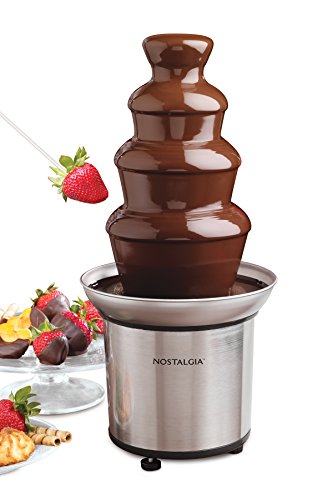


As an Amazon Associate we earn from qualifying purchases at no extra cost to you. Ratings are shown as listed on Amazon.
Best overall: a mid-size stainless-steel auger fountain
A commercial auger fountain in the 4–6 kg class is the strongest all-round choice. It is tall enough to create a visible cascade, but still manageable for one person to load into a vehicle. Stainless-steel construction resists staining and absorbs less chocolate odour than porous materials, while a separate heat control helps maintain flow without overheating the chocolate.
Commercial ranges from brands such as Sephra are worth considering in this category. The important point is not the logo alone; check whether the tower, basin, auger, and splash guard can be removed without specialist tools. A fountain that takes ten minutes to strip down is more valuable to a caterer than one with a marginally taller display.
Why the auger matters
An auger is a spiral shaft that lifts chocolate from the heated basin to the top of the tower. It is usually the better system for chocolate because it has a simple flow path and can be removed for washing. When the chocolate is correctly melted and filled above the minimum level, the auger produces a stable curtain with relatively little mechanical complexity.
The auger does not compensate for thick or cold chocolate. Couverture chocolate normally needs a suitable cocoa-butter content, and many operators thin it with cocoa butter or a manufacturer-approved fluid fat. Water, steam, crumbs, and refrigerated fruit can make the flow lumpy or cause seizure.
Best for frequent high-volume work: a large commercial auger
Choose a six- or seven-tier fountain with at least 6 kg of working capacity when the machine will run through multiple events each week or serve a large dessert station. Extra capacity reduces the need to refill during service, and the taller structure remains visible behind a crowd.
The practical limit is often transport rather than chocolate volume. A large fountain can weigh 15–25 kg before packaging and accessories, and its assembled height may exceed 80 cm. Confirm that it fits through the venue’s doors, inside the transport vehicle, and on a table with enough clearance for a drip tray.
Large machines are also less forgiving of poor setup. The table must be firm and level, because even a small tilt can make one side of the curtain thin. A spirit level, non-slip mat, and a dedicated transport case are inexpensive safeguards for rental operators.
Best for occasional events: a compact countertop fountain
A compact three- or four-tier auger fountain is appropriate when events involve fewer than roughly 50 guests, storage space is limited, or the fountain will be used only a few times per year. Its lower capacity means faster refilling, but it usually uses less power and is easier to carry and clean.
Do not select a domestic novelty fountain simply because its advertised height looks similar. Commercial models generally offer stronger heating, more durable bearings, better alignment, and parts that are intended to be removed repeatedly. For paid catering, those ownership details matter more than a decorative exterior.
Auger versus pump: the head-to-head decision
| Criterion | Auger system | Pump system |
|---|---|---|
| Chocolate reliability | Usually best for standard fountain chocolate | Can be sensitive to viscosity and particles |
| Disassembly | Often one removable shaft and tower | May require pump housing and hoses to be cleaned |
| Noise | Typically a quiet motor hum | Varies; pump vibration can be more noticeable |
| Blockage risk | Lower when chocolate is filtered and fluid | Higher if crumbs or thick chocolate enter the intake |
| Specialty liquids | Limited by the auger and food-safe operating instructions | May offer more flexibility, depending on the pump |
| Best match | Chocolate-focused catering | Operators needing a particular liquid-flow arrangement |
For chocolate-only service, an auger is the safer default. A pump becomes attractive only when the manufacturer explicitly supports the intended liquid and provides clear instructions for cleaning the pump assembly. Never assume that a fountain designed for thin cheese or syrup will handle chocolate without modification.
How much chocolate do you actually need?
Capacity is not the same as consumption. A fountain needs a minimum amount to keep the auger covered, then uses additional chocolate as guests take portions. A practical planning estimate is 60–90 g per guest for fruit and light dipping, or 100–150 g for a dessert-focused station with marshmallows, cake, and biscuits.
For example, 80 guests at an estimated 90 g each requires:
80 × 0.09 kg = 7.2 kg of chocolate consumed or lost to dipping.
A 4 kg fountain would therefore need replenishment, even though its bowl may appear adequate at the start. For a two-hour service, a 6–8 kg machine with a prepared reserve is more practical. Keep reserve chocolate melted in a food-safe container and add it gradually; tipping in cold blocks can lower the temperature and interrupt the curtain.
Setup and cleaning details that separate good machines from frustrating ones
- Level the table before loading. Use a small spirit level and place a stable, washable mat beneath the fountain. A tilted basin causes uneven flow and increases splashing.
- Melt chocolate separately. Melt it in a microwave-safe container or controlled bain-marie, then pour it into the warmed basin. This reduces the heating time and prevents unmelted pieces from stressing the motor.
- Check the minimum fill line. Running an auger partly exposed can create noise, vibration, and unstable flow. Add chocolate before the level falls far enough to uncover the intake.
- Keep food away from the basin. Use long skewers, tongs, and a separate dipping table. Crumbs, fruit juice, and water are common causes of seized chocolate and blocked mechanisms.
- Drain while warm, not scalding. Once service ends, remove excess chocolate while it remains fluid. Letting it harden around the auger and seals turns a routine cleanup into scraping and soaking.
- Disassemble according to the manual. Wash removable food-contact parts with warm water and suitable detergent, but keep the motor base and electrical controls dry. Sanitize and dry every part before storage.
Durability and ownership costs
The parts most likely to wear first are the drive coupling, auger bearing or bushing, power switch, and removable seals. Frequent operators should ask whether replacement parts are sold separately and whether the manufacturer provides a service diagram. A machine with an inexpensive spare coupling can be cheaper to own than a supposedly lower-priced fountain with no parts support.
Budget for transport tubs, drip trays, food-safe cleaning supplies, spare couplings, and chocolate losses. Chocolate left overnight in the tower is not a cleaning shortcut; it hardens around moving parts and can damage the drive when the machine is restarted.
Buying decision by situation
- Under 50 guests and occasional use: choose a three- or four-tier auger with 1.5–3 kg capacity.
- Regular weddings and corporate events: choose a four- or five-tier stainless-steel auger with 3–6 kg capacity and removable parts.
- Large buffets or rental work: choose a five- to seven-tier commercial auger with at least 6 kg capacity, a transport case, and available replacement parts.
- Limited storage or a narrow venue: prioritize footprint and packed weight over maximum tier height.
- New operator: avoid complicated pump systems unless the cleaning procedure and supported liquids are clearly documented.
In short, the best commercial chocolate fountains balance tier height with working capacity and cleanup time. For most event and catering businesses in 2026, that means a stainless-steel, mid-size auger model: tall enough to attract attention, large enough for a real service, and simple enough to disassemble before the next booking.

Write Your Review
No reviews yet. Be the first to share your experience!