

Key takeaways
- Measure the drive end across flats or across the shaft, not just the outside diameter of the flight.
- Check whether the auger uses a retaining pin, bolt, quick hitch, or keyed connection.
- Confirm that the bit’s maximum diameter is approved for your exact power unit.
- Use the correct extension and retaining hardware; improvised pins can shear or loosen.
- Inspect the gearbox output for play before fitting a larger or heavier bit.
The best earth augers match the bit diameter and cutting head to your soil, then provide enough torque for that diameter without exceeding the limits of the operator, gearbox, or machine mount. For occasional fence posts, a 40–60V cordless handheld auger is usually the cleanest choice; for repeated holes, hard ground, or bits larger than about 12 inches, use a two-person petrol unit, skid-steer attachment, or dedicated tractor-mounted auger.
Our top picks

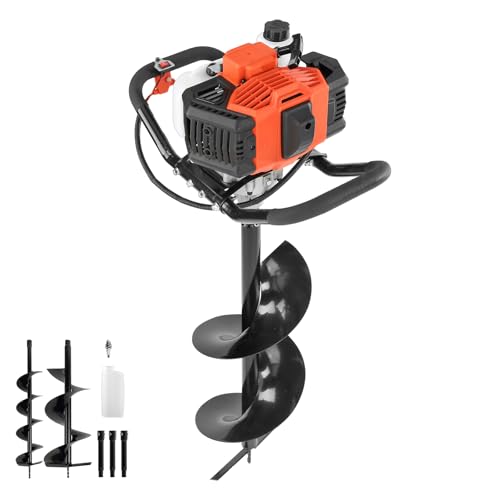


As an Amazon Associate we earn from qualifying purchases at no extra cost to you. Ratings are shown as listed on Amazon.
Best earth augers by situation
| Situation | Best auger type | Useful bit range | Typical power requirement | Main compromise |
|---|---|---|---|---|
| A few fence or sign posts in prepared soil | Single-person cordless handheld | 4–8 inches | 40–60V battery, roughly 1.5–3 kW peak motor output | Limited runtime and stall resistance in roots or clay |
| Regular landscaping and dozens of holes | Two-person petrol or high-torque cordless unit | 6–12 inches | 35–55cc petrol engine or high-output battery system | Heavier, noisier, and more tiring |
| Large shrubs, footings, and dense soil | Two-person petrol auger with reduction gearing | 8–14 inches | 45–70cc petrol engine | Needs careful handling when the bit catches |
| Many holes or difficult ground | Skid-steer, tractor, or mini-loader attachment | 6–30 inches | Hydraulic flow commonly 10–30 gallons per minute | Transport, attachment, and access costs |
| Very hard, rocky, or root-filled ground | Machine-mounted auger with heavy-duty or carbide tooling | 8–24 inches | High-torque hydraulic drive; select by carrier specifications | Slow progress if the tooling is not matched to the ground |
Choose the bit diameter before choosing the motor
Bit diameter determines both the hole size and the torque demand. A 4-inch bit removes about four times as much soil cross-section as a 2-inch bit, while a 12-inch bit removes nine times as much as a 4-inch bit. That is why a machine that handles small planting holes may stall or overheat with a wide post-hole bit.
For standard fence posts, choose a bit diameter about 2–4 inches wider than the post. A 4-inch round post commonly suits a 6–8-inch hole, depending on the soil and required backfill. For a 6-inch post, an 8–10-inch bit is more typical. Check local construction requirements for structural fences, decks, signs, and foundations rather than relying on a general rule.
Bit length matters too. Many earth augers use flights around 30–48 inches long. Longer bits can reach the required depth with fewer extensions, but they also increase leverage when the flight jams. If you need deeper holes, verify that the gearbox and shaft system are approved for extensions; do not assume a longer shaft is safe simply because it fits.
Cutting-head materials: steel, carbide, and replaceable teeth
Standard hardened steel
Hardened steel blades are the sensible choice for ordinary topsoil, loam, sand, and moderately compacted ground. They are usually affordable to sharpen or replace, and a worn cutting edge gives clear visual warning. The limitation is abrasive soil: sand and gravel can round the edge quickly.
Carbide-tipped teeth
Carbide inserts retain an edge longer in compacted, rocky, or abrasive soil. They are not indestructible. Striking buried concrete, steel, or large rocks can chip carbide, and replacement teeth cost more than plain steel blades. Carbide is worthwhile when downtime costs more than the tooling premium, not as a substitute for locating underground services.
Rock and root tooling
Rock augers generally use aggressive replaceable teeth, heavier flighting, and a pilot designed to keep the bit tracking. Root-cutting designs use sharp, reinforced teeth for fibrous roots. These specialized heads can make difficult ground manageable, but they also transmit higher shock loads to the drive. Use them only with a carrier and gearbox rated for the job.
Shaft and drive compatibility is easy to get wrong
Never buy a replacement bit based only on diameter. Confirm the drive connection, shaft length, rotation direction, retaining method, and maximum permitted bit size. Common systems include hexagonal drives, round keyed shafts, and manufacturer-specific couplings. Even two bits advertised for the same nominal shaft size may differ in pin-hole position or usable length.
- Measure the drive end across flats or across the shaft, not just the outside diameter of the flight.
- Check whether the auger uses a retaining pin, bolt, quick hitch, or keyed connection.
- Confirm that the bit’s maximum diameter is approved for your exact power unit.
- Use the correct extension and retaining hardware; improvised pins can shear or loosen.
- Inspect the gearbox output for play before fitting a larger or heavier bit.
For machine-mounted equipment, compatibility also includes hydraulic flow, pressure, mounting plate or three-point hitch category, and the carrier’s lift capacity. A hydraulic motor designed for 10–15 gallons per minute may run poorly or dangerously on a system delivering substantially more flow. The attachment manufacturer’s flow range takes priority over a generic “high-flow” label.
Soil limits determine whether handheld power is enough
Handheld augers work best in loose to moderately firm soil that has already been cleared of major roots and stones. Clay can stick to the flights and overload the motor. Dry compacted soil may require repeated shallow passes, while wet clay can form a plug that lifts out as one heavy mass.
Stop and change equipment when the bit repeatedly stalls, the operator must twist against the handles, or the machine cannot clear spoil from the hole. A stall is not merely an inconvenience: it can damage a clutch, overheat an electric motor, break a drive pin, or cause sudden handle rotation when the bit releases.
Before drilling, contact the relevant utility-location service and inspect the proposed hole for visible irrigation, drainage, footing, and landscaping hazards. An auger is not suitable for blindly drilling through unknown ground.
Battery, petrol, and hydraulic power compared
| Power source | Practical operating pattern | Strengths | Limitations |
|---|---|---|---|
| 40–60V cordless battery | Approximately 20–60 holes per charge with a 6–8-inch bit, depending on soil and battery capacity | Quiet startup, low maintenance, no fuel mixing, useful for residential work | Runtime falls sharply in clay, roots, cold weather, and wide holes |
| 35–70cc petrol | Several dozen holes per tank; actual output depends on bit size and soil | Longer continuous operation and strong peak torque | Noise, exhaust, vibration, fuel storage, and engine maintenance |
| Hydraulic machine mount | Continuous operation while carrier fuel and hydraulic cooling capacity remain adequate | High torque, operator separation from the bit, broad bit selection | Requires a compatible carrier and careful control of downforce |
Battery capacity is expressed in watt-hours: volts multiplied by amp-hours. A 56V, 5Ah battery stores about 280 watt-hours before conversion losses. If an auger averages 1,400 watts while drilling, that equals roughly 12 minutes of equivalent full-load runtime, although intermittent drilling can produce many more holes because the motor is not continuously at maximum output. This calculation is more useful than a universal hole-count claim.
What wears first and how to extend service life
Cutting teeth and pilot points usually wear first, followed by the lower flight edge. On handheld machines, drive pins, clutch components, gearbox seals, and handle fasteners deserve regular inspection. On hydraulic attachments, check the motor, hoses, couplers, mounting bolts, and planetary gearbox for leaks or looseness.
- Remove soil from the flight after use, especially clay that can harden around the shaft.
- Wash mud away from cutting edges, then dry and apply a light corrosion protectant.
- Sharpen steel teeth only to the manufacturer’s angle; excessive thinning makes them chip.
- Replace bent or cracked flights rather than heating and straightening them casually.
- Grease the gearbox and inspect fluid levels at the intervals specified for that model.
- Do not use the bit as a lever to widen a hole; that loads the shaft and gearbox sideways.
A common mistake is applying heavy downforce to make a dull bit cut. That often compacts the soil below the flight and increases stall risk. A sharp tooth, controlled lift-and-clear technique, and several shallow passes usually outperform brute force.
Bottom line
The best earth augers for occasional small holes are lightweight cordless models with 4–8-inch bits and a compatible high-capacity battery. Choose a petrol two-person unit when you need repeated 8–14-inch holes or work in firm ground. For large diameters, rocky soil, roots, or production drilling, a hydraulic machine-mounted auger is the safer and more productive choice. Match the bit, cutting material, shaft, and power source as one system; a powerful motor cannot compensate for the wrong tooth design or an incompatible drive.

Write Your Review
No reviews yet. Be the first to share your experience!