

Key takeaways
- A wheel that turns smoothly without requiring force.
- An adjustable stop or portion setting rather than a permanently fixed outlet.
- An outlet large enough for the largest cereal shape you plan to use.
- A removable mechanism that can be washed without dismantling a fragile spring.
- A stable base that does not move when children or guests operate the lever.
Best Countertop Cereal Dispenser for Kitchen and Buffet
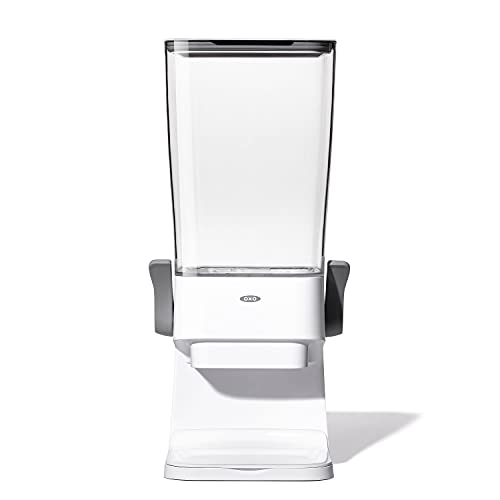
The best countertop cereal dispenser for most homes is a single-canister model with a 4- to 5-liter capacity, a sealed lid, and an adjustable portion wheel; choose a triple-canister unit when several cereals must be available at once for a family, office, guesthouse, or buffet.
The right choice depends less on appearance than on four practical questions: how many cereals you need to serve, how much counter space is available, whether consistent portions matter, and how quickly the food will be consumed. A single dispenser is simpler and usually easier to keep fresh, while a triple dispenser creates a more useful self-serve station but costs more and has three dispensing mechanisms to clean and maintain.
Our top picks



As an Amazon Associate we earn from qualifying purchases at no extra cost to you. Ratings are shown as listed on Amazon.
Single vs. triple cereal dispensers
| Feature | Single-canister dispenser | Triple-canister dispenser |
|---|---|---|
| Typical capacity | 3–5 liters, about 10–18 servings depending on cereal | 9–15 liters total, about 30–54 servings |
| Typical footprint | 15–22 cm wide by 20–30 cm deep | 35–50 cm wide by 20–30 cm deep |
| Typical height | 35–50 cm | 35–55 cm |
| Common materials | ABS or polypropylene body, clear plastic container, silicone or rubber seal | Plastic or metal frame, three clear containers, three seals and dispensing wheels |
| Portion control | Usually adjustable; roughly 25–45 g per full turn | Usually adjustable per canister; settings may not be identical |
| Refilling frequency | Every few days to two weeks in ordinary home use | Every day to two weeks, depending on traffic and capacity |
| Typical market price | About $25–$60 | About $60–$150 |
These figures are useful planning ranges rather than guaranteed specifications. Cereal volume varies considerably: dense granola weighs more per cup than puffed rice, and large flakes may bridge inside a narrow outlet.
Choose a single dispenser when simplicity matters
A single unit is the better buy for one person, a couple, or a kitchen where one everyday cereal is used. It occupies less space, has fewer parts to wash, and exposes only one food to air each time the lid is opened. It is also the safer choice when the counter is shallow or when the dispenser will sit beneath cabinets.
Single-canister models are particularly convenient for dry cereal eaten within one or two weeks. They can also work well for oats, trail mix, crackers, or small dry snacks, provided the opening is large enough and the product is intended for that food type.
Choose a triple dispenser for variety and self-service
A triple dispenser earns its space when people want different cereals without opening multiple bags. It suits a family breakfast station, office kitchenette, short-term rental, reception area, or buffet serving roughly 10 or more people per day.
The trade-off is that three containers do not automatically mean three times the convenience. A wide unit may consume nearly half a meter of counter width, and slow-moving cereal can sit in one chamber for weeks. If one variety is rarely chosen, its texture may deteriorate before the container is empty. For a low-traffic station, two smaller dispensers or sealed original bags may preserve freshness better.
Portion control: useful, but not perfectly precise
Most countertop dispensers use a rotating wheel, paddle, or lever. The mechanism meters food by volume, not by weight, so the same setting will not deliver an identical gram amount for every cereal. A full serving of lightweight flakes may look larger than a full serving of dense granola.
For a buffet, portion control is valuable because it reduces accidental over-dispensing and helps estimate how much food is needed. For a home kitchen, it is mainly a convenience feature. Look for:
- A wheel that turns smoothly without requiring force.
- An adjustable stop or portion setting rather than a permanently fixed outlet.
- An outlet large enough for the largest cereal shape you plan to use.
- A removable mechanism that can be washed without dismantling a fragile spring.
- A stable base that does not move when children or guests operate the lever.
A practical way to calibrate a dispenser is to collect ten portions in a bowl and weigh the total. Divide that weight by ten, then repeat with the cereal that will be served most often. If a mechanism delivers 32 g per turn and a household uses four portions per day, a 4-liter container may last approximately 12 to 18 days, depending on cereal density and how much empty space remains between pieces.
Freshness and airtight design
A dispenser can protect cereal from dust and casual handling, but “airtight” is often used loosely. Many countertop units have a fitted lid rather than a truly airtight food-storage seal. That is usually adequate for short-term daily use, but it will not preserve crispness as well as a gasketed container with a locking lid.
For the best freshness, prioritize a silicone gasket, a lid that closes without gaps, and an outlet that does not remain open after dispensing. Keep the unit away from steam, direct sunlight, the dishwasher exhaust, and the stovetop. Moisture is a greater enemy of crisp cereal than ordinary room air.
Do not mix a new batch into old cereal. Empty the container, inspect the lower outlet for crumbs or oil, wash and dry the parts completely, then refill. Topping up can trap stale pieces at the bottom and makes it difficult to know how long the contents have been stored.
Decision matrix: which format fits your situation?
| Your situation | Recommended format | Why |
|---|---|---|
| One cereal, one to four servings per day | Single, 3–4 liters | Lowest footprint and easiest cleaning |
| Two or three cereals used every morning | Triple, 3–5 liters per canister | Less bag handling and clear variety |
| Small counter or overhead cabinets | Low-profile single or wall-free compact unit | Avoids blocked cabinet doors and wasted width |
| Occasional guests or a low-volume rental | Single or two separate sealed containers | Prevents slow-moving cereal from aging in multiple chambers |
| Daily self-service for 10 or more people | Triple with a weighted base | Faster service and better portion consistency |
| Granola, clusters, or large flakes | Wide-outlet dispenser | Reduces bridging and jams |
| Strict budget under about $40 | Basic single unit | Usually offers better construction per dollar |
Setup and cleaning procedure
Correct setup makes a larger difference than many buyers expect. Use this routine when first installing a dispenser or changing cereal types:
- Measure the counter first. Allow at least 5 cm of clearance around the unit so the lid can open and the dispenser can be wiped.
- Wash food-contact parts. Follow the manufacturer’s instructions; some clear containers cloud or deform in high dishwasher heat.
- Dry every part fully. A few drops of trapped water can soften cereal near the outlet and create a blockage.
- Test with a small amount. Add one or two cups, operate the mechanism, and check whether flakes pass cleanly before filling the container.
- Set the portion. Collect several portions and adjust the wheel or stopper until the output is suitable for your bowls or buffet cups.
- Label the refill date. This is especially helpful in guest-facing locations where several people refill the machine.
- Clean the outlet frequently. Wipe it daily in busy settings and wash the entire food-contact assembly whenever changing products.
Durability and ownership realities
The first part to wear is commonly the dispensing wheel, paddle, lever pivot, or its seal—not the clear container. Repeated operation, sticky cereal dust, and forcing oversized clusters through a narrow outlet accelerate wear. A metal frame can improve stability, but it does not guarantee that the internal food-contact mechanism is stronger.
Before buying, check whether replacement seals, wheels, or dispensing assemblies are available. A low-cost dispenser with no replaceable mechanism may be false economy if it is used dozens of times per day. Avoid filling beyond the marked maximum level, since excess weight can make the wheel stiff and place stress on the pivot.
For buffet use, choose a weighted or non-slip base, rounded surfaces with few crumb traps, and a container that can be removed without lifting the entire stand. For home use, a lighter plastic unit may be easier to empty and wash.
Final verdict
For most kitchens, buy a single 3- to 5-liter countertop cereal dispenser with a gasketed lid, adjustable portion wheel, wide outlet, and removable food-contact parts. It gives the best balance of freshness, price, and maintenance. Choose a triple-canister dispenser only when the variety will be used frequently enough to justify its width and three cleaning routines. In either format, capacity and sealing matter less than matching the dispenser to your cereal type, daily traffic, and willingness to empty and clean it between refills.




Write Your Review
No reviews yet. Be the first to share your experience!