

Key takeaways
- Do not charge a standard LiFePO4 battery below freezing unless its battery-management system specifically prevents this or the battery includes heating.
- Check whether the internal battery-management system supports your inverter’s surge current and the expected charging current.
- Many RV converter-chargers and marine alternators need a lithium-compatible setting or a DC-to-DC charger.
- The initial price is commonly about $500–$1,000 for a quality 100Ah 12V battery, compared with roughly $180–$350 for AGM and $200–$350 for flooded capacity in the same broad category.
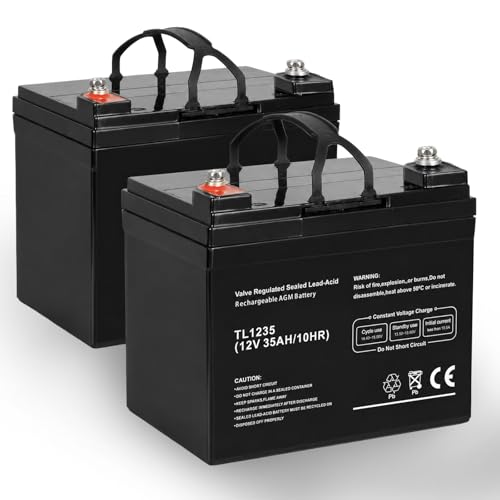
The best deep cycle batteries for most RV, marine, and off-grid systems are 12-volt LiFePO4 lithium batteries when low weight, frequent cycling, and usable capacity matter; AGM is the better maintenance-free choice for moderate budgets, while flooded lead-acid remains the lowest-cost option for stationary systems with ventilation and regular maintenance.
Our top picks

As an Amazon Associate we earn from qualifying purchases at no extra cost to you. Ratings are shown as listed on Amazon.
Quick picks by use case
| Situation | Best battery type | Practical pick | Why |
|---|---|---|---|
| Frequent RV travel and boondocking | 12V LiFePO4 | 100–200Ah lithium bank | High usable capacity, low weight, fast charging |
| Marine electronics and weekend cruising | AGM | 100–125Ah marine AGM | Sealed, vibration-resistant, and simpler to install |
| Lowest purchase price | Flooded lead-acid | Two 6V golf-cart batteries | Strong value if maintenance and ventilation are acceptable |
| Solar cabin used year-round | LiFePO4 | 200–400Ah at 12V, or a 24V bank | Long cycle life and efficient daily charging |
| Infrequent emergency or backup use | AGM | 100Ah AGM | Low self-discharge and no watering |
Best deep cycle batteries compared
Capacity alone does not determine value. A battery’s weight, safe depth of discharge, charging requirements, temperature limits, cycle life, and physical dimensions can matter more than its advertised amp-hours.
| Battery example or type | Nominal capacity | Approx. weight | Recommended usable capacity | Typical cycle-life range | Best fit |
|---|---|---|---|---|---|
| Battle Born BB10012 LiFePO4 | 100Ah at 12.8V | About 31 lb | 80–100Ah | About 3,000–5,000 cycles | RV, van, marine, frequent off-grid use |
| Renogy 12V 100Ah LiFePO4 class | 100Ah at 12.8V | About 25–30 lb | 80–100Ah | About 3,000–5,000 cycles | Budget-conscious mobile solar systems |
| 12V 100Ah AGM deep-cycle battery | 100Ah at 12V | About 60–70 lb | 50Ah | About 500–1,000 cycles | Marine, RV backup, occasional use |
| Lifeline GPL-31T AGM | 125Ah at 12V | About 75 lb | About 62Ah | Roughly 500–1,000 cycles | Premium marine and RV installations |
| Trojan T-105 flooded battery | 225Ah at 6V | About 62 lb each | About 112Ah per two-battery series bank | About 750–1,200 cycles | Stationary solar and golf-cart-style banks |
Figures vary by temperature, discharge rate, charging method, and manufacturer test conditions. “Usable capacity” assumes roughly 80–100% depth of discharge for lithium, about 50% for AGM, and about 50% for flooded lead-acid if long service life is the priority.
Lithium: the best performance per pound
LiFePO4 batteries are usually the strongest choice for an RV or off-grid system that cycles every day. A 100Ah lithium battery provides approximately 1,280 watt-hours at its nominal 12.8 volts. Using most of that capacity is normally acceptable, whereas repeatedly draining a lead-acid battery below half charge shortens its life.
Lithium also maintains a flatter voltage curve. Lights, refrigerators, inverters, and marine electronics receive steadier voltage until the battery is nearly empty. Charging is generally faster, and a lithium battery can accept more of the output from a solar controller or alternator.
Important lithium limitations
- Do not charge a standard LiFePO4 battery below freezing unless its battery-management system specifically prevents this or the battery includes heating.
- Check whether the internal battery-management system supports your inverter’s surge current and the expected charging current.
- Many RV converter-chargers and marine alternators need a lithium-compatible setting or a DC-to-DC charger.
- The initial price is commonly about $500–$1,000 for a quality 100Ah 12V battery, compared with roughly $180–$350 for AGM and $200–$350 for flooded capacity in the same broad category.
AGM: the balanced marine and RV choice
Absorbent glass mat batteries are sealed lead-acid batteries with no routine water topping-up. They tolerate vibration better than many flooded batteries and can be installed in more positions, although the manufacturer’s mounting instructions still apply. AGM is a sensible choice when the battery is used on weekends, stored in a trailer, or installed in a boat where simplicity matters more than minimum weight.
The main compromise is weight. A 100Ah AGM battery can weigh more than twice as much as a comparable lithium battery, while only about half its rated capacity should normally be used. AGM batteries also need a complete absorption charge after discharge; chronic undercharging causes sulfation and permanent capacity loss.
Flooded lead-acid: lowest cost, highest involvement
Flooded deep-cycle batteries remain attractive for a fixed solar bank because they deliver substantial capacity at a relatively low purchase price. Two 6V golf-cart batteries wired in series produce a 12V bank while retaining the amp-hour rating of one battery. They are widely available and can be replaced individually if one fails.
They require ventilation because charging can produce hydrogen gas. Check electrolyte levels regularly with distilled water, clean corrosion from terminals, and avoid placing them directly on an unsealed floor where spills or acid residue can cause damage. Flooded batteries should not be repeatedly discharged deeply, and their capacity falls in cold weather.
Worked sizing example for an RV
Suppose an RV uses a 12V compressor refrigerator averaging 45 watts, LED lighting using 20 watts for four hours, a water pump using 60 watts for 20 minutes, and phone and laptop charging totaling 80 watt-hours per day.
- Refrigerator: 45W × 24 hours = 1,080Wh
- Lighting: 20W × 4 hours = 80Wh
- Water pump: 60W × 0.33 hours = about 20Wh
- Charging: 80Wh
- Total: about 1,260Wh per day
Allowing 15% for inverter, wiring, and temperature losses produces approximately 1,450Wh. A 100Ah 12.8V lithium battery stores about 1,280Wh nominally, so one battery is marginal for a full day. A 200Ah lithium bank provides about 2,560Wh nominally and is a better one-day choice with reserve. The equivalent AGM bank would need roughly 250–300Ah to offer similar practical usable energy, adding considerable weight.
What wears out first?
In lead-acid batteries, sulfation from partial charging is a common failure mechanism. Heat, overcharging, repeated deep discharge, and low electrolyte levels accelerate aging. In flooded batteries, terminals and cable connections may corrode before the plates are completely worn out.
In lithium systems, the cells often last longer than the surrounding electronics. The battery-management system, internal relays, heating elements, or poorly sized terminals can become the limiting components. Lithium batteries are also less forgiving of incorrect charging equipment and freezing conditions.
Installation and maintenance checklist
- Measure the battery compartment before buying. Confirm length, width, height, terminal location, and cable clearance.
- Calculate daily watt-hours rather than choosing by amp-hours alone.
- Size cables and fuses for the inverter and maximum charging current, not merely for average loads.
- Use batteries of the same chemistry, capacity, age, and model when making a series or parallel bank.
- Secure marine batteries against movement and protect terminals from accidental short circuits.
- Program the charger for the chosen chemistry. Avoid leaving AGM or flooded batteries chronically undercharged.
- Inspect connections several times per year and look for heat discoloration, swelling, corrosion, or damaged insulation.
Final buying decision
Choose LiFePO4 if the system cycles frequently, weight is important, or solar energy must be used efficiently. Choose AGM for a sealed, low-maintenance battery in a boat, RV, or backup system that is used periodically. Choose flooded lead-acid when purchase cost is the priority and you have a ventilated installation, room for heavy batteries, and the time to maintain them.
The best deep cycle batteries are not necessarily those with the largest amp-hour label. The right purchase matches usable watt-hours, charging equipment, space, temperature, expected cycle frequency, and the maintenance you are prepared to perform.




Write Your Review
No reviews yet. Be the first to share your experience!