

Key takeaways
- Low balance: quicker hands, easier blocks, and less effort during repeated defensive shots.
- Medium balance: a practical compromise for mixed play.
- High balance: more leverage and attacking weight, but greater demand on timing and arm endurance.
The best padel rackets are the ones whose shape, balance, weight, foam, and surface match your swing: choose a round, low-balance racket for control, a teardrop model for an adaptable all-round game, or a diamond, head-heavy racket for maximum attacking power.
Our top picks


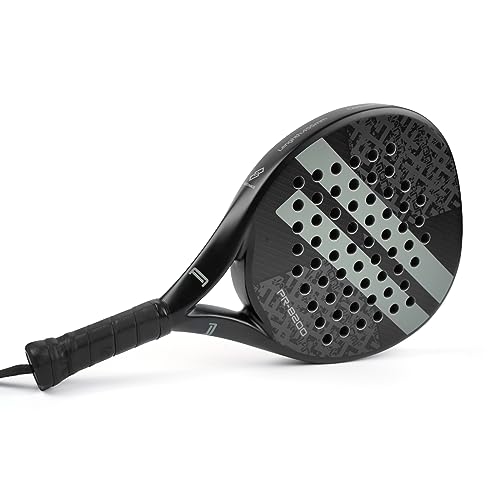

As an Amazon Associate we earn from qualifying purchases at no extra cost to you. Ratings are shown as listed on Amazon.
Best padel rackets by playing situation
| Player or situation | Recommended shape | Useful target specifications | Why it works |
|---|---|---|---|
| First racket or occasional player | Round | 350–365 g; low balance; soft EVA or hybrid foam; 3K–12K carbon or fiberglass face | The broad sweet spot makes off-centre contact less punishing and improves defensive consistency. |
| Beginner developing technique | Round or teardrop | 360–370 g; medium balance; medium-soft foam; 3K–12K carbon | Provides control while leaving enough pace for lobs, volleys, and overheads. |
| Control-focused player | Round | 360–375 g; low balance; medium or soft foam; smooth or lightly rough surface | Predictable handling and a forgiving sweet spot help with placement and defensive resets. |
| All-round intermediate player | Teardrop | 365–380 g; medium balance; medium-density foam; carbon face with moderate texture | Balances easy defence with useful attacking speed as technique improves. |
| Advanced power hitter | Diamond | 370–385 g; medium-high or high balance; firm EVA; 12K–24K carbon face | Extra mass behind the upper contact area increases overhead and volley potential. |
These are buying targets rather than rigid rules. Actual balance depends on the frame, protector, overgrip, and even the amount of moisture absorbed by the racket. A racket listed at 365 g can feel substantially heavier after adding two overgrips and a protective strip.
Shape: the first decision to make
Round rackets for control and confidence
Round rackets place the sweet spot close to the centre of the face. Their lower balance usually makes them easier to manoeuvre at the net and in quick defensive exchanges. They are the safest choice for most beginners, especially players who are still learning the glass rebound, bandeja, and basic volley technique.
The trade-off is that a round racket does not create as much leverage on high contact points as a diamond model. You can still hit hard, but the racket rewards clean technique rather than supplying power automatically.
Teardrop rackets for versatility
Teardrop shapes move the sweet spot slightly higher and offer a middle ground between round and diamond designs. They suit intermediate players who alternate between defence and attack, or beginners who already have reasonable racket-sport coordination.
A teardrop racket is often the best single-racket compromise for a player who does not yet know whether they will become a control specialist or an aggressive overhead player. It is less forgiving than a round racket but generally easier to use than a strongly diamond-shaped model.
Diamond rackets for attacking play
Diamond rackets concentrate more material toward the top of the face and normally have a higher balance. This helps generate pace on smashes, viboras, and attacking volleys, but it reduces forgiveness when contact is low or off-centre.
They are best for experienced players with a reliable swing and enough preparation time. A heavy diamond racket can feel slow during defence, particularly for a smaller player or anyone transitioning from tennis or badminton without padel-specific footwork.
Balance and weight: how the numbers feel in play
Static weight is only part of the story. Balance describes where the racket’s mass is concentrated. A 375 g racket with low balance may feel quicker than a 365 g racket with a heavily head-loaded design.
- Low balance: quicker hands, easier blocks, and less effort during repeated defensive shots.
- Medium balance: a practical compromise for mixed play.
- High balance: more leverage and attacking weight, but greater demand on timing and arm endurance.
For most new players, 350–370 g is a sensible range before accessories. Advanced players may prefer 370–385 g, but extra weight should serve a purpose. It should not be used to compensate for a slow swing or poor contact point.
To estimate your playing weight, add approximately 5–8 g for an overgrip and 3–8 g for a protector. For example, a 365 g racket plus two 6 g overgrips and a 5 g protector weighs about 382 g in use. That 17 g increase can noticeably change balance and fatigue over a long match.
Foam density: soft does not simply mean better
Padel rackets commonly use EVA foam, polyethylene foam, or a hybrid construction. Foam density influences comfort, rebound, control, and the amount of effort required to produce pace.
Soft foam
Soft foam compresses easily and can provide a lively response at moderate swing speeds. It is useful for beginners, defensive players, and anyone who prefers a comfortable, easy-rebound feel. However, a very soft racket may launch the ball higher than expected during fast swings and can feel less precise on powerful volleys.
Medium-density foam
Medium foam is the most adaptable choice. It provides enough rebound for lobs and defensive shots while remaining stable during faster attacks. Many intermediate all-round players should start here, particularly if they play two or three times per week.
Firm foam
Firm EVA rewards a fast, controlled swing with stability and direct feedback. It is often paired with diamond shapes and higher balances for advanced attacking players. It can feel demanding when the ball is cold, when the player is late, or when the racket is used for long defensive exchanges.
Foam also ages. Repeated impacts, heat, cold storage, and prolonged compression can reduce its original response. A racket that suddenly feels unusually harsh, dead, or inconsistent may be worn internally even if the face looks intact.
Surface texture: spin aid, not a substitute for technique
A smooth face offers a consistent, predictable contact. Sand-textured faces and moulded patterns can increase friction and help players produce topspin or slice, especially on serves, chiquitas, and kick-style overheads.
Texture does not create spin by itself. Swing path, racket angle, timing, and clean ball contact matter more. Aggressive textured surfaces can also wear unevenly, particularly if the racket is scraped against glass or the court. Players who value a consistent response over maximum spin may prefer a lightly textured or smooth face.
There is also a difference between a painted rough finish and a moulded surface pattern. A painted finish can become smoother with use, while a moulded pattern is usually more durable but may feel less sharp. Neither option makes an unsuitable racket shape easier to control.
A practical buying decision matrix
| Your priority | Choose | Avoid |
|---|---|---|
| Lowest learning curve | Round, low balance, 350–365 g, soft or medium foam | Heavy diamond racket with firm foam |
| Maximum control near the back glass | Round shape, low balance, medium-soft foam | Very head-heavy balance and highly lively foam |
| One racket for mixed singles-style training and doubles | Teardrop, medium balance, 365–375 g, medium foam | Extreme control or extreme power designs |
| Smash and aggressive volley performance | Diamond, high balance, firm foam, carbon face | Very light, low-balance beginner models |
| Limited budget | Reliable round or teardrop racket with a durable fiberglass or 3K carbon face | Paying mainly for exotic carbon claims without checking shape and balance |
Ownership realities: what wears first
The bumper guard and upper corners usually show damage first because they contact glass, fencing, and the floor. Small cosmetic chips are common, but cracks around the frame or holes should not be ignored. A damaged frame can change the racket’s response and may eventually fail during a swing.
- Use a protector, but remember that it adds weight and can shift balance upward.
- Keep the racket out of a hot car and avoid storing it in direct sun.
- Wipe away sweat and grit with a soft, slightly damp cloth; do not use abrasive cleaners.
- Do not strike the fence or ground to remove a ball.
- Replace worn overgrips before they become slippery. A secure grip reduces the temptation to squeeze the handle too tightly.
- Store the racket in a padded cover rather than loose in a bag with shoes, keys, or hard accessories.
For regular players, a quality racket may last a season or several seasons, but durability depends heavily on court contact, climate, playing frequency, and impact style. Frequent players should inspect the face and frame every few sessions rather than waiting for a visible crack.
Bottom line
For most beginners, the best padel racket is a round model around 350–365 g with low balance and soft-to-medium foam. Control players should prioritise a forgiving round shape, manageable balance, and predictable foam over headline carbon specifications. Power hitters should consider a diamond racket with firm foam and higher balance only after developing consistent timing. If your needs sit between these categories, a medium-weight teardrop racket is the most dependable all-round choice.





Write Your Review
No reviews yet. Be the first to share your experience!