

Key takeaways
- Caliber range: Usually suitable from small pistol cartridges through common .30-caliber and magnum rifle cartridges; verify ram diameter, shell holder fit, and vertical clearance for unusually long cases.
- Throughput: Roughly 50 to 100 completed rounds per hour once the operator is organized, often less for careful rifle ammunition.
- Footprint: Commonly about 6 to 8 inches wide and 10 to 14 inches deep, excluding the handle swing and mounting overhang.
- Adjustment ease: Highest of the three categories because only one die is active at a time.
- Frame rigidity: Usually excellent, particularly with cast-iron frames and a substantial bench mount.
The best reloading presses depend on how much ammunition you load, how many calibers you change between, and whether you value maximum control or maximum throughput: a single-stage press suits careful low-volume loading, a turret press is the best compromise for several calibers, and a progressive press wins when consistent volume matters.
Our top picks
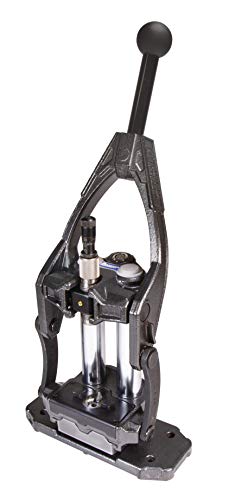


As an Amazon Associate we earn from qualifying purchases at no extra cost to you. Ratings are shown as listed on Amazon.
Quick picks by loading situation
| Situation | Best press type | Strong examples | Why it fits |
|---|---|---|---|
| First press, small rifle batches, lowest complexity | Single-stage | RCBS Rock Chucker Supreme, Lee Classic Cast, Hornady Lock-N-Load Classic | Maximum visibility and simple die adjustment |
| One or two pistol calibers, moderate weekly use | Turret | Lee Classic Cast Turret, Lyman All American 8 | Dies can remain installed while retaining manual control |
| Several calibers and frequent practice | Turret or manually indexed progressive | Redding T-7, Dillon RL 550C | Good caliber flexibility without requiring maximum automation |
| High-volume pistol or .223 Remington loading | Progressive | Dillon XL 750, Hornady Lock-N-Load AP, RCBS Pro Chucker 7 | Multiple operations occur on each handle stroke |
| Limited bench space | Compact single-stage | Lee Challenger-style single-stage presses or similar compact designs | Smaller footprint and lower accessory cost |
Single-stage presses: best for control and learning
A single-stage press holds one die at a time. Each case normally goes through one operation before you change dies or repeat the cycle. That sounds slow, but it makes the process easy to inspect and diagnose. For bottleneck rifle cartridges, careful handloaders often prefer this deliberate workflow.
The RCBS Rock Chucker Supreme is a widely established heavy-frame option with enough clearance for many long-action rifle cartridges. The Lee Classic Cast emphasizes substantial cast-iron construction at a generally lower market price. Hornady’s Lock-N-Load Classic adds a quick-change bushing system, which can reduce die-change time if you buy compatible bushings for each die.
- Caliber range: Usually suitable from small pistol cartridges through common .30-caliber and magnum rifle cartridges; verify ram diameter, shell holder fit, and vertical clearance for unusually long cases.
- Throughput: Roughly 50 to 100 completed rounds per hour once the operator is organized, often less for careful rifle ammunition.
- Footprint: Commonly about 6 to 8 inches wide and 10 to 14 inches deep, excluding the handle swing and mounting overhang.
- Adjustment ease: Highest of the three categories because only one die is active at a time.
- Frame rigidity: Usually excellent, particularly with cast-iron frames and a substantial bench mount.
Choose a single-stage press if you are learning, loading precision rifle ammunition in small batches, or want one robust press for occasional use. Its main disadvantage is not strength; it is repetitive die changes and case handling.
Turret presses: the practical middle ground
A turret press keeps several dies installed in a rotating head. Depending on the design, the head can be manually rotated or the entire sequence can be indexed after each stroke. This preserves much of the visibility of a single-stage press while reducing setup time.
The Lee Classic Cast Turret is attractive for budget-conscious loaders who want a compact, relatively fast system. The Lyman All American 8 provides a large turret with room for multiple die sets. Redding’s T-7 is a heavier, premium turret press aimed at users who value a rigid platform and long-term die-station organization.
- Caliber range: Common pistol and rifle cartridges, subject to turret height, shell holder availability, and the press’s published cartridge limitations.
- Throughput: Approximately 100 to 250 rounds per hour, depending on whether the turret is manually or automatically indexed and how much inspection is performed.
- Footprint: Often 8 to 12 inches wide and 10 to 15 inches deep; the turret increases height and can interfere with overhead shelving.
- Adjustment ease: Very good after each die is set, since the settings can remain in the turret. Caliber changes are faster when separate turret heads are available.
- Frame rigidity: Generally strong, but the rotating head introduces more movement than a fixed single-stage die station.
A turret is often the best choice for someone who loads both pistol and rifle ammunition, changes calibers regularly, or wants more output without committing to a complex progressive setup. The main ownership issue is keeping the indexing mechanism clean and correctly adjusted. A small amount of spilled powder or primer debris can make automatic indexing inconsistent.
Progressive presses: the throughput choice
A progressive press performs several operations during one handle cycle. One station may size a fired case while another expands or primes a case, and another seats a bullet. Once the shell plate is populated, output can rise dramatically.
The Dillon RL 550C is a manually indexed progressive known for broad caliber support and relatively approachable operation. The Dillon XL 750 adds automatic indexing and is better suited to higher-volume production. Hornady’s Lock-N-Load AP uses quick-change die bushings and a five-station layout. The RCBS Pro Chucker 7 offers seven stations, which can provide room for separate powder-check and crimp operations.
| Characteristic | Single-stage | Turret | Progressive |
|---|---|---|---|
| Typical completed output | 50–100 rounds/hour | 100–250 rounds/hour | 300–700 rounds/hour after setup |
| Typical station count | 1 | 4–8 die positions | 4–7 stations |
| Approximate press weight | 12–25 lb | 15–35 lb | 20–35 lb before feeders and accessories |
| Best use | Small batches and rifle work | Mixed calibers and moderate volume | Frequent pistol or .223 Remington production |
| Setup complexity | Low | Moderate | High |
| Bench requirement | Solid mount | Solid, with height clearance | Very solid mount and generous operating space |
Progressive presses reward routine and organization. They are less forgiving of an incorrect die setting, an empty primer tube, a powder measure adjustment, or a case that fails to enter the shell plate correctly. For a new loader, a progressive can still work, but learning it first as a single-station process is usually easier and safer.
What matters more than the advertised speed
Frame rigidity
Rigidity affects alignment, handle feel, and repeatability. A heavy cast-iron frame is useful for sizing large rifle cases, but a rigid mounting surface matters just as much. A press bolted to a thin, flexing bench can feel inaccurate even when the press itself is well made. Through-bolts, large washers, and a reinforced bench top are preferable to short screws driven into unsupported wood.
Die changes and caliber conversion cost
Compare the complete system rather than the bare press. A progressive may need a shell plate, locator buttons, primer system parts, powder measure components, and caliber-specific conversion hardware. A turret may need only another turret head or shell holder. A single-stage press has the lowest conversion complexity, but repeated die changes consume time.
Clearance and cartridge length
Check the press’s maximum ram stroke, window opening, and distance from the shell holder to the top of the frame. Most mainstream presses handle common handgun and hunting-rifle cartridges, but long magnum cases, specialty cartridges, and oversized bullets can expose clearance problems. Also confirm that your shell holder matches the press brand or uses the correct interchangeable standard.
Ownership realities: what wears first
Press frames normally last for decades when kept clean and lubricated appropriately. The parts that usually need attention first are inexpensive wear items: spent-primer tubes, primer-punch springs, shell-plate springs, indexing parts, retaining rings, and powder-measure seals. Progressive presses have more of these parts, so they benefit from a manufacturer with readily available spares and clear diagrams.
Clean spilled powder promptly, keep abrasive primer residue away from moving surfaces, and avoid forcing the handle when a case stops unexpectedly. Lubricate pivots according to the manual, but keep lubricant away from primers and powder. Inspect finished cartridges with the appropriate gauge for the cartridge before use, and follow current data from a reputable loading manual rather than relying on an internet recipe.
Final recommendation
Buy a single-stage press if precision, learning, low cost, and small batches are your priorities. Choose a turret press if you want the most balanced answer for multiple calibers and regular but not industrial-volume loading. Choose a progressive press only when your round count justifies its setup and maintenance demands. For many households, a sturdy single-stage press remains useful even after buying a progressive: it can handle small batches, specialty operations, and troubleshooting without dismantling the higher-output machine.






Write Your Review
No reviews yet. Be the first to share your experience!