

Key takeaways
- Push-button gasket: best for frequent opening, provided the button and underside are washed thoroughly.
- Four-sided locking lid: dependable for dry staples and usually easier to diagnose if a seal fails.
- Clamp-top gasket: excellent for glass storage, but the rubber ring eventually needs replacement.
- Screw-top lid: mechanically simple, though slower to use and more sensitive to dirty threads.
- Loose press-fit lid: suitable for short-term organization, but not the first choice for keeping flour or crackers fresh.
The best kitchen canister set with airtight lids for most homes is a modular set of clear containers with silicone or rubber gaskets, clip-free push-button lids, and a mix of roughly 1- to 4-quart capacities; choose glass instead if heat resistance, stain resistance, and long-term durability matter more than weight.
The right set depends less on the number of pieces in the box than on whether its seals, shapes, and capacities match the ingredients you actually use. Flour and sugar need tall, roomy containers; tea and snacks benefit from smaller boxes; cereal requires a wide opening and enough headroom for a measuring cup.
Our top picks
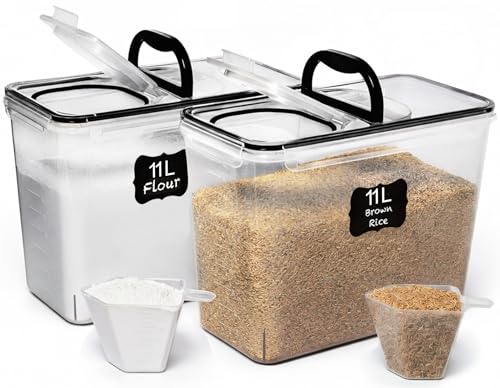

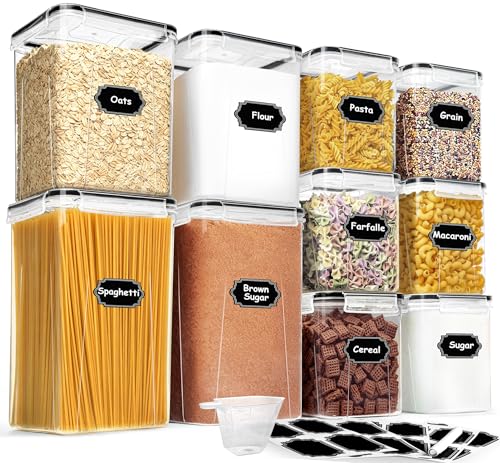
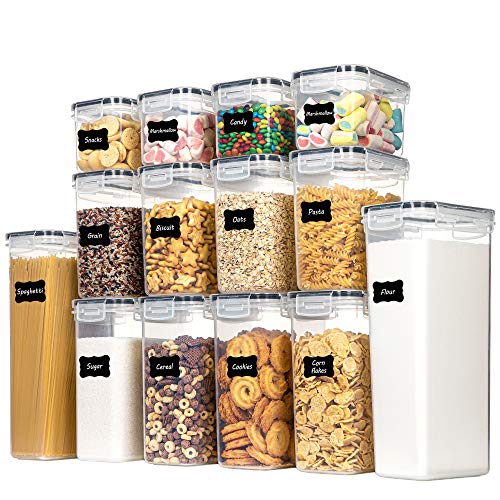
As an Amazon Associate we earn from qualifying purchases at no extra cost to you. Ratings are shown as listed on Amazon.
Best canister sets by kitchen situation
| Kitchen situation | Best choice | Useful capacity range | Why it fits | Main compromise |
|---|---|---|---|---|
| Small cupboards or shallow shelves | Modular plastic pantry containers | 0.5–2.5 quarts | Light, stackable, and available in several footprints | Plastic can scratch and retain odors over time |
| Frequent baking | Tall rectangular containers with gasketed lids | 2–4 quarts | Holds flour, sugar, oats, and baking mixes efficiently | Tall designs may not fit under low shelves |
| Food visibility and stain resistance | Glass jars with silicone or clamp seals | 0.75–2.5 quarts | Does not absorb tomato, curry, or coffee odors and is easy to inspect | Heavy, breakable, and less practical for overhead storage |
| Children or frequent daily access | Push-button plastic containers | 1–3 quarts | One-handed opening and a broad, controlled seal | Moving lid mechanisms need more careful cleaning |
| Lowest initial budget | Basic screw-top or clip-top containers | 0.5–2 quarts | Usually the least expensive way to standardize storage | Less convenient and often harder to stack neatly |
What makes a lid genuinely airtight?
Airtight storage depends on the interface between the lid and container, not simply on a lid that feels tight. Look for a continuous silicone or rubber gasket that contacts the rim all the way around. A lid with four locking tabs can seal well, but it may require two hands and can wear at the hinges. Push-button lids are faster for daily use, although the button and valve create extra crevices.
Clip-top glass jars use a hinged wire and replaceable rubber ring. They can make a strong seal when the ring is correctly seated, but the ring is a consumable part. Inspect it for flattening, cracks, or permanent discoloration. A screw-top lid is simple and often durable, but its threads must remain clean; a small grain of sugar can prevent full closure.
Seal types compared
- Push-button gasket: best for frequent opening, provided the button and underside are washed thoroughly.
- Four-sided locking lid: dependable for dry staples and usually easier to diagnose if a seal fails.
- Clamp-top gasket: excellent for glass storage, but the rubber ring eventually needs replacement.
- Screw-top lid: mechanically simple, though slower to use and more sensitive to dirty threads.
- Loose press-fit lid: suitable for short-term organization, but not the first choice for keeping flour or crackers fresh.
Plastic versus glass: the practical head-to-head
| Feature | Plastic canisters | Glass canisters |
|---|---|---|
| Typical empty weight for a 1-quart container | About 150–350 g | About 500–900 g |
| Drop resistance | High, though lids can crack | Low; may chip or shatter |
| Odor and stain resistance | Good to moderate, depending on plastic | Excellent |
| Stacking practicality | Usually excellent | Good only with a stable, wide base |
| Visibility | Clear, but may haze or scratch | Clear and stays clearer when properly washed |
| Cleaning concerns | Gaskets and lid channels may trap residue | Heavy; seals and wire hardware need separate attention |
| Typical market range for a small set | About $20–$70 | About $25–$90 |
Plastic is normally the better choice for shelves above shoulder height, narrow cabinets, and households that move containers often. Choose food-safe, BPA-free plastic designed for pantry storage, and avoid assuming that “dishwasher safe” applies equally to the lid, gasket, and container. Glass is preferable for strong-colored or strongly scented foods, but calculate the filled weight before placing it on a high shelf.
Notable real-world options and what they do best
OXO Good Grips POP Container sets
OXO POP containers are a strong fit for shoppers who prioritize quick access and coordinated shapes. Their push-button lids are convenient for daily ingredients, while the rectangular and square formats make efficient use of shelf space. They are particularly useful for flour, oats, cereal, and snacks. Check each model’s height before buying: tall versions can be too high for shelves with limited clearance, and the lid mechanism adds parts that must be cleaned properly.
Rubbermaid Brilliance Pantry containers
Rubbermaid Brilliance Pantry containers suit kitchens that need clear, modular plastic storage and easy visual inventory. Their rectangular designs are useful where round jars waste shelf width, and the range typically includes smaller containers for toppings and larger ones for dry staples. They are a practical choice for families, but inspect the lid channels after washing because crumbs can collect around the seal area.
Anchor Hocking glass storage
Anchor Hocking glass containers are worth considering when stain resistance and a substantial, stable container matter more than low weight. Glass makes it easy to check whether contents are dry or contaminated by condensation, and it does not retain most pantry odors. Choose wide-mouth shapes for flour and rice; narrow mouths are harder to clean and awkward with measuring cups.
Fido-style clamp-top glass jars
Fido-style clamp-top jars are a good choice for people who prefer glass and do not mind replacing rubber rings periodically. They work well for beans, pasta, coffee, and decorative countertop storage. Their round footprint wastes some corner space, and the wire hardware prevents the jars from stacking as neatly as purpose-built rectangular pantry containers.
How to choose capacities without wasting space
Buy by ingredient volume rather than by the number of pieces. A useful starting point is:
- 0.5–1 quart: spices, seeds, nuts, tea bags, baking powder, and small snacks.
- 1–2 quarts: rice, lentils, breadcrumbs, pasta shapes, and regularly used snacks.
- 2–3 quarts: oats, cereal, sugar, and medium bags of flour.
- 3–4 quarts: large flour bags, bulk grains, pet treats, and family-size cereal.
Measure the shelf before shopping. Allow at least 2 cm of vertical clearance above the closed lid so containers can be removed without scraping the shelf. For a shelf 30 cm deep, a container with a 28 cm depth may technically fit but will be difficult to grip; a 23–25 cm depth leaves useful finger room.
Stackability is about shape, not just marketing
Look for flat lids, matching footprints, and a lower container that does not taper sharply toward its base. A tall, narrow jar may hold the same quantity as a short rectangular box but be less stable and harder to scoop from. If you stack two containers, place the heavier ingredient below and keep the total filled stack within the shelf’s load rating.
Before filling a set, arrange empty containers on the shelf with their lids attached. This reveals whether the advertised modular system actually uses your space efficiently. Leave one spare container position for an ingredient you may add later; a perfectly full arrangement becomes inconvenient when one container is being washed.
Cleaning and maintenance that extend seal life
- Empty the container completely. Do not top up old flour or cereal with a new batch, because stale residue can remain at the bottom.
- Separate removable parts. Remove silicone rings, valves, or button components when the manufacturer permits it.
- Wash with warm water and mild detergent. Use a soft brush for lid channels rather than a sharp tool that can deform the gasket.
- Dry every part fully. Trapped water is especially problematic for flour, grains, and powdered foods.
- Inspect before refilling. Replace a flattened gasket, cracked lid, chipped glass, or lid that no longer closes evenly.
The component most likely to wear first is usually the gasket or hinge area, not the container body. Avoid forcing an overfilled container closed: pressure can distort the seal and make the lid appear closed without being airtight. Do not pour hot food into a pantry canister unless the manufacturer specifically permits it; many are intended only for cooled, dry ingredients.
Bottom line
For the best balance of airtight performance, capacity variety, and shelf efficiency, choose a modular rectangular plastic set such as OXO POP or Rubbermaid Brilliance Pantry. Select glass, including Anchor Hocking or Fido-style clamp-top jars, when odor resistance and long service life outweigh weight and breakage risk. The best set is the one whose filled containers fit your shelves, whose openings accommodate your measuring tools, and whose seals you will actually remove and clean.

Write Your Review
No reviews yet. Be the first to share your experience!