

Key takeaways
- Performance fabric: More comfortable than a hard seat and often treated for stain resistance. Check the cleaning code and avoid assuming every fabric is machine washable.
- Top-grain or genuine leather: Durable and repairable in some cases, but may require conditioning and can show scratches or color changes.
- Faux leather: Easy to wipe and usually less expensive. Heat, sunlight, body oils, and repeated flexing can eventually cause peeling, especially on seat edges and seams.
- Wood: Long-lasting when sealed, but spills can stain unfinished grain. Hard seats benefit from a shaped profile or removable cushion.
- Molded plastic or polypropylene: Practical for families and workout spaces because it resists spills and cleans quickly. It may feel less warm and supportive during long sessions.
- Metal: Strong and visually light, but a metal seat can become uncomfortable without a cushion. Powder-coated finishes are generally easier to maintain than uncoated steel.
The best counter height bar stools usually have a 24-to-27-inch seat height, which leaves roughly 9 to 12 inches between the seat and a standard 36-inch kitchen counter.
That measurement matters more than a stool’s advertised label. “Counter height” generally describes stools made for 34-to-36-inch counters, while “bar height” usually means a 28-to-33-inch seat for 40-to-42-inch bar tops. A beautiful stool at the wrong height can make eating uncomfortable, restrict legroom, and encourage poor posture during long meals, work sessions, or post-training conversations.
Our top picks


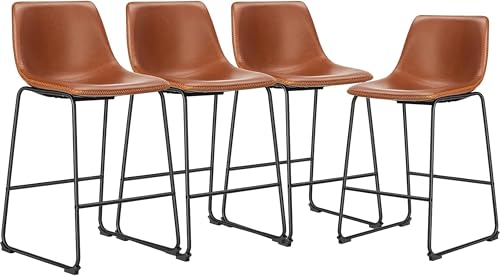
As an Amazon Associate we earn from qualifying purchases at no extra cost to you. Ratings are shown as listed on Amazon.
Quick picks by shopping situation
| Situation | Best stool type | Recommended specification | Why it fits |
|---|---|---|---|
| Most kitchens | Backed counter stool | 24–26-inch seat; 275-pound or higher capacity | Comfortable for meals without overwhelming the counter |
| Small apartment or narrow island | Backless stool | 24–25-inch seat; 14–17-inch width | Slides beneath the counter and preserves walking space |
| Frequent, extended sitting | Padded upholstered stool with back | 25–27-inch seat; 17–20-inch seat depth | Provides support for meals, laptop work, and conversation |
| Children or active households | Wipe-clean molded or performance-upholstered stool | 24–26-inch seat; stable four-leg or pedestal base | Handles spills and repeated climbing on and off |
| Industrial or workout-room aesthetic | Steel-frame stool with wood or molded seat | 24–26-inch seat; non-slip footrest | Resists hard daily use and is easy to maintain |
Match the stool to your counter before comparing styles
Measure from the finished floor to the top of the counter, then subtract that height from the stool’s actual seat height. Aim for 9 to 12 inches of clearance. A 36-inch counter paired with a 25-inch seat gives 11 inches of space, a comfortable starting point for most adults.
For a 34-inch counter, a 24-inch seat usually works well. For a 35-inch counter, consider 24 to 26 inches. For a 36-inch counter, 25 to 27 inches gives more flexibility. If the counter has a thick apron, drawers, or a projecting edge underneath, measure the usable knee clearance rather than relying only on the overall counter height.
Seat height is measured from the floor to the top of the seat cushion, not always to the top of a surrounding frame. Upholstery can compress by approximately half an inch or more under load, so a very soft cushion may feel lower than its listed measurement.
A practical spacing calculation
Allow at least 24 inches of counter width per stool for ordinary use. If people will eat full meals or need elbow room, 26 to 30 inches is more comfortable. For example, a 72-inch island can technically accommodate three stools at 24 inches each, but three 19-inch-wide stools leave only 2 inches between frames if centered tightly. Two 19-inch stools provide better clearance and easier entry.
Also leave approximately 12 inches behind the stool for a seated person’s movement, and about 30 to 36 inches behind it if people must walk through the area regularly.
Back support versus a clean, space-saving silhouette
Backless stools
Backless stools are the best choice when the stools need to disappear under an island or when the room is narrow. They are also less visually dominant and often easier to move. The trade-off is reduced support: users tend to perch rather than settle in, making them less suitable for long meals or desk-like counter work.
Choose a broad, slightly contoured seat instead of a narrow round perch. A footrest is especially important because it prevents the legs from dangling and reduces pressure behind the knees.
Low-back stools
A low back offers a useful middle ground. It supports the lower back while keeping the stool relatively compact. Look for a back that rises at least several inches above the seat and does not force the shoulders forward. Low-back designs work well in kitchens where the stools are used daily but must still slide partly beneath the counter.
Full-back stools
Full-back stools are the strongest choice for comfort during long sitting. They provide more support and make a counter feel like a proper dining or work station. However, they usually occupy more visual and physical space. Check the back height, overall depth, and clearance behind the counter before ordering, particularly in open-plan rooms.
Upholstery and materials: compare the maintenance burden
- Performance fabric: More comfortable than a hard seat and often treated for stain resistance. Check the cleaning code and avoid assuming every fabric is machine washable.
- Top-grain or genuine leather: Durable and repairable in some cases, but may require conditioning and can show scratches or color changes.
- Faux leather: Easy to wipe and usually less expensive. Heat, sunlight, body oils, and repeated flexing can eventually cause peeling, especially on seat edges and seams.
- Wood: Long-lasting when sealed, but spills can stain unfinished grain. Hard seats benefit from a shaped profile or removable cushion.
- Molded plastic or polypropylene: Practical for families and workout spaces because it resists spills and cleans quickly. It may feel less warm and supportive during long sessions.
- Metal: Strong and visually light, but a metal seat can become uncomfortable without a cushion. Powder-coated finishes are generally easier to maintain than uncoated steel.
The areas that wear first are usually the front edge of the cushion, stitching at the corners, the footrest finish, and the joints where the legs meet the frame. Inspect close-up photographs for reinforced seams, welded joints, capped feet, and a footrest that is integrated into the structure rather than attached with a single small bracket.
Why footrests and stability deserve equal attention
A footrest should sit at a natural height for the selected seat. If it is too low, the legs extend forward; if it is too high, the knees rise and the user may slide off the seat. A continuous metal foot ring generally offers more positioning freedom than a small horizontal bar on only one side.
Stability depends on more than the number of legs. A wide base, properly braced joints, level feet, and a seat that is not excessively deep all matter. Four-leg stools can be very stable but may rock on uneven floors. Pedestal stools offer a clean footprint and sometimes swivel, but the base must be heavy and wide enough to resist tipping when someone sits on the edge.
For everyday use, a published capacity of at least 250 to 275 pounds provides a useful margin over the user’s body weight. Heavier users, people who lean back, and households where someone may kneel or climb onto a stool should choose a higher-rated model and follow the manufacturer’s safety instructions. No counter stool should be used as a step ladder.
Swivel or stationary?
Swiveling makes entry and exit easier, especially when the counter has a deep overhang. A return-to-center mechanism keeps the room looking orderly, while a free swivel is more flexible for conversation. The mechanism adds moving parts that can loosen or squeak, so look for a sturdy bearing assembly and accessible fasteners.
Stationary stools are usually simpler, lighter, and less expensive. They are a sensible choice when users can pull the stool out directly and when maximum stability matters more than rotation. For a busy kitchen, stationary stools with rubber or felt floor protectors also reduce maintenance.
Ownership costs and maintenance
General market pricing is roughly $50 to $120 per stool for basic metal, wood, or molded designs; $120 to $300 for better-padded, swivel, or sturdier models; and $300 or more for premium materials and detailed construction. Buying four stools at $150 each is a $600 purchase, but the cheapest option may cost more over time if faux leather peels or joints loosen after heavy use.
Wipe spills promptly with a barely damp cloth. Use the cleaner specified for the upholstery, avoid soaking wood joints, and do not use abrasive pads on powder-coated metal. Check and tighten accessible screws after the first few weeks and then every few months. Replace worn floor glides before exposed metal begins scratching the floor.
For households that sit four times daily, a stool used 1,400 times per year costs about 11 cents per use at a $150 purchase price, before maintenance. That makes comfort, repairability, and correct sizing more important than a small initial price difference.
Final buying checklist
- Measure the finished counter height and any obstruction underneath.
- Choose a 24-to-27-inch seat only when it leaves approximately 9 to 12 inches of clearance.
- Allow 24 inches of counter width per stool, or 26 to 30 inches for more comfortable dining.
- Select a backless design for tight spaces and a backed design for longer sitting.
- Prioritize wipe-clean upholstery in busy kitchens and active households.
- Check the weight capacity, base width, bracing, footrest, and floor protection.
- Confirm the total depth and back height, not just the seat height.
- Prefer replaceable glides, accessible fasteners, and a clearly stated care method.
The best counter height bar stools are therefore not simply the most attractive or heavily padded models. They are the ones that match the counter within a few inches, leave enough room to sit naturally, support the way the space is used, and remain stable and maintainable after years of daily entry, eating, cleaning, and movement.



Write Your Review
No reviews yet. Be the first to share your experience!