

Key takeaways
- Budget: DEX FIT Cru553 and NoCry CutGuard+ give A5 protection with more modest dexterity and durability. They suit occasional use, gardening, craft work and light kitchen jobs.
- Mid-range: The Ansell HyFlex 11-561 and the Ironclad KONG KKC4 sit here. You get a well-regarded A4 build or A4 with impact guards, which covers most workshop and site work.
- Premium: The Mechanix Wear Pursuit D5, Ironclad Command Impact 360, Mechanix SpeedKnit M-Pact and HexArmor Helix 2076 cost more but offer A5 with better feel, impact padding or higher cut levels.
For most workshop, garage and assembly jobs, an ANSI A4 glove such as the Ansell HyFlex 11-561 gives the best mix of feel and protection, while buyers who handle glass, sheet metal or exposed blades should step up to an A5 glove such as the Mechanix Wear Pursuit D5 or a budget A5 like the DEX FIT Cru553. Anyone who also needs knuckle or back-of-hand impact protection should look at the Ironclad KONG KKC4 or the Mechanix SpeedKnit M-Pact. The rest of this guide explains how the ratings work, how the main options compare, and which one suits which job.
Our top picks

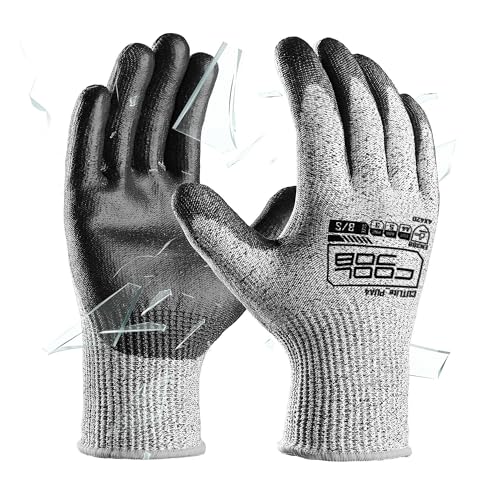


As an Amazon Associate we earn from qualifying purchases at no extra cost to you.
How cut ratings work before you compare models
Most cut resistant gloves sold in North America carry a rating under the ANSI/ISEA 105 standard. The scale runs from A1 to A9, and the number refers to the weight in grams a blade needs to cut through the material in a lab test. Reviewers at WC Safety describe A4 as roughly 1,500 to 2,199 grams and A5 as roughly 2,200 to 2,999 grams. Higher numbers mean a tougher yarn blend, and that usually means a thicker, stiffer or more expensive glove.
Two cautions apply to every glove in this guide. First, the rating measures resistance to a slicing cut only. Puncture from needles, nails or glass shards and crushing impact are outside that scale and need separate ratings or added padding. Second, cut resistant does not mean cut proof. A fast, heavy, pointed blade can still get through, so the rating should be matched to a realistic hazard assessment rather than simply buying the highest number.
It is also worth reading the model name closely. One independent roundup noted that a single brand page listed some of its products at both A2 and A5, so confirm the rating printed on the specific pair rather than relying on the brand name or a marketing headline.
Cut resistant gloves at a glance
| Glove | Stated cut level | Best for | Main limit |
|---|---|---|---|
| Ansell HyFlex 11-561 | A4 | General fabrication, assembly, light shop work | Not enough for glass plate or heavy blade work |
| Mechanix Wear Pursuit D5 | A5 | Daily wear where dexterity matters at a high cut level | Premium cost for the rating |
| DEX FIT Cru553 | A5 | Budget buyers wanting A5 protection | Reviewers rate dexterity below premium gloves |
| NoCry CutGuard+ Reinforced | A5 (maker lists A5) | Kitchen, craft and household cutting tasks | Check the rating on the exact model purchased |
| Ironclad KONG KKC4 | A4 with impact guards | Construction, demolition, rough handling | Bulkier than knit-only gloves |
| Mechanix Wear SpeedKnit M-Pact | A4 with D3O impact padding | Heavy-duty work with knuckle risk | Warmer and thicker |
| Ironclad Command Impact 360 | A5 with impact guards | Mechanics and tradespeople needing cut plus impact | Less nimble for fine tasks |
| HexArmor Helix 2076 | A6 | Higher hazard environments | Specialist glove, more cost |
Ratings above come from the makers or from independent outlets such as WC Safety, DIYRated, Gloves360 and Panoz Auto, which publish their own roundups. Several of those pages are written by sellers or carry affiliate arrangements, so treat the rankings as one input rather than a verdict.
Best everyday pick: Ansell HyFlex 11-561
WC Safety names the HyFlex 11-561 as its best A4 glove, citing the balance between dexterity and protection. The HyFlex line is a thin, knit-style glove with a coated palm, which is why it appears so often in assembly, automotive and light manufacturing settings. Because A4 liners are generally thinner than A5 liners, you can pick up screws, thread a bolt or handle a small part without taking the glove off.
Choose it if your main risk is the occasional slip with a utility knife, a box cutter or the edge of a trimmed panel. Skip it if the job involves repeated contact with exposed sharp edges, such as handling flat glass or stamped sheet metal, where the extra band of protection is worth the stiffer feel.
Best A5 for dexterity: Mechanix Wear Pursuit D5
WC Safety lists the Pursuit D5 as its top A5 glove, describing a liner that blends high-performance polyethylene with steel and a nitrile palm. DIYRated calls it the most dexterous cut glove in its roundup, but also points out that it costs several times what a budget A5 glove costs for the same cut rating. That makes it a good fit for people who wear a cut glove for most of the day and notice every bit of lost feel, and a harder sell for someone who needs a pair twice a year.
Best budget A5: DEX FIT Cru553 and NoCry
Several outlets point buyers who want A5 protection on a tight budget to the DEX FIT Cru553. Gloves360 also groups DEX FIT and NoCry together as options that reach A5 at a low price. The trade-off reported by reviewers is usually feel: low-cost A5 gloves tend to be a little stiffer, and the coating may wear sooner than on premium pairs.
NoCry lists its CutGuard+ Reinforced glove as ANSI Level A5 on its own site, and Gloves360 highlights the NoCry Premium as a kitchen-friendly option described as food-contact compliant. If you plan to use any glove around food, read the maker’s wording on food contact rather than assuming it, and note that a glove that touches raw food needs to be washed or replaced according to the instructions.
Best with impact protection: Ironclad and Mechanix padded options
Cut resistance and impact protection solve different problems. Panoz Auto includes the Ironclad Command Impact 360 in its mechanic glove list and describes it as a 360-degree cut glove with impact guards. DIYRated lists the Ironclad KONG KKC4 as an A4 glove with impact protection for construction and demolition. Gloves360 calls the Mechanix Wear SpeedKnit M-Pact, which combines A4 cut protection with D3O impact padding, the best heavy-duty option in its list.
These gloves are a good match for people who bang knuckles on engine bays, handle rough lumber or work around falling debris. They are less pleasant for fine, repetitive tasks because the padding adds bulk and heat.
Step-up option: HexArmor Helix 2076
WC Safety names the HexArmor Helix 2076 as the step up from A4 when the hazard is higher. It carries an A6 rating, so it is meant for environments where a standard A4 or A5 glove is not enough. This is specialist equipment, and a workplace should base the choice on a written hazard assessment instead of a roundup.
Budget tiers explained
- Budget: DEX FIT Cru553 and NoCry CutGuard+ give A5 protection with more modest dexterity and durability. They suit occasional use, gardening, craft work and light kitchen jobs.
- Mid-range: The Ansell HyFlex 11-561 and the Ironclad KONG KKC4 sit here. You get a well-regarded A4 build or A4 with impact guards, which covers most workshop and site work.
- Premium: The Mechanix Wear Pursuit D5, Ironclad Command Impact 360, Mechanix SpeedKnit M-Pact and HexArmor Helix 2076 cost more but offer A5 with better feel, impact padding or higher cut levels.
Pick this if… decision table
| If you need… | Pick | Why |
|---|---|---|
| All-day dexterity at A4 | Ansell HyFlex 11-561 | Thin knit build, WC Safety best A4 choice |
| Highest feel at A5 | Mechanix Pursuit D5 | Steel and polyethylene blend liner, nitrile palm |
| A5 on a small budget | DEX FIT Cru553 | Multiple outlets name it as the budget A5 |
| Kitchen or craft cutting | NoCry CutGuard+ | A5 rating listed by the maker |
| Impact plus cut at a mid level | Ironclad KONG KKC4 | A4 with impact guards |
| Heavy-duty impact padding | Mechanix SpeedKnit M-Pact | A4 with D3O padding |
| Cut plus impact at A5 | Ironclad Command Impact 360 | 360-degree cut protection with guards |
| Higher hazard than A5 | HexArmor Helix 2076 | A6 rating |
Fit, sizing and care notes
A cut glove that is too large bunches in the fingertips and reduces control, which can lead to more accidents rather than fewer. Measure the width of your dominant hand around the knuckles, compare it to the size chart the maker publishes, and choose the size where the fingertips sit snugly with no excess material. Many knit gloves stretch a little with wear, so a snug fit at first is normal.
For care, follow the label. Most coated knit gloves can be hand washed or machine washed on a gentle cycle with mild detergent and air dried, but heat and harsh chemicals can degrade coatings and fibers. Retire any glove that has visible cuts, thin patches in the palm, frayed fingertips or a coating that is peeling. Cut gloves also do not replace the other safe habits, such as cutting away from the body, using sharp tools and keeping the blade guarded.
For chemical, heat or electrical hazards, a cut glove is not the right protection. Follow your employer’s safety guidance or the tool maker’s manual, and speak to a qualified safety professional if you are unsure what the job demands.
Alternatives to consider
- Cut resistant sleeves: Worn with ordinary work gloves, they protect forearms from sheet metal and glass edges. They are useful when a glove is too clumsy for the task.
- Stainless mesh gloves: Often used in butchery and oyster shucking. They are heavy and are chosen for repeated knife work, which is a different job from general shop use.
- Coated leather work gloves: Tough against abrasion and heat, but not rated for cut. They fit tasks where abrasion matters more than blades.
Frequently Asked Questions
Is an A4 glove enough for most home projects?
For most home and workshop jobs, such as trimming panels, handling sheet material or using a utility knife, A4 is the level many reviewers suggest. It keeps the glove thin enough to feel small parts. If you handle glass plates or sharp metal edges regularly, consider A5.
Can cut resistant gloves stop a knife stab?
No. The ANSI cut rating covers slicing resistance, not puncture. Needles, knife tips and nails can pass through knit fibers, so puncture resistance needs a separate rating on the product.
Are cut resistant gloves safe to use around food?
Only if the maker states they are suitable for food contact. Some brands, such as NoCry, promote kitchen-oriented models, but you should read the specific product description and wash the glove according to the label.
How long do cut resistant gloves last?
It depends on use, coating, and washing. Replace them when you see exposed fibers, holes, thin palm coating or fraying, since protection can fall off before the glove looks ruined.
Do higher cut levels always protect better?
A higher number means more resistance in the lab test, but real protection depends on the blade, the force and the contact angle. Heavier gloves can reduce feel, which can raise risk on delicate tasks, so match the rating to the hazard.
Should I buy a bigger size so the glove is comfortable?
Not usually. Extra material at the fingertips reduces grip and can catch on moving parts. Use the maker’s size chart and aim for a close, comfortable fit.









Write Your Review
No reviews yet. Be the first to share your experience!