

Key takeaways
- Best Muay Thai shin guards: six padded options from Fairtex, Venum, FIVING and more, compared by size, padding, straps and instep cover.
The Fairtex SP5 is the best overall pick for Muay Thai: it is a competition-style guard from a Thai brand, with a seamless synthetic shell and dense foam lining, and it is the one on this list built around the sport itself. Muay Thai shin guards are padded guards worn over the shin and instep so that partners can throw and check kicks in sparring without the bone-on-bone punishment of bare legs. The other five picks serve different jobs: the Venum Challenger pairs are an established standup choice, and the FIVING and Elite Sports guards are lighter-duty options that make sense for beginners and kickboxing or MMA classes.
Sizing is the biggest trap with shin guards, so read the size notes in each section before adding one to your cart.
Quick List
- FIVING Shin Guards (black, medium) – best for beginners who want adjustable padding with instep protection
- Venum Challenger Standup (medium) – best for average-height strikers who want a known standup brand
- Venum Challenger Standup (large) – best for taller or larger-legged fighters in the same design
- Elite Sports Muay Thai Shin Guards – best for sparring and training across kickboxing, MMA and BJJ classes
- FIVING Shin Guards (white, medium) – best for buyers who want the FIVING design in a lighter color
- Fairtex SP5 – best for serious Muay Thai students and competitors
Which One Is Right for You?
| If you… | Choose |
|---|---|
| Train Muay Thai seriously and want a competition-style guard | Fairtex SP5 |
| Want a trusted standup guard and wear a medium | Venum Challenger Standup (medium) |
| Are taller or have larger calves and need more room | Venum Challenger Standup (large) |
| Are new to sparring and want adjustable straps with instep cover | FIVING (black, medium) |
| Prefer a lighter color to show off in class | FIVING (white, medium) |
| Cross-train in kickboxing, MMA and BJJ | Elite Sports Muay Thai Shin Guards |
If you spar with heavy kickers, put the Fairtex or Venum first, since they are the more established designs for standup work. If your classes are mostly pad rounds with light technical sparring, the FIVING or Elite Sports guards are enough. The most important choice is size, so measure your leg before you commit.
All 6 Picks in Detail
1. FIVING Shin Guards (Black, Medium) – Best for Beginners
As an Amazon Associate we earn from qualifying purchases at no extra cost to you.

FIVING sells these as MMA and martial arts shin guards for Muay Thai, kickboxing and MMA training, with padding, adjustable straps and instep protection called out in the listing. They are aimed at the student in the first year of training, the kind of person who needs gear that works for light to medium sparring and does not cost as much as a Thai-made competition pair.
The medium size is shown in black. Because sizing runs by brand, compare your shin length and calf width to the chart rather than relying on your usual clothing size. A guard that is too long can bunch at the ankle or knee, and a guard that is too short leaves part of the shin exposed.
- Marketed for Muay Thai, kickboxing and MMA training
- Padded design with adjustable straps, per the listing
- Instep protection included, per the listing
- Size shown: medium, black
- Padding type and shell material: confirm on listing
- Strap count and closure: confirm on listing
The black color and padded build also make it forgiving of daily use. Beginners tend to drag gear across mats, stuff it into bags and forget to dry it, and a simple design handles that better than a delicate one. Expect to adjust the straps a few times in the first weeks as you learn how snug you like the guard, and check that the instep section lies flat on top of your foot rather than folding. If the guard shifts during kicks, tighten the lower strap before the upper one.
Pros:
- Beginner-friendly adjustability
- Instep coverage in the same piece
Cons:
- Lesser-known brand for hard kicking
- Material details not in the listing name
Compared with the Venum Challenger, it is the lighter-duty option for newer students.
2. Venum Challenger Standup (Medium) – Best for Average-Size Strikers

Venum is one of the best-known names in combat-sports gear, and the Challenger Standup is a long-running shin guard aimed at standup striking. This listing is the medium in black and black. It suits the student who spars regularly and wants a guard with a reputation, without moving to a premium Thai handmade pair.
Standup guards like this one focus on a padded shin and an attached instep section, with straps to hold the guard in place. Because exact padding thickness and shell materials are not stated in the listing name, confirm them on the page. Venum publishes size information on its own product pages, and checking it will save you a return.
- Standup shin guard design
- Size: medium, black over black
- Marketed for striking and sparring
- Shell and foam details: confirm on listing
- Strap system: confirm on listing
- Instep section: confirm on listing
Standup guards of this type are built for the usual kickboxing and Muay Thai drill sequence: rounds of pad work, technical sparring with a partner, and occasional harder rounds. They tend to carry more padding than minimalist Thai guards, which can feel reassuring if your partner throws heavy low kicks. The tradeoff is added bulk, so you may notice more weight on your own kicks. Give yourself a few weeks of drills to see how your balance adjusts.
Pros:
- Established combat-sports brand
- Straightforward black design goes with any kit
Cons:
- Sizing needs checking against the maker’s chart
- Limited details in the listing title
It is the same guard as the next entry in a different size, so decide by your leg measurements.
3. Venum Challenger Standup (Large) – Best for Taller Fighters
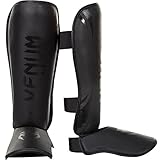
This is the same Venum Challenger Standup design in a large. The reason to have it as a separate pick is that sizing is the single most common reason shin guards disappoint. A medium that rides up on a taller fighter leaves the lower shin exposed, while a large on a smaller leg slides and twists when you kick.
If you are over average height, have thicker calves, or like a bit of room for a wrap or sleeve, this is the one to look at. If you are between sizes, think about what you do: a heavy sparrer often prefers a snug fit that stays still, while a student who mostly holds pads can accept a looser one.
- Same Challenger Standup design as the medium
- Size: large, black over black
- Intended for standup sparring and kickboxing
- Exact length and calf width: confirm on listing
- Padding and shell material: confirm on listing
- Strap style: confirm on listing
If you are tempted to pick the larger size just to be safe, resist the urge. An oversized guard rotates when you kick, and a rotating guard leaves the front of the shin uncovered right when you need it. On the other hand, taller fighters who squeeze into a medium often find the guard rides up the leg and leaves the lower shin and ankle open. Compare the manufacturer’s size chart to a tape measure and take notes on your knee-to-ankle length before you choose.
Pros:
- Gives taller fighters more coverage
- Same trusted design as the medium
Cons:
- Can be too large for average-size legs
- Same limited listing detail as the medium
Pick it over the medium only if your measurements say so, not because bigger feels safer.
4. Elite Sports Muay Thai Shin Guards – Best for Cross-Training Classes

Elite Sports markets these as Muay Thai shin guards for kickboxing and MMA, with leg and instep protective pads for martial arts kicking, sparring and training, and it also names BJJ. That makes them a good fit for a student who flits between classes and wants one affordable guard in the bag.
Guards labeled for many sports are rarely specialized. They tend to offer moderate padding and a flexible fit that works for light sparring and pad work. If you are heading toward harder Muay Thai sparring, you will probably want to move up to a more focused design. For starting out, they do the job.
- Marketed for Muay Thai, kickboxing, MMA and sparring
- Leg and instep protective pads, per the listing
- Listing also references BJJ use
- Sizes available: confirm on listing
- Padding thickness and shell: confirm on listing
- Strap count: confirm on listing
A cross-training guard also needs to behave in the clinch and on the ground. Lighter padding and flexible straps are easier to wear when you transition between standing and grappling, and a snug fit stops the pad from catching on a partner. If you plan to wrestle or roll while wearing the guards, check with your coach, because many gyms ask students to remove them for ground work. Dry them after each class and keep them away from direct heat, which can warp the foam.
Pros:
- Broad sport coverage
- Instep protection in a single piece
Cons:
- Generalist design
- Details on construction are limited in the title
Next to the FIVING pairs, it plays a similar role, with a more cross-training angle.
5. FIVING Shin Guards (White, Medium) – Best for a Lighter Color Choice
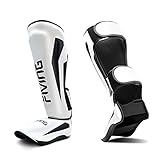
This is the same FIVING design as the black pair, shown in white and medium. Color is more than cosmetic: white shows scuffs and sweat, which some students dislike, while others enjoy being able to tell their gear apart from a training partner’s in a crowded rack.
Everything in the first FIVING entry applies here, from the adjustable straps to the instep protection. Because the listing sizes are the same, use the same size check. If you train with a partner who also uses the black pair, picking a different color is a simple way to avoid mixing up gear at the end of class.
- Same FIVING design as the black version
- Color: white; size: medium
- Padded with adjustable straps and instep protection, per the listing
- Marketed for Muay Thai, kickboxing and MMA training
- Shell material and padding: confirm on listing
- Strap style: confirm on listing
If you like the FIVING design, a second pair in a different color has practical benefits. Having two pairs lets one dry out while the other is in use, and it gives a training partner a loaner without you losing your own. Light colors do show stains, but a wipe with a damp cloth after class keeps them respectable. Avoid washing the guards in a machine, which can damage the straps and compress the foam.
Pros:
- Easy to tell apart from a partner’s black pair
- Same beginner-friendly adjustability
Cons:
- White shows dirt and wear quickly
- Same limited listing detail
It is the same product as pick one in a different color, so choose by taste.
6. Fairtex SP5 – Best for Serious Muay Thai Students

Fairtex is a Thai brand with deep roots in the sport, and the SP5 is its lightweight competition-style shin guard. The listing describes a seamless synthetic shell with dense foam lining and an ergonomic lower section. Fairtex’s own material describes a synthetic-leather shell, double layers of high-density foam, no stitching across the shin and instep connection, and no metal loops. That design suits students who spar hard and compete.
The SP5 is available in several sizes, and Fairtex publishes a chart using height, knee-to-ankle length and foot length. Use it. The brand’s guards are made to be snug and light, so a good fit matters more than usual. Because strap details vary by retailer descriptions, confirm the strap count on the listing.
- Lightweight competition-style Muay Thai guard
- Seamless synthetic shell with dense foam lining, per the listing
- Ergonomic lower section, per the listing
- Sizes: confirm on listing; the maker uses a height and shin-length chart
- Strap count: confirm on listing
- Color options: confirm on listing
The SP5 follows the Thai tradition of a close, lightweight fit rather than a bulky trainer shape. That helps with speed and balance and suits competition rounds, where you want the guard to disappear on your leg. In heavy sparring with a much larger partner, some students prefer a thicker trainer-style guard, so think about who you spar with. Many serious students own two pairs: lighter ones for technical work and thicker ones for hard rounds.
Pros:
- Built around Muay Thai
- Light and seamless design
Cons:
- Lighter padding than bulky trainers prefer for heavy sparring
- Needs careful sizing
It is the most sport-specific guard here, while the Venum Challenger is the more padded all-round trainer.
Specs Compared
| Product | Size in listing | Color | Stated features | Stated sports |
|---|---|---|---|---|
| FIVING Shin Guards (black) | Medium | Black | Padded, adjustable, instep protection | Muay Thai, kickboxing, MMA |
| Venum Challenger Standup (medium) | Medium | Black/black | Standup shin guard; confirm on listing | Standup striking |
| Venum Challenger Standup (large) | Large | Black/black | Standup shin guard; confirm on listing | Standup striking |
| Elite Sports Muay Thai Shin Guards | Confirm on listing | Confirm on listing | Leg and instep protective pads | Muay Thai, kickboxing, MMA, BJJ |
| FIVING Shin Guards (white) | Medium | White | Padded, adjustable, instep protection | Muay Thai, kickboxing, MMA |
| Fairtex SP5 | Confirm on listing | Confirm on listing | Seamless synthetic shell, dense foam lining | Muay Thai |
How We Chose These
We began with the current catalog of Muay Thai and standup shin guards and compared the intended sport, size, color, padding description and instep coverage that each listing states. We favored guards named for Muay Thai or striking, and we treated multi-sport guards as cross-training options. We also read manufacturer product pages and size charts, plus retailer descriptions, to see how brands describe their shells, foam and straps. Where a listing leaves out a detail, we say to confirm it on the product page. The picks are a research-based shortlist, not a ranking from physical trials.
What to Look For
Sizing: the first decision
Shin guards are sized by leg length more than clothing size. Measure from the center of the knee to the top of the foot, since a guard must cover the shin without pressing into the knee or sliding down over the ankle. Fairtex, for example, publishes a chart that pairs height with knee-to-ankle length: a person from about 5 feet 3 inches to 5 feet 10 inches measures around 15 inches from knee to ankle in its medium. Venum and other brands publish their own charts, and they do not always match. When you are between sizes, snug usually beats loose for sparring, because a guard that spins on the leg exposes the shin and can irritate the skin.
Padding, shell and weight
Thicker foam absorbs more of a partner’s kick but weighs more and can feel clumsy on your own kicks. Lightweight competition-style guards use dense, thin foam and a snug shape. Shell material matters too: synthetic leather is common, genuine leather is heavier and pricier, and softer vinyl or fabric hybrids are lighter and cheaper. Dense foam gives a more consistent feel, while cheap foam can compress and stop protecting after months of use. Heavier guards are usually better for hard sparring, and lighter guards for technical work and competitions.
Straps, closures and instep design
Most guards use hook-and-loop straps at the calf and ankle. Two straps are common, and some designs use more for a more secure fit. Elastic stirrups and sleeve-style guards slip on more easily but may give less control. Attached instep sections protect the top of the foot, though they can feel restrictive. Some Thai-style guards leave the foot more open so you can pivot and check kicks freely. Wide straps spread pressure and are more comfortable than thin ones. Check that straps are long enough for your calf.
Care, safety and a rule of thumb
Wipe the guards after each session and let them dry, because sweat and closed bags breed odor and break down foam. Replace them when the foam goes flat, the shell cracks or the straps lose grip. Shin guards reduce the impact of kicks, but they do not make hard sparring risk-free, so control your power, use a mouthguard and have a coach supervise. As a rule of thumb, buy the lightest guard that your sparring partners will accept. Example: a 5-foot-9 student who spars two nights a week might choose a snug medium, replace the guards once the foam feels flat, and keep the smaller backup for lighter pad days.
Questions
What size shin guard do I need for Muay Thai?
Measure your leg from the knee to the ankle and compare it with the brand’s chart. Sizes differ between brands, so do not assume a medium in one is a medium in another.
Are Muay Thai shin guards the same as soccer shin guards?
No. Muay Thai guards are larger, with thicker padding that wraps around the shin and often the instep, because partners throw full-power kicks. Soccer guards are thin plates meant for incidental contact.
Do I need instep protection?
Many sparring partners want it, since foot-to-foot contact is common in kickboxing. Some Thai-style guards leave the instep more open for freedom of movement, so ask your coach what your gym prefers.
How tight should shin guards be?
Snug enough that they do not slide or spin when you kick, but not so tight that straps leave deep marks or cut off circulation. You should be able to bend your ankle fully.
How long do shin guards last?
It depends on use. Regular sparrers often find the foam flattens after a year or so, and a guard that no longer rebounds should be replaced.
Can I use the same guards for Muay Thai and MMA?
Yes, for training. MMA events have their own rules about gear, so check requirements before a fight. Many students keep one pair for sparring and a second lighter pair for pad work.
Update History
- October 20, 2026 – Initial publication; product set drawn from current catalog listings.
- Check the product page for current specifications and availability before buying.
Sources
- Manufacturer product and size-chart pages for Fairtex and Venum
- Retailer listing titles and specification fields for FIVING, Elite Sports, Venum and Fairtex
- Muay Thai gear guides and retailer descriptions of shell, foam and strap construction



Write Your Review
No reviews yet. Be the first to share your experience!