

Key takeaways
- Do not cover ventilation areas or place the warmer on a wet surface.
- Do not assume a 12V car plug can power a household model unless the specifications explicitly support it.
- Do not put a cold, dense dish into a warmer shortly before guests arrive; allow at least 60–90 minutes for thorough reheating, depending on portion size.
- Do not immerse the electrical section. Remove the container and wipe the heating compartment according to the manufacturer’s instructions.
Best Portable Food Warmers for Parties: 2026 Buying Guide
The best portable food warmer for parties is an insulated carrier for simple transport, an electric warmer for small dishes near an outlet, or a disposable chafing setup for large buffet trays and outdoor serving.
There is no single winner because these three types solve different problems. Insulated warmers are the easiest to carry and the cheapest to reuse. Electric units provide the most predictable heat but need a power source and usually serve fewer people. Disposable chafing dishes offer the greatest buffet capacity, although their fuel and trays create more setup, fire-safety, and waste considerations.
Our top picks


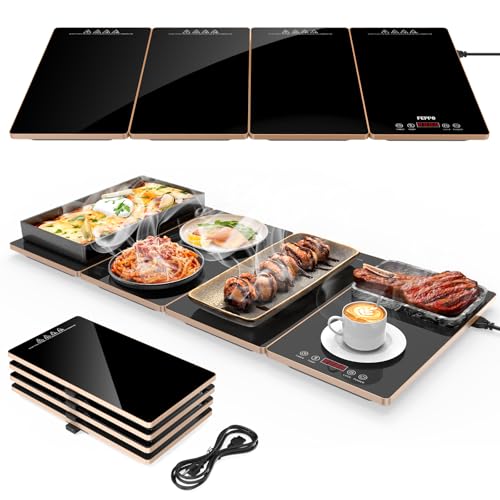

As an Amazon Associate we earn from qualifying purchases at no extra cost to you. Ratings are shown as listed on Amazon.
Quick comparison: electric, insulated, and disposable warmers
| Warmer type | Typical capacity | Heat performance | Power requirement | Transport and spill resistance | Typical cost range |
|---|---|---|---|---|---|
| Electric food warmer bag | 1.5–3.5 quarts | Usually reaches about 140–200°F after 30–90 minutes; maintains heat while powered | 110–120V wall outlet; some models include 12V vehicle plugs | Good when level; zipper and cord openings can be weak points | $25–$80 |
| Insulated casserole carrier | 2–6 quarts | Often retains serving temperature for roughly 2–4 hours, depending on starting temperature and insulation | None | Best for carrying sealed dishes; soft sides need careful loading | $15–$60 |
| Disposable chafing dish | One full-size tray, about 8–9 quarts, or two half-size trays | Maintains a hot buffet surface while fuel burns; performance varies with wind, water pan, and lid use | Gel or wick fuel; no electrical outlet | Rigid tray but awkward to carry once filled; fuel must be transported separately and safely | $12–$35 per setup |
| Insulated food jar | 12–32 fluid ounces | Commonly keeps food hot for 5–10 hours when preheated and filled correctly | None | Excellent leak resistance when the gasket and threads are clean | $15–$45 |
These are practical market ranges rather than guarantees. Actual retention depends on food density, starting temperature, container fill level, outdoor temperature, wind, and how often the lid is opened.
Best choice by party situation
| Your situation | Best fit | Why | Main compromise |
|---|---|---|---|
| One or two dishes at a home gathering | Electric warmer bag | Steady heat and simple serving from a removable dish | Needs a nearby outlet and has limited capacity |
| Traveling 30–90 minutes with prepared food | Insulated casserole carrier | No cords, fuel, or waiting for the warmer to heat | It cannot recover temperature if the food starts lukewarm |
| Large buffet for 10–20 guests | Disposable chafing dishes | Full-size trays hold far more food than portable electric bags | Fuel handling, flame supervision, and cleanup are required |
| Outdoor event with no outlet | Insulated carrier or chafing dish | Both operate without mains electricity | Insulation loses heat gradually; flame-based units are affected by wind |
| Frequent weekly use | Reusable electric or heavy-duty insulated warmer | Lower waste and better long-term value than disposable trays | Higher initial cost and more parts to clean |
| Small apartment or tailgate setup | Insulated food jar or compact electric bag | Small footprint and easier carrying | Not suitable for serving a large group at once |
Electric warmers: the most controllable option
Electric food warmer bags use a low-power heating element around a removable container or casserole dish. They are a strong choice when food needs to remain warm for several hours and an outlet is available. Many draw approximately 30–80 watts, so they use far less electricity than an oven, but they are designed mainly for holding and gently reheating food rather than rapidly cooking it.
Capacity is the important limitation. A 1.5-quart unit is suitable for dips, side dishes, or a small portion of chili. A 3–3.5-quart unit can handle a family-size casserole, but it still will not replace a full buffet tray. Check the interior dimensions rather than relying only on the stated quart capacity, because rectangular dishes and round slow-cooker inserts are not interchangeable.
For transport, choose a model with a snug removable dish, a lid with a silicone gasket, and a separate exterior pocket for the cord. A zipper that closes around the dish is useful, but it is not a substitute for a leakproof lid. Keep the warmer upright and do not carry it by a soft handle when the container is full.
Electric warmer mistakes to avoid
- Do not cover ventilation areas or place the warmer on a wet surface.
- Do not assume a 12V car plug can power a household model unless the specifications explicitly support it.
- Do not put a cold, dense dish into a warmer shortly before guests arrive; allow at least 60–90 minutes for thorough reheating, depending on portion size.
- Do not immerse the electrical section. Remove the container and wipe the heating compartment according to the manufacturer’s instructions.
Insulated carriers: best for transport and low fuss
Insulated casserole carriers use foam, reflective lining, or vacuum insulation to slow heat loss. They do not add heat, making them ideal for food that is already hot and needs to travel to the party. Their advantages are quiet operation, no electricity, no flame, and easy storage after use.
For a larger casserole, look for thick insulation, reinforced handles, a rigid base, and a washable lining. A carrier designed for a 9-by-13-inch baking dish is often more useful for parties than a tall lunch bag. A food jar is better for soup, rice, sauces, and other single-serving or small-batch foods because its screw top generally offers better spill resistance than a soft carrier.
A simple retention calculation explains why filling matters. Suppose a carrier loses about 15°F per hour in the conditions of your trip. Food loaded at 180°F could theoretically be near 135°F after three hours, before accounting for opening the lid. In practice, heat loss is not perfectly linear, so the safer approach is to minimize the travel time, preheat the carrier, fill empty space, and verify the food temperature with a food thermometer rather than relying on the outside of the bag.
How to get the most from an insulated warmer
- Preheat the carrier with hot water for several minutes, then empty and dry it.
- Heat the food thoroughly before transferring it to the container.
- Fill the container as much as practical; a half-empty container loses heat faster.
- Use a tightly sealed lid and place the container level in the carrier.
- Open it only when serving, and return the lid immediately afterward.
Disposable chafing dishes: best for buffet capacity
A disposable chafing setup normally includes a metal or foil water pan, a food pan, a frame, and one or more gel or wick fuel cans. It is the closest match to a conventional buffet warmer and is usually the best option when many guests will serve themselves from one large dish.
The water pan buffers the heat and reduces scorching. Add hot water to the pan before lighting the fuel, but keep water out of the fuel container. A lid helps conserve heat, reduce contamination, and limit evaporation. Wind shields are valuable outdoors because wind can shorten burn time, blow out a flame, or heat one side of the tray unevenly.
Disposable warmers have the greatest fire risk of the three categories. Use them on a stable, nonflammable surface, keep paper decorations and clothing away from the flame, never leave them unattended, and extinguish the fuel according to its instructions. Do not move a lit or hot tray unless the setup is specifically designed for it. Check local venue rules before using open-flame fuel indoors.
Durability, cleaning, and ownership costs
The parts that usually wear first are electric warmer zippers, power cords, heating pads, silicone gaskets, and soft carrying handles. On insulated carriers, the lining and seams tend to fail before the insulation itself. For food jars, the lid gasket can absorb odors or lose its seal; replacement gaskets are worth seeking before buying a difficult-to-service design.
Do not store an electric warmer while it is damp. Wipe spills promptly, because grease can harden around a zipper or heating plate. Wash removable containers soon after serving, particularly after dairy-based dips, meat, or acidic sauces. Avoid using disposable foil trays directly on a heating element unless the product instructions permit it.
Reusable equipment becomes more economical with repeated use. For example, a $50 electric warmer used 25 times costs about $2 per use before electricity. A $20 disposable chafing setup used for each of those same 25 events would cost $500 and create considerably more waste. Disposable units still make sense when you need a large buffet occasionally and do not want to store or clean bulky equipment.
Final recommendation
Choose an insulated carrier when transport matters most, an electric warmer when you have an outlet and need several hours of controlled holding, and a disposable chafing dish when serving capacity is the deciding factor. For many hosts, the most versatile combination is a leak-resistant insulated carrier for bringing food to the event and a reusable electric warmer or approved serving dish at the destination.
Whichever type you select, keep hot food at or above 140°F when possible, use a thermometer for confirmation, limit time in the unsafe temperature range, and follow applicable food-safety guidance. A warmer can slow cooling or maintain heat; it cannot make poorly handled food safe.

Write Your Review
No reviews yet. Be the first to share your experience!