

Key takeaways
- Water: faster to add, lighter to transport when empty, and less messy during setup. It is usually the better choice for renters or anyone who may move house.
- Sand: denser and less prone to sloshing, with a firmer feel under impact. It is difficult to remove completely and can expose seams to greater long-term load.
- Mixed filling: some owners use water in the main cavity and a small amount of sand only where the manufacturer permits it. Do not improvise if the instructions specify water only; excessive density can damage the base.
The best freestanding punching bags for most home users are the Century Wavemaster 2XL Pro for all-around boxing and kickboxing, the Century BOB XL for realistic target height and defensive drills, and the Everlast Powercore for a lower-cost setup in a smaller room.
Freestanding bags trade the swing and ceiling hardware of a hanging heavy bag for easier installation. The compromise is rebound: a filled base keeps the unit upright, but it cannot reproduce the predictable arc of a properly mounted bag. Your choice should therefore begin with training style, available floor space, and how much base movement you can tolerate—not just the bag’s height.
Our top picks


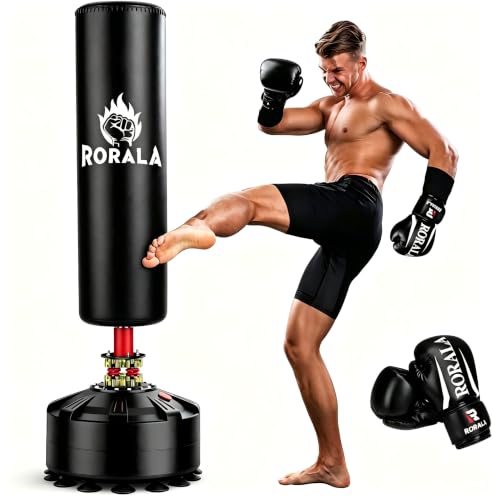

As an Amazon Associate we earn from qualifying purchases at no extra cost to you. Ratings are shown as listed on Amazon.
Best freestanding punching bags by situation
| Training situation | Best fit | Why it makes sense | Main compromise |
|---|---|---|---|
| General boxing, kickboxing, and frequent home sessions | Century Wavemaster 2XL Pro | Large striking area, adjustable height, and a broad water- or sand-filled base | Needs roughly a 4 ft by 4 ft clear working zone |
| Head-level combinations, knees, and realistic target practice | Century BOB XL | Human-shaped torso gives clearer target zones and a useful upper-body height | More expensive and less convenient to store |
| Limited space and occasional training | Everlast Powercore freestanding bag | Compact base and adjustable height in a generally lower market price range | Less mass and less convincing rebound under hard kicks |
| Hard kick training and maximum resistance | A high-capacity, sand-filled freestanding kickboxing bag | Sand adds weight and reduces sliding during low and body kicks | Much harder to move, empty, or repair after filling |
Head-to-head comparison
The figures below describe commonly published dimensions and capacities for these product families. Exact measurements vary by generation and retailer, so check the current manufacturer specification before ordering.
| Model or type | Approximate bag height | Base footprint | Filled weight | Filling method | Rebound and stability |
|---|---|---|---|---|---|
| Century Wavemaster 2XL Pro | Approximately 47–68 in adjustable | About 28 in diameter | Up to approximately 270 lb with water | Water or sand, depending on the version | Moderate rebound; stable for punches and controlled kicks |
| Century BOB XL | Approximately 60–82 in adjustable | About 30 in diameter | Up to approximately 270 lb with water | Water-filled base | Moderate rebound; torso flexes and returns rather than swinging freely |
| Everlast Powercore | Approximately 52–65 in adjustable | About 22–26 in diameter, depending on version | Roughly 130–250 lb filled, depending on model and medium | Usually water or sand | Noticeable movement under powerful kicks; adequate for light-to-moderate work |
| Commercial-style heavy freestanding kick bag | Approximately 55–75 in | About 30–36 in diameter | Approximately 250–350 lb filled | Usually sand or water | Lowest movement, slower rebound, highest resistance |
How the leading choices differ
Century Wavemaster 2XL Pro: the safest all-round recommendation
The Wavemaster 2XL Pro is the most balanced option when one bag must cover jabs, crosses, hooks, body shots, round kicks, front kicks, and occasional knees. Its adjustable striking height works for several users, while the broad base distributes force better than compact entry-level bags.
Its rebound is controlled rather than dramatic. That suits combination training: the bag gives enough movement to make you reset your feet, but it usually does not travel across the room after every punch. For hard kickers, fill the base fully and place it on a rubber exercise mat. Water is easier to remove; sand provides more mass but makes the bag difficult to relocate.
Century BOB XL: best for target accuracy
The BOB XL’s molded human-shaped torso changes the training question from “where is the center of the bag?” to “can I hit the correct target?” The face, chest, abdomen, and sides provide useful references for straight punches, hooks, uppercuts, body combinations, and controlled knees. Its height range also makes it more practical for taller users than a short cylindrical bag.
It is not automatically the best choice for full-power low kicks. The torso can make contact feel more realistic, but the structure and base still need to absorb repeated impact. If your main goal is high-volume punching or Muay Thai-style kicking, a cylindrical bag with a larger strike surface may offer better value and fewer awkward angles.
Everlast Powercore: best when floor space and budget dominate
The Powercore family is appealing for a spare bedroom, apartment, or occasional workout area. Several versions use an adjustable-height column and a relatively compact base, allowing the bag to fit where a 30-inch-plus commercial unit cannot. Expect more base movement if you hit hard, especially when the base is not completely filled.
This is a sensible choice for technique rounds, fitness boxing, and moderate kick practice. It is less convincing for repeated maximum-power round kicks, where the smaller base can slide or wobble. A compact bag can still work well if you accept shorter rounds and reposition it between sessions.
Water versus sand: the filling decision
- Water: faster to add, lighter to transport when empty, and less messy during setup. It is usually the better choice for renters or anyone who may move house.
- Sand: denser and less prone to sloshing, with a firmer feel under impact. It is difficult to remove completely and can expose seams to greater long-term load.
- Mixed filling: some owners use water in the main cavity and a small amount of sand only where the manufacturer permits it. Do not improvise if the instructions specify water only; excessive density can damage the base.
A useful stability calculation is simple: if a bag weighs 25 lb empty and its filled base holds about 25 gallons of water, the water adds roughly 208 lb because one US gallon weighs about 8.3 lb. The finished unit is then around 230 lb before any accessory weight. That is plenty for ordinary punches, but a hard kick still creates sideways force, so the floor surface matters as much as the advertised weight.
Footprint and clearance matter more than the base diameter
Measure the base, then add a working margin. For a 28-inch base, a practical minimum is approximately 48 inches by 48 inches of clear floor space. That allows about 10 inches beyond the base on each side, but it is still tight for wide hooks, round kicks, or stepping combinations. A more comfortable area is 60 inches by 60 inches.
Check overhead clearance too. An adjustable bag set near 68 inches can require more than 7 feet of clear height once you account for the top of the bag, your gloves, and raised kicks. Keep it away from glass, furniture corners, ceiling fans, and walls that could be damaged when the unit rebounds.
Decision matrix: match the bag to your use
| Your priority | Recommended specification | What to avoid |
|---|---|---|
| Beginner, two or three sessions weekly | 130–230 lb filled weight, adjustable 52–65 in height, water base | A very light base that slides after ordinary punches |
| Experienced boxer, four or more sessions weekly | 250 lb or greater filled weight, dense foam, reinforced seams, broad base | Thin vinyl and a narrow base designed mainly for fitness use |
| Kickboxing with frequent low kicks | Long 55–75 in target area and 250–350 lb filled capacity | Short torso-only bags or compact bases |
| Small room or shared living space | Base under 28 in diameter, drainable water filling, manageable empty weight | Sand-filled commercial units that cannot be moved without help |
| Several users of different heights | Tool-free or secure height adjustment with at least 12 in of range | Fixed bags that force short users to punch above shoulder height |
Setup and maintenance that extend service life
- Inspect before filling. Check the drain plug, cap, seams, and column connection while the unit is still easy to return or replace.
- Use a rubber mat. It reduces sliding, protects the floor from condensation, and limits vibration transmitted into hard flooring.
- Fill gradually. Add the recommended medium in stages and check that the base remains level. Do not exceed the stated capacity.
- Set the height for technique. Your usual punching target should be around shoulder or upper-chest level, while the lower section should remain available for body shots and kicks.
- Wipe the striking surface. Sweat and skin oils eventually degrade some synthetic coverings. Use a lightly damp cloth and the cleaner specified by the manufacturer; avoid soaking foam or seams.
- Inspect weekly. Look for splitting at the base, loosened fasteners, wrinkles that expose foam, and leaks. Stop using the bag if the column shifts or the base bulges.
The parts most likely to wear first are the outer cover, seam stitching, height-adjustment hardware, and base plug—not the foam itself. Bare-knuckle strikes, jewelry, sharp-edged gloves, outdoor weather, and dragging a full bag across the floor accelerate that wear. Use properly fitted hand wraps and gloves, and treat the bag as equipment rather than a substitute for coaching or partner drills.
Final verdict
Choose the Century Wavemaster 2XL Pro if you want one versatile bag for regular home boxing and kickboxing. Choose the Century BOB XL when target placement and human-shaped reference points matter more than compact storage. Choose an Everlast Powercore model when room size and budget are the deciding constraints. For frequent maximum-power kicking, prioritize a 250–350 lb filled capacity and a 30-inch-or-larger base, even if that means giving up easy portability.

Write Your Review
No reviews yet. Be the first to share your experience!