

Key takeaways
- Advantages: excellent underbody access, relatively small footprint, and strong suitability for repair work.
- Limitations: requires carefully evaluated concrete, permanent anchoring, accurate vehicle positioning, and enough ceiling height.
- Typical storage need: the lift remains in place; overhead clearance is more important than floor storage.
The best car lifts for home garages are a two-post lift for serious repair work, a four-post lift for stable storage and maintenance, or a portable scissor/quick-lift system when ceiling height and installation are limited.
Our top picks
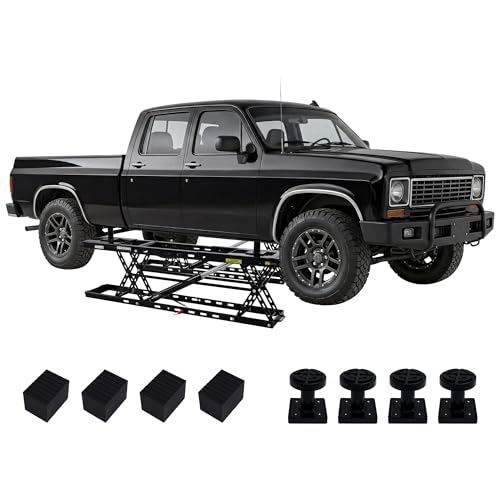


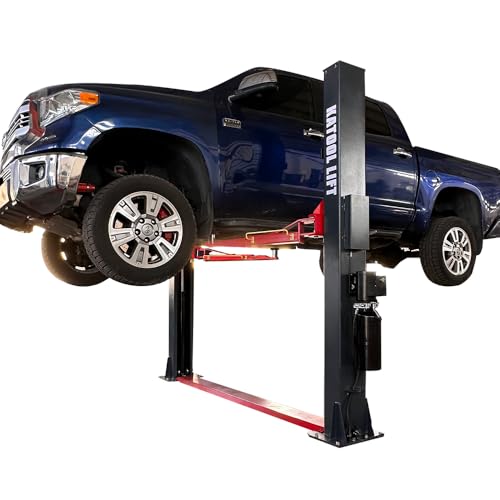
As an Amazon Associate we earn from qualifying purchases at no extra cost to you. Ratings are shown as listed on Amazon.
Best car lifts by garage situation
| Garage situation | Best lift type | Typical capacity | Typical maximum lifting height | Why it fits |
|---|---|---|---|---|
| Frequent suspension, brake, and exhaust work | Two-post asymmetric or symmetric lift | 7,000–10,000 lb | 68–80 in | Best wheel access and underbody clearance |
| Long-term vehicle storage | Four-post lift | 8,000–9,000 lb | 70–80 in | Stable runways and easier loading |
| Low ceiling or rented property | Portable frame or scissor lift | 5,000–7,000 lb | 18–30 in | Usually movable and requires less permanent work |
| Occasional oil changes and wheel service | Portable quick-lift system | 3,500–7,000 lb | 17–24 in | Lower cost and compact storage |
| Heavy trucks, vans, or full-size SUVs | Heavy-duty two-post or four-post lift | 10,000–15,000 lb | 72–84 in | Extra capacity and longer runways |
Two-post lifts: the best choice for repair access
A two-post lift is usually the best car lift for a home mechanic who wants genuine access to wheels, axles, exhaust components, fuel tanks, and suspension. The vehicle is supported at its frame or approved lifting points, leaving the wheels hanging free.
Common residential models from established manufacturers such as BendPak, Rotary, and Challenger Lifts are generally rated from 7,000 to 10,000 lb. A 9,000-lb lift is enough for most cars, crossovers, pickups, and SUVs, but the rating is only useful when the arms, adapters, concrete, and installation all meet the manufacturer’s requirements.
Symmetric versus asymmetric posts
Symmetric lifts place the vehicle’s center of mass approximately between the columns. They suit longer vehicles and heavier trucks, but the doors may sit close to the posts. Asymmetric lifts rotate the columns and arms so the vehicle sits farther back, giving more door clearance. They are often more convenient in a narrow residential garage.
Check the arm reach rather than looking only at capacity. A high-capacity lift may not safely reach the manufacturer-approved lifting points on a short-wheelbase sports car, while a compact lift may not provide enough reach for a long pickup.
- Advantages: excellent underbody access, relatively small footprint, and strong suitability for repair work.
- Limitations: requires carefully evaluated concrete, permanent anchoring, accurate vehicle positioning, and enough ceiling height.
- Typical storage need: the lift remains in place; overhead clearance is more important than floor storage.
Four-post lifts: best for storage and easy loading
Four-post lifts support the tires on runways, making them more stable and forgiving for storage. They are often the best car lifts for a collector who wants to park one vehicle above another, or for an owner who prefers simple drive-on loading rather than positioning four arms under lifting points.
Residential four-post models commonly carry 8,000 or 9,000 lb, while heavy-duty versions may reach 12,000–15,000 lb. Runway widths are often about 18–22 inches each, with an inside clearance commonly around 40–45 inches. Confirm the usable space between the runways, not just the overall width, especially with wide tires.
The main compromise is wheel access. You can add rolling bridge jacks to lift the tires off the runways, but that adds cost, weight, and another component to maintain. A four-post lift also occupies more floor area than a two-post design and may need removable caster kits or a designated storage position if the garage must remain flexible.
Portable and scissor lifts for low-clearance garages
Portable systems such as the QuickJack BL-5000SLX are designed for owners who need more access than ramps or a floor jack provide without installing full-height columns. The BL-5000SLX is rated at 5,000 lb and reaches roughly 21 inches, although exact specifications vary by kit and configuration.
These systems are useful for wheel removal, brake work, oil changes, and underbody inspections. They do not provide standing-height access, and the lifting blocks must be positioned at the correct points for the specific vehicle. A portable scissor lift typically raises a car about 18–30 inches and may offer a wider central working area than a low-profile jack, but its frame can obstruct portions of the underside.
- Choose portable lifting equipment when you work on one vehicle at a time, have a ceiling below about 10 feet, or cannot permanently modify the garage.
- Expect setup time: hoses, frames, adapters, and blocks must be positioned correctly before every use.
- Plan storage: many portable systems need 6–10 square feet of wall, shelf, or floor space when not deployed.
Garage clearance: calculate before buying
Lift height alone does not determine whether a vehicle will fit. Measure the garage’s lowest obstruction, then subtract the vehicle’s height, the lift’s minimum runway or arm height, and a practical safety margin.
For example, suppose a garage has 108 inches of usable height, a 69-inch SUV, and a four-post lift that adds 6 inches below the tires at its lowest position. The theoretical remaining space is:
108 − 69 − 6 = 33 inches
That may be enough to store a second low vehicle, but it is not enough for a person to stand beneath the SUV. If you need standing-height work, a two-post lift with a maximum rise around 72 inches generally requires a ceiling closer to 12 feet once vehicle height and overhead clearance are included.
Measure garage-door tracks, openers, lights, sprinklers, beams, and sloped ceilings. A lift rated for a 72-inch rise may need a lower “overall height” setting or a short-column configuration to work safely under obstructions.
Installation and safety features that matter
Permanent lifts should be installed on a suitable concrete slab, not on asphalt, cracked concrete, or an unverified garage floor. Manufacturers commonly specify minimum slab thickness and concrete strength, but the requirement differs by model and installation method. An experienced lift installer or qualified building professional can evaluate the slab, anchoring, electrical supply, and local code requirements.
Important safety features include:
- Automatic arm restraints that prevent the arms from rotating when loaded.
- Mechanical locking positions that support the load if hydraulic pressure falls.
- Overhead shutoff bars on many two-post lifts to reduce the chance of crushing a tall vehicle or obstruction.
- Slack-cable or chain detection to stop operation if the lifting system becomes uneven.
- Secondary lock releases that let both sides lower in a controlled, synchronized way.
- Adapter height options for unibody cars, trucks, and low ground-clearance vehicles.
Never rely on hydraulic pressure alone. Raise the vehicle only high enough to test stability, stop the lift on its mechanical locks, and shake the vehicle gently before entering the work area. Use the manufacturer’s lifting points and never exceed the lowest-rated component in the system.
Ownership costs and what wears first
A basic portable lift may cost roughly $1,500–$3,000, while a residential four-post or two-post lift commonly falls around $2,500–$6,000 before delivery and installation. Heavy-duty or commercial-grade equipment can cost considerably more. Installation, electrical work, concrete repairs, bridge jacks, drip trays, casters, and approach ramps can add hundreds or several thousand dollars.
Hydraulic seals, hoses, cable sheaves, arm restraints, rubber lifting pads, and runway rollers are typical wear items. Rubber pads harden or split first when exposed to oil, sunlight, and excessive loading. Wipe spilled fluids promptly, lubricate pivot points as specified, inspect cables and anchor bolts periodically, and keep the lift free of brake dust and road salt.
One common mistake is buying by vehicle weight alone. A 6,000-lb SUV does not automatically require a 6,000-lb lift: uneven loading, accessories, adapters, and the manufacturer’s recommended margin matter. Another is choosing a lift that fits the car but not the garage door, opener, or walking space around it.
Final buying decision
Choose a two-post lift if repair access is the priority and your slab and ceiling can support permanent installation. Choose a four-post lift if storage, stability, and easy loading matter more than unrestricted wheel access. Choose a portable quick-lift or scissor lift for occasional work, low ceilings, or a garage that cannot accommodate anchors.
Before ordering, record the heaviest vehicle weight, wheelbase, tire width, lifting-point locations, ceiling height, slab details, available electrical supply, and the space needed to open doors and walk around the vehicle. The best car lift is the one whose capacity, geometry, installation requirements, and safety systems all match the garage—not merely the one with the largest number on its label.




Write Your Review
No reviews yet. Be the first to share your experience!